Revisiting Tim Dillon's Interview with Andrew Tate
"You're kind of like Jordan Peterson, but if Jordan Peterson had swagger."
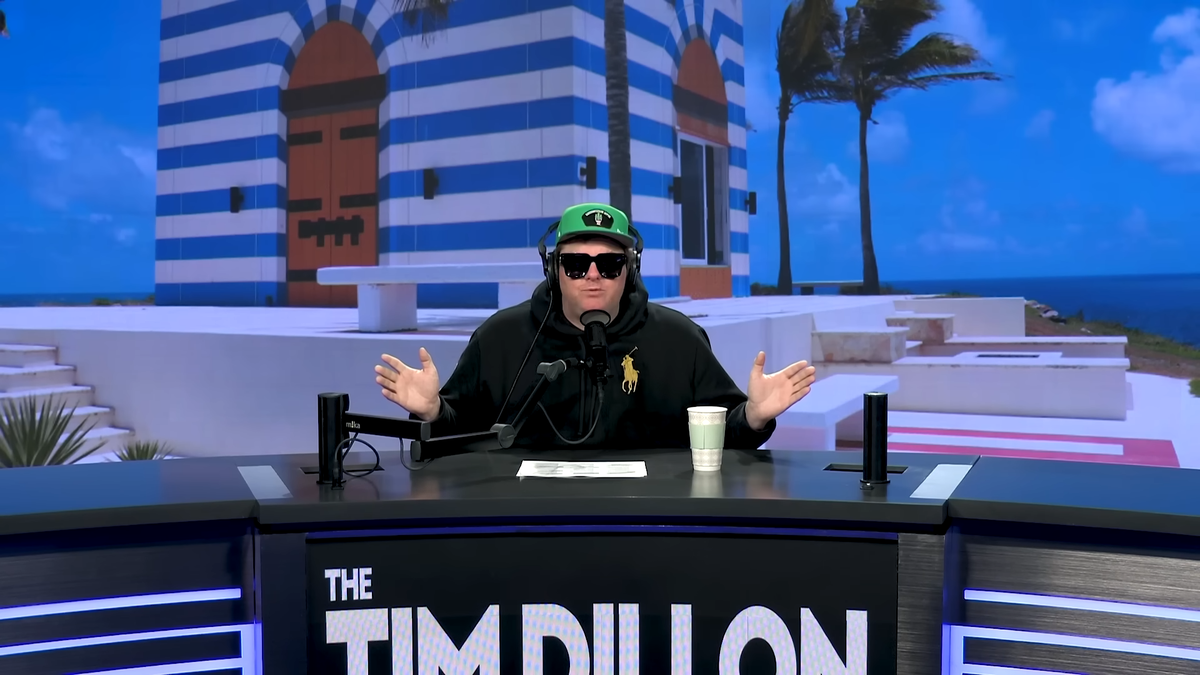
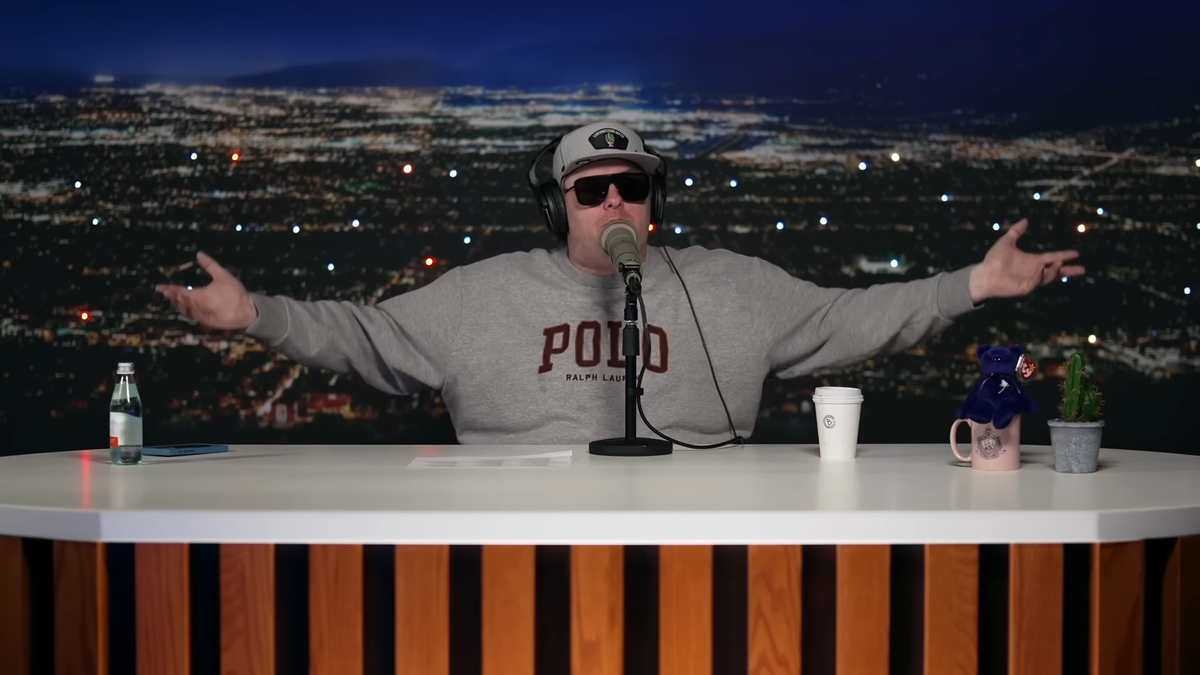
In the fall of 2022, Tim Dillon interviewed the sex trafficker Andrew Tate at his compound outside Bucharest, Romania. Dillon had flown to Bucharest, he said, for a private comedy gig at a crypto magnate's birthday party, after which there was little else to do but meet Tate, who moved to Romania from the U.K. in 2015 after three women there accused him of rape and strangulation. Dillon, describing Tate as "president of the manosphere," sat down with him for an hourlong interview that he published exclusively for his Patreon subscribers, though he has since taken it down.
The interview is fawning and credulous. Dillon gives Tate ample space to lie about the allegations against him, defend his scam manosphere businesses, spout misogynist vitriol, and whine about the sorry state of men in the 21st century. At one point Dillon joins him in complaining about gender-affirming care for trans people; elsewhere, he mocks the idea that Tate is a human trafficker. He says he hasn't yet encountered a "smoking gun" about Tate, who by that point had said he moved to Romania to evade rape charges, and who was fired from the reality series Big Brother in 2016 after a video emerged of him beating a woman with a belt.
 Seth Simons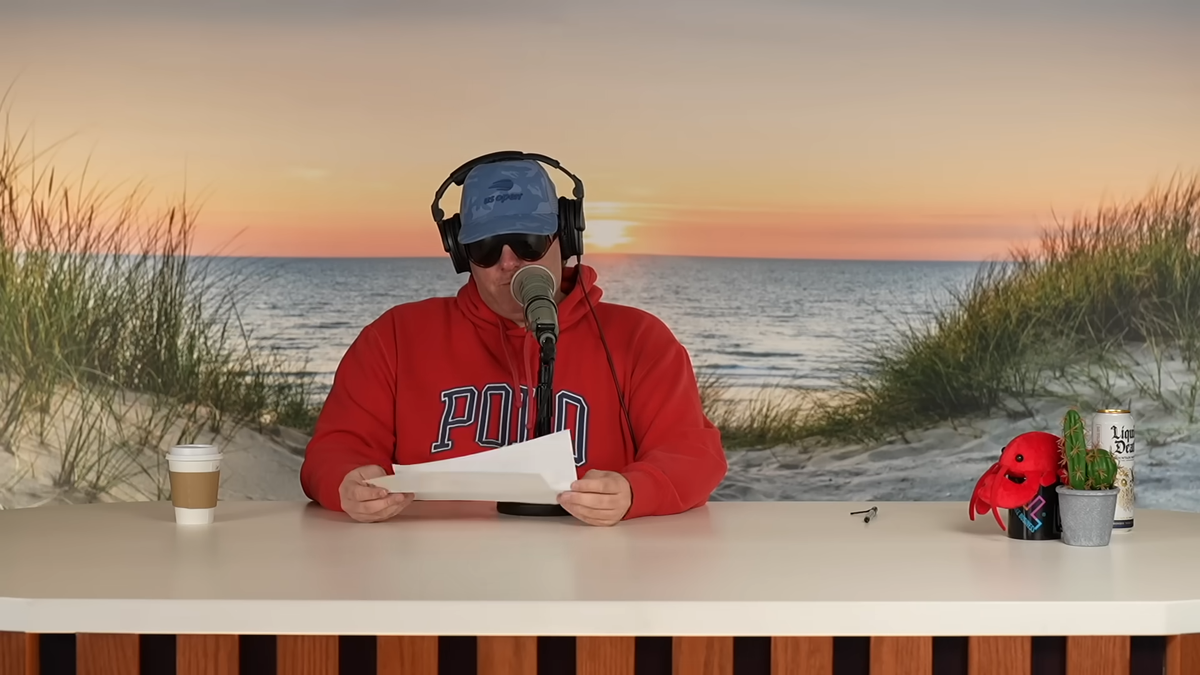
After authorities in Romania indicted Tate on charges of rape and human trafficking in 2023, Dillon said he hadn't seen any evidence indicating Tate's guilt or innocence, observed that mainstream media is often wrong, suggested that Tate was the victim of a political prosecution, and reflected that Tate had been a lovely host and a delightful person. "I love anyone that shows up in a Rolls-Royce, who puts me in a Rolls-Royce," he said. "Some of the women with him, I don't know what was going on. They seemed quiet, and I thought they were just quiet. Coming from America, it's a nice change of pace that the women were a little quiet, that they were more reserved."
Today I would like to place passages from Dillon's podcast with Tate beside excerpts from the New Yorker's new investigation into Tate's trafficking empire. That article is a difficult read, but it makes an undeniable case that Tate is a violent criminal and a serial sex abuser—including an abuser of minors—and that he was so at the time Dillon sat down for a friendly, flattering conversation with him. I offer this as a companion to my piece on Dillon's unwitting role in the Epstein coverup. Consider, as you read, that Dillon has emerged in recent years as a vocal critic of the Epstein class, someone who rants on a near-weekly basis about the conspiracy of silence surrounding Epstein's crimes. "This is the thing about conspiracies," he said in February of this year:
They always say, they go, "Well, how could so many people keep their mouth shut? There's no way conspiracies could exist because so many people would have to be in on it." That's the dumb guy thing that everyone says… People shut their mouth all the time. "There's so many people that would have to keep quiet about it." And they will. They will. What are we, running around with a bunch of heroes in this country? What are you, fucking idiots? We got a bunch of heroes in this country willing to risk it all? "I'm gonna risk it all to help some woman I don't know."
Half of those people, they're jealous they can't rape the women. What are you talking about? What? A bunch of heroes. They're gonna risk life and limb to help their fellow man. What country do you live in? Fucking get out of here. What country do you live in? "Well, so many people would have to be in on it." No. No. They would gladly be in on it. They would willfully be in on it. Because they don't want to make their lives any more difficult than they already are.
If you don't care to read thousands of words about Andrew Tate—and I understand if you don't—then let me leave you with this: Dillon is in on it. He has used his considerable platform to help Andrew Tate and Donald Trump evade accountability for some of the worst crimes imaginable. If he had any self-awareness, he'd turn off his microphone for good and go back to selling subprime mortgages.
Note: this piece is best read on a web browser; your email provider will cut it off somewhere down the page.
Tate: They come at me with everything, bro. Anything that's ever bad happened on the planet, world hunger is my fault. It's crazy.
Dillon: When people say things like, "He's advocated violence against women."
Tate: You know what's amazing to me when they say things like that? Not a single woman's come forward saying I was violent to them. I have no criminal record. There are the number of famous rappers who have genuinely done time for that exact thing.
Dillon: Yeah.
Tate: And somehow I'm the face of it when no women have come forward. I don't have a criminal record. I've never been convicted of it. No woman saying I've done it. People have just come along and said, "He's somehow evil and attempted to attack me and cancel me with this fake virtue." And that's what happens now in the world. None of this virtue is genuine. It's weaponized virtue.
Dillon: Yeah.
Tate: They don't actually give a shit about the issue. They just want a reason to dislike you. So they weaponize virtue.
In Romania, Tate rarely seemed to face consequences for his actions. In the summer of 2016, though, he risked returning to the U.K. to appear on the reality show “Big Brother.” People who had seen his early sex shows with Hruskova remembered him, and some of the footage was leaked online.
In one video, Tate lay on a bed and ordered Hruskova to show the camera her tattoo. “Why does it say ‘Tate’?” he asked.
“Because I’m his whore,” she replied.
“Why’s your ass got a bruise on it?”
“Because my daddy hits me.”
Tate picked up a belt and began whipping Hruskova as she lay in the fetal position, sobbing. “Bitch, look at the camera,” he told her, yanking her head back by the hair. “This is what happens when you don’t fucking listen.”
The Sun, a leading tabloid, reported on the footage, and Tate was forced out of the “Big Brother” house. He posted a protest online: “We were having a laugh? The sun are morons.” He said that Hruskova was an ex-girlfriend, and shared a photo of her holding a belt inscribed with the words “But I love when Andrew spanks me.”
In fact, Tate’s removal from “Big Brother” had nothing to do with the videos. The Hertfordshire police had contacted the producers to inform them of the assault allegations from Navarro, Walker, and Price. But officers apparently missed indications of another crime: child pornography. Tate said that the belt video was made in 2012, at the start of his relationship with Hruskova. That year, she turned fifteen.
Dillon: When you said women are the property of men, and I even defended you, I was on a podcast, I said, "Listen, you don't have to agree with it, but it was in some type of religious context."
Tate: Completely. And this is the amazing thing that's happened with social media and the whole kind of format has changed. When you made a video five, six years ago, even two, three years ago, you could do a six minute video and that was considered a short video. But nowadays, anything longer than 30 seconds is long format. Everything is YouTube shorts, Instagram stories, TikToks. So if you make a long format video making very nuanced points talking about delicate truths, they're going to take a couple seconds and they're going to weaponize it against you when the media machine decides to lie.
And yeah, I talked about a man marrying a woman and the woman's father walking her down the aisle and giving her away and her taking the other man's last name and her becoming a member of that man's family and that man has a duty to protect and provide for her. And they've come along and saying, "He thinks that and he owns women." And like I said, it's not genuine virtue, it's weaponized virtue because all of these people—I'll tell you something. Everyone who's come out who are genuinely against me, I have an organization called the War Room and they're the people I work with, it's how I make most of my money and I said, "Find a single charitable act for women that any of my haters or detractors have ever contributed to." Do any of them even donate to women's charities? Are any of them actually genuinely good people, or are they hateful people looking for an excuse to hate me?
In Romania, the Tates turned their small-time webcam enterprise into a kind of industrial operation. Their approach to recruiting resembled what trafficking experts call the “lover-boy method.” They trawled dating apps and social media for young women, blasting out hundreds of identical messages and frequently changing their location to expand their reach. Women who responded were romanced. Tate sent one a flurry of questions: Where did she want to travel? Had she ever been skydiving? Had she ever seen a Dubai sunset? Those who proved susceptible were groomed for sex work. “Every day, I sent twenty Instagrams. Every day, I was on a date. I was fucking four girls, five girls a week,” Tate said in a War Room video. “I built my business off the back of my dick.”
Tate had learned from Ken Ivy, the “Pimpology” author, the importance of having a “bottom bitch.” He needed a recruiting sergeant who could lure in other women, and he assigned this role to Hruskova. After he slept with a woman, Hruskova would come in to “sell the dream” of webcam work, he explained in a War Room video. “Before this, I was a waitress, and it was shit,” he coached her to say. “Now I do this, I make so much money.”
In fact, Tate said, Hruskova saw little of the money she generated. He reported in private chats that her live streams had made him around two million dollars, but all she got was pocket money for coffee and manicures. “She works hard to please me. To get attention,” he said. He was certain that she would never leave him. “I own her mind,” he told associates. “If I died, she would commit suicide.” (One worker from that time told me that Hruskova seemed to have lost the capacity for independent thought. “She’s not herself—she’s like an extension of Andrew,” she said. “We were all brainwashed.”)
Dillon: How do people make money? Because a lot of people have said your thing's a Ponzi scheme or whatever and that you're not giving people real advice. Then I'm not saying to do what—obviously I'm not saying give it all away. But what would you say to people that accuse you of that?
Tate: Yeah, that was an interesting attack. And the reason that they attacked my program—at the time it was called Hustlers University, the name's changing to The Real World, to escape the matrix—but the reason they attacked that is because they don't like me. All of the reviews on it saying it was negative are people who never joined the program. They just didn't like me. So they just do a review. And it's kind of interesting because I was in the middle of—and within six months I managed to become the most googled man on the planet, but then you also have to understand the repercussions of that. And the repercussions are if random YouTuber number fucking 55 realizes if you do an anti-Andrew Tate video, the algorithm rewards it, then random YouTuber number 56 is going to get an idea. And so it was random YouTuber number 57.
So what happened was all these YouTubers were just doing negative Andrew Tate videos because it was rewarded by the algorithm. None of them were based on fact in any way. So they were trying to find something to latch onto. And I'm quite a difficult person to attack because—I state without arrogance because I'm a humble, very humble—that's how I'm described.
Dillon: When I arrived here, from the guards to the 10 cars to the mansion, "humble" is the first word that comes to my mind.
Tate: Thank you, brother.
Dillon: It's like you're living, it's like a monk. Like a Tibetan monk. Who has a McLaren.
Tate: Completely. I'm tall and sexy and strong and rich and funny and charismatic and humble.
Dillon: Maybe your greatest asset is the humility.
Tate had risen to prominence in the online realm of incels, pickup artists, and red-pill believers known as the manosphere—and he’d engineered an ingenious way to expand his reach. Not long before the raid, he had launched Hustlers University, an online school that, for $49.99 a month, taught “modern wealth creation” methods, including an affiliate-marketing program that functioned as a gigantic content factory. Members were given access to a library of Tate’s videos, and earned commissions by reposting clips to attract new subscribers. More than a hundred and sixty thousand students enrolled, pumping Tate’s content into algorithms already primed to amplify extreme ideas.
In the months after the raid, videos tagged #AndrewTate were viewed more than twelve billion times on TikTok alone, and he became one of the world’s most Googled people. His followers spread his rhetoric to millions of homes and classrooms. Teen-age boys around the world barked Tate’s slogan “Make me a sandwich” at female teachers, and reports spread of sexual aggression by his followers.
Tate’s enormous reach made him a political force. He had always been an enthusiastic supporter of Donald Trump—“He’s grabbing bitches by the pussy. I like that guy,” he’d once said—and he became a singularly influential proponent of masculinism: a creed, devoted to countering feminism and restoring the patriarchy, that helped unite the disparate factions of the maga coalition. Tate called for women to be stripped of the vote, barred from the workplace, and forced to procreate. By comparison, conservative politicians’ efforts to erode reproductive rights and roll back gender-equality laws seemed moderate. “I have shifted the Overton window heavily since I became famous,” Tate bragged.
Tate: So as a humble man, I like to state that I understand very well if I disliked me and I had to try and define an attack vector on me, I'm a difficult man to attack. You can't really call me dumb. You can't call me unsuccessful. You can't call me weak. You can't call me stupid. You can't call me sad. I'm obviously a very big, strong, happy guy. So they're like, well, all we can do is say he's a bad person. And then they need a reason to call me a bad person. So they weaponize virtue. And then by extension, looking for ways to attack me, I'm perhaps difficult to attack. So then they tried to attack my program.
What's crazy about it all is I had a school, it was called Hustlers University. I taught people how to make money online with 18 modern wealth creation methods. It was $49 a month. It was pennies. And we were teaching everything from cryptocurrency to drop shipping to Amazon FBA to how to make websites to SEO, basic stuff for 49 bucks. And everyone who joined was like, "This is worth more than my entire college degree that I did."
Dillon: Right.
Tate: And all the detractors who were attacking it never even enrolled and they were just looking for a vector to attack me through. They were trying to just find a way to destroy me and say I'm a negative person. The reason I can say, and I can prove conclusively that it was not a Ponzi scheme or anything detrimental is because traditional education exists within a vacuum. You get a loan to go to that school and you can't get the loan outside of going to that school. So the money is not in the open market, right? "We'll give you 100 grand only if you go to school. We won't get 100 grand for any other reason." So education isn't fairly compared to other markets. I think if you were to give the average 18-year-old 100 grand and say, you can choose: invest in real estate, invest in cryptocurrency, start your own business, revamp your parents' house, save the money, or get a degree. I have a feeling that there would be very few degrees. Nobody would go.
Dillon: Right, yeah. Nobody would go.
Tate: Nobody would go. So they know that because they know that their product has got a lot less value than they pretend it does. So they make sure that the money and the education exists in a vacuum so it doesn't have any fair competition. Whereas my educational platform for $49 a month was open to the fair market. You can put $49 a month into my education system or you can buy a Taco Bell. You can do whatever you think is worth more to you. And we had 175,000 students renewing. People, 175,000 people in the world were getting more value per month than they invested. That proves in and of itself is not a scam or I wouldn't have a single repeat client.
Dillon: Right.
At the time of the raid, Andrew Tate was on the cusp of becoming one of the most famous men on the planet. He’d amassed a vast following on social media, mixing posts about diamond watches, cigars, and supercars with jokes and misogynistic rants. He told alienated young men that they were the victims of a feminized society determined to crush their male essence, and urged them to get fit, get rich, and reclaim their “natural masculine imperative for power.”
Often, that imperative seemed to equate to sexual violence. In one video, Tate described the “basic moves of pimping” while lying on his bed waving a machete. “Bang out the machete, boom in her face, then grip her up by the neck,” he said. “The machete’s on the floor, her panties are all wet, and you go fuck her. That’s how it goes. Slap, slap, grab, choke. Shut up, bitch. Sex.”
Dillon: Early on, you were doing the webcam stuff. And people were, I don't know if the right word is "offended," but people were basically like, they were judgmental of it or they were like, listen, here's a guy who's talking about morality, but then he's also got this house full of women on camera.
Tate: Yeah. And you know what? I as a professional have analyzed very, very hard, if I was my enemy, how would I hurt me?
Dillon: Right.
Tate: I've had these conversations at length. So I understand my vulnerabilities and I understand my strengths very, very well, which is why I'm so hard to kill. But I do also understand by analyzing myself as a professional should, I do get that the story is very interesting. An American guy and now he's in Romania and he's a web—
Dillon: Are you American?
Tate: I was American. I'm British. Now he's in Romania and he had all these girls working for him on a webcam studio and now he's a millionaire.
Tate knew some street pimps, and he contemplated that route, but he didn’t want other men touching what he saw as his property. Opening a strip club was too expensive. Then he stumbled on an ad for a webcam-porn site. He flew all of his girlfriends to Luton and assembled them at a restaurant, where they learned of one another’s existence. “I said, ‘Listen, young ladies, I’m starting a webcam business,’ ” Tate later recalled. “ ‘This is going to change your life.’ ”
Most of the women left, but Hruskova stayed. Tate set up a profile for her on a site called MyFreeCams, which allows users to watch models for free, then pay them to perform specific sex acts or private shows. Filming sexual imagery of anyone under eighteen is illegal in the U.S. and the U.K. On camera, Hruskova became a Russian woman in her twenties, performing under the username KissofaCobra. Tate persuaded her to get a tattoo of a cobra down one side of her body and another reading “Tate Property” above her crotch.
Dillon: It is interesting.
Tate: It's just weird.
Dillon: It's weird.
Tate: Yeah. So people are like, "He has to be evil."
Dillon: It's a vibe of a super villain, kind of.
Tate: It is, isn't it. Thank you very much.
With Tate controlling her performances, Hruskova became a fan favorite. “I think I’ve fallen in love (again),” one user wrote. For a price, Tate would have sex with her on camera. In one video, he keeps his face out of view as he penetrates Hruskova from behind, but the distinctive cobra tattoo on his chest and arm is clearly visible. “She will perform anal sex in front of hundreds of viewers, who will keep tipping to push her boundaries,” a review site noted.
Tate has claimed that, in the first month with Hruskova on camera, he made more than a hundred thousand dollars; the brothers bought an Aston Martin. That April, Andrew won the kickboxing world championship for a fourth time. But he soon stepped back from the sport to focus on expanding his webcam business, telling a kickboxing magazine that he was now a “pimp superstar.”
Dillon: You have all of these things. You've kind of designed this thing that feels like a Batman villain and then it kind of got that response.
Tate: It did. And I had a lot of people come to me and say, "It's not what you say. It's the fact that you're scary." I'm like, "What do you mean?" They're like, "You're just this big kickboxing champion with a bunch of guns in Romania and all these hot women in this big house." It's villain. It's villain.
Dillon: Well, people also think about Eastern Europe. When I was coming here, we were told a million times by a lot of people, watch out, get security, hire security. They drug drinks. They kidnap people. Not that they're kidnapping me for whatever. I mean, I don't think I'm being trafficked—
Tate: You are handsome. You're handsome, bro.
Dillon: The idea that I'll be trafficked is hilarious. Like them just dropping me off in Serbia and I walk out of a truck, they're like, "Well, this week's lot wasn't great." But this idea that it's very dangerous. So the fact that you live here, if you lived in New Jersey, it's less of a—but the fact that you are out in the far-flung regions in Eastern Europe, I mean, this is like, we think of the movie Hostel with Eli Roth. You think that you are selling some type of thing where you get to take apart a woman.
Tate: Yeah, completely.
Dillon: And organs and stuff like that.
Tate: And that vibe.
Dillon: [Joking] I walked in the house and we had dinner and you've got a few organs, nothing much. You have a few things that you're transferring, somebody needs this, somebody needs that. It's not a big thing.
Tate: I've scaled back since the cancellation.
Dillon: Right.
Tate: I've scaled back. Yeah, I completely understand that vibe. So I'm not gonna sit here and pretend I don't understand why people think that. But anyone with a brain who's educated can understand that I travel the world endlessly and if I was truly a criminal of some kind, I would be in jail by now.
Dillon: Right.
Tate: And I'm not doing anything wrong. I do understand the vibe. And I can't sit here and pretend that I don't kind of enjoy the vibe.
Dillon: Right.
The women lived in the brothers’ properties, and the most prized workers were not allowed to go out unattended or to have relationships with anyone but the Tates. Otherwise, Andrew explained, “that other person she’s fucking is going to have the control over her mind.” Each brother had a personal “harem.” Tate called the women his wives, and ordered them to address him as “king.”
Often, the recruits came from troubled homes or were living in poverty. One former member of Tate’s “harem” told me that she had found his initial love-bombing intoxicating: “You go along with it, and, before you know it, you’re in absolute hell.” Tate had a way of “casually peppering the abuse through day-to-day life,” she said. “He kind of serves it to you in a tongue-in-cheek, humorous way, but it’s deadly serious.” Physical abuse was often disguised as “rough sex.” Once, she said, Tate beat her so hard that she sustained lasting injuries to her eye and breast. “You’re a sexually violent person,” she texted him afterward. He replied, “You never told me to stop.”
Tate: It's kind of cool to be a mob boss. It's kind of like, it is what it is, but I'm certainly not hurting anybody.
Vintilla said that she was alarmed by life at the villa, where her housemates had “nightmares, spasms in their sleep.” She told Hadley that she wanted to run away, but Tate had forbidden her to leave. She was terrified of him. He had told her by text that he had mafia connections who might try to find her, and that he had the same blood chemistry as a serial killer. A few days earlier, after she wrote him that she was miserable, he had summoned her to his bedroom. There, Vintilla said, he punched her in the face and raped her, squeezing her head painfully between his hands. She said he threatened to get her pregnant and then lock her in a house—so that she would “definitely go crazy.”
Tate: But yeah, that's why they attacked the school. And as for the webcam thing, yeah, I've talked about it at length. Yeah, I had a webcam business. I had a bunch of beautiful women on the internet who were talking to men online.This was about 10 years ago. It was all pretty new then. OnlyFans is mainstream now, right?
Dillon: Right.
Tate: But I was one of the pioneers of the industry as such and that's what it makes me laugh. All these feminists attack me. I said, I've made more women millionaires than you'd believe.
Dillon: Right.
When Tate picked her up for the second shift, there was a young woman, whom I’ll call Emilia Walker, in the back seat. Navarro knew Walker a little from school and felt more at ease with her there. Between stints on camera, they laughed and drank bottles of rosé that the brothers supplied. At the end of the week, Tate gave each woman several hundred pounds in cash—more than Navarro had ever held. She said that he drove them to a shopping center and declared, “You’ve got money now. Start spending it.” Navarro bought a Michael Kors watch and, after a few more shifts, a pair of Louboutin heels; it was such a thrill that she kept the receipt as a trophy. “I felt really, really proud of myself,” she said. “It was kind of, like, Oh, this is what my life can be like if I stay here.”
But Tate was already coming to resent paying Navarro and Walker a cut of their earnings. Hruskova let him keep “100% of the fucking money,” he later said. But, he complained, “once you get bigger, you start hiring girls who don’t love you.” He decided on a strategy: “I have a financial incentive to fuck as many as I can.”
Tate: I turned 50 women into millionaires. So yeah, it was a very professional setup. It was a business.
Dillon: Yeah. No, for sure. And the people that are criticizing you are often pro-sex work, pro-sex worker.
Tate: Yeah, they're pro all that, but they're anti-me for some reason. And I don't want to be arrogant enough to say jealousy, but hate never comes from above.
Before long, Tate told Navarro and Walker they would now be working from a room in a Hilton hotel in Luton. On the second night, the women fell asleep there, and Navarro said that she woke up to find Tate behind her, touching her legs. Then, she said, he pulled down her underwear and grabbed her throat, forcing himself inside her. “You’re such a good little girl,” she remembered him saying, while he choked her until she struggled for breath. Navarro said that she repeatedly told Tate to stop, and tried to loosen his grip on her throat, but he continued.
Navarro recalls that she passed out afterward, and woke up beside Tate feeling “disgusting, ashamed, dirty.” She left and returned to her mother’s house, but resuming normal life was hard. “My crappy house, my crap bedroom, and my tiny little bed—that definitely put it into perspective,” she said. “Slowly, I was, like, I should go back, because that’s the most money I’ve ever made.” She told herself that she’d be firmer with Tate: “I was, like, Maybe he won’t do it again. Maybe he’ll just leave me alone.”
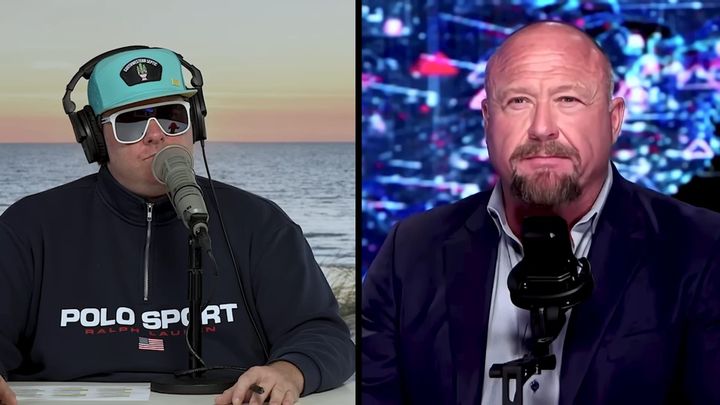
Dillon: You were talking about when you get canceled, there's kind of a bat signal, you feel it coming, you feel when it's on that level where—you know, I know Alex [Jones] and I know Alex got completely deplatformed, he has other issues, but when it happened to you, it was kind of like something that you weren't completely surprised.
Tate: No, I was zero percent surprised because of the level of orchestration which was involved. Long before the cancellation, I had already decided, I thought, okay, I'm massively famous now. I'm going to curate my message a little bit, perhaps be a little bit less scary because I do have responsibility as an adult and I don't want it to be misconstrued by my massive audience, even if it's a very small percentage of it.
So I understood all of this, but when the attacks started coming, they were coming so orchestrated, I knew that time was running out because you'd go to sleep and the news articles would be empty and you'd wake up and seven or eight NGOs or charities at the exact same moment have done a press release with the exact same words slightly rewritten at the same time, unconnected entities, entity in Australia, an entity in England, an entity in Germany, an entity in America all at the same day decided to do this press release saying that for somehow I'm dangerous to whatever and all the wording is basically exactly the same and all these independent NGOs and charities hit you at once with this media spin.
And this was happening on repeat and I was like, somebody is behind all of these things and they're deciding to try and paint a narrative of me. And the reason they paint a narrative of you is so that the general populace will accept your cancellation. They spin up the machine to convince the world you're bad so that when you're canceled, nobody kicks up too big a fuss. And then post-cancellation when you have no voice and you can't defend yourself, they turn it up another notch hoping to put the nail in the coffin that you're a bad guy forever. And then people just go, "Well, he's a bad guy. He deserves it." And that's what they're trying to do.
When Pavel was fifteen, she told investigators, she had accompanied a school friend to a party hosted by the Tates, which was full of young girls. Her friend paired off with Tristan, leaving her with Andrew, who was so drunk that he spat as he talked. He pulled her into a bedroom and raped her, she said. Afterward, some of Tate’s “female friends” persuaded the girls to stick around for several days, and Tate kept having sex with Pavel. “We had normal, oral, and anal sexual relations, but I mention that the anal sexual acts were traumatic for me because I was in pain,” she told investigators. “Even though I asked Andrew to stop, he continued.”
The girls eventually had to go back to school, but, Pavel said, the Tates sent a taxi every few weeks to bring them to the compound. Tate was “often aggressive,” beating her with a belt and choking her—but he also bought her Teddy bears. Finally, he discovered that she had been chatting with a boy online and became furious, throwing her phone into the pool and kicking her out.
Dillon: When you're talking about a lot of men are being fed stuff that they—because it does, a lot of this—and I've said it, right? I've said it seems like when you have people that Harry Styles or whoever it is, right and I don't care what they do or what they wear, but it's like when you have a guy that's never worn a dress, never expressed a desire to wear a dress, but he's wearing a dress on a massively popular magazine, right? It seems odd. It seems like there is, because there is this idea now that if you don't accept every single thing that is being put out as fact, if you go, "Hey, trans people should live the lives they want, but not at 14, if they do something irreversible to their bodies, it could be a tragedy for them."
Tate: Agreed. Yep.
Dillon: If you have that opinion, if you say that kids shouldn't be taught about gender theory in third grade, any one of these things makes you kind of an enemy of what they're calling progress, but it's not necessarily that you're an enemy of progress, it's that you're thinking of each issue individually and saying, okay, it's not that you hate gay people or hate trans people or you don't want people to live their lives, but you're saying some of these things need more discussion.
Tate: Well, they're trying to convince us all to be tolerant of absolutely everything with no moral standing and no hard lines regardless of how ridiculous they are. And my basic premise is if somebody's trying to convince me to be tolerant of everything, is that because they want to make me be tolerant of things that are good for me or tolerant of things that are bad for me? If the things are genuinely good for me, they don't have to try and train my brain to accept everything. Right?
Dillon: Right.
Tate: When they're trying to train my brain to accept everything and to deny facts and to deny common sense and deny God and deny morality, but they're telling me I have to accept these things, isn't that because later on they want me to accept something which is genuinely detrimental to me? So that's what I believe. So when they're coming along saying, "You need to be tolerant," well, if you're tolerant of everything, then you believe in absolutely nothing. There has to be a hard line somewhere where you say, "Okay, tolerance is great, but this goes beyond tolerance into genuine detriment for either me or somebody else.”
The most zealous pimp was a meaty, shaven-headed Romanian named Vlad Obuzic, who ran a webcam studio in Bucharest. Obuzic was starstruck by Tate, who he said was “way above my level.” He enthused that “using his mindset helped me alot at ‘exploiting’ females.” Previously, Obuzic said, he had been careful not to “mix love with business,” but, since Tate had taught him that a woman is “loyal only to the dick that’s curently fucking her,” he had started having sex with his top worker. In his estimation, the arrangement was going well. “She’s always crying because of me witch is a good thing,” he wrote. “I have control 95% over her mind.”
When another member asked Obuzic how he subdued recruits, he gave a recent example. “I took her keyboard and hit her in the head with it. She went in the room and worked 7 hours without any break,” he said, later adding that he had beaten every woman he had been with. Some users were perturbed by Obuzic’s stories. “That just sounds like abuse to me,” one wrote. But the Tates elevated Obuzic; he got his own channel, the Revenge Room, where he taught “raw, uncensored methods of pimping and handling women.” As his status grew, he dispensed lessons on handling local law enforcement. “I had multiple charges for beating people up, hitting them with bricks in the head etc and I just paid 500-1000$ and nothing happened,” he said. “If you position yourself right, corruption suits you.”
Dillon: Yeah, but it's also you've been asked things like if you had a kid that was gay, what would you do? I think the interviewer thought you would go, "I'd kill him or something," but you said, "No, I would just let him live his life." I think the interviewer thought you were going to say, "Oh, I'd kill him." I think the interviewer thought "I'd bury him in the mountains of Transylvania," but you've been kind of—I would say that the things I've heard you say about a lot of these issues don't seem completely unreasonable.
Tate: Oh, completely not.
Dillon: They don't seem like it's somebody who's completely insane. You're not sitting there talking about the Jews, you're not going on and on about—you have an old school mentality about certain things, which a lot of people do.
Tate: And that's what's amazing to me. I say this all the time. People say, "How did you become so famous?" And I said, "Well, I started telling everyone that water is wet and some reason somehow in the clown world we now live in, that's somehow crazy." After my cancellation, the number of videos that came out supporting me and especially by Arabs or Muslims, there's a beautiful Arab girl and she came out and said, "He's less extreme than my dad, my brothers, my uncle. This is just family dinner table talk."
Dillon: Yes.
Tate: "And the way he talks is the way that every man talked and behaved 15 years ago." And a lot of the time when I have a problem with an issue, it's not because of me or my selfish desires. I have a genuine concern. You just nailed it. I think that asking a 13-year-old to take hormones that'll change their lives forever is dangerous. It's not to me, because I'm not taking them. I think it could affect them. I think that you should allow them to grow up and make a decision.
Dillon: It's crazy when people—the opposition to that has been painted as hateful.
Tate: It was the absolute opposite of hateful. We have concern. It's concern. And this is the thing, if you're not tolerant of absolutely everything, somehow you're hateful. And I think that that is just programming of the slave mind. They want to get you to a point of tolerance where someone can set you on fire and you can go, "Well, I don't want to be fireist, so I guess I just got to burn to death. Don't call me names."
Dillon: There is something that 100% feels incredibly disingenuous because none of these people really care about what they say they care about and they just want you to be unquestioning no matter what.
Tate: They want you to be mushed. They want to turn your brain into mush. They want to erase—I say this all the time, before they want to inject slave programming into you, because they want you to be a slave to some degree on every level.
Elsewhere in American Village, discipline was often administered by two Romanian women. Tate had assigned Georgiana Naghel to “keep the farm animals on task,” and a former police officer named Luana Radu was brought in to work alongside her. The two were a ferocious team. They issued instructions through a WhatsApp group called Suspicious Death, and punished workers who failed to comply. Women could be fined for failing to work their required hours, or for committing various offenses on camera, including crying or wiping their noses.
According to women who worked in the house, Iasmina Pencov racked up thousands of dollars in fines, effectively keeping her indentured. One day, Tate wrote her an accusatory note about her productivity, calling her a “cunt.” She replied that she had been “tired and sick,” with “too many thoughts” to fall asleep. She wrote to Naghel that she blamed herself for disappointing Tate: “I’m scared of a lot of stuff and I’m going crazy.” Another morning, when Pencov failed to meet her target, Naghel texted her while en route to the villa. “Punch yourself in the mouth till I get there, then I’ll give you 10 more, you hopeless lazy bitch,” she wrote. “i have a bad feeling that instead of breast surgery you will go to the morgue.”
Dillon: You're kind of like Jordan Peterson, but if Jordan Peterson had swagger. You know what I mean? Jordan, you're the next phase of it, because Jordan Peterson came out, he's like, "Read books, read the classics." And you're kind of out here being like, "Get a hot tub." You know what I mean? "Webcams are your friend. The pool is fun. You don't need one woman. A few can suffice. I'm just more fun. "You're the more fun Jordan Peterson.
Tate: Yeah, to a degree. I think my overall message I try and tell men, if I had to say what my overall message is, I try and explain that I believe being a man is a blessing and I believe it's a blessing because it starts so difficult. I believe that every man is born without any value at all. I think that the world's never gonna think you're important unless you make yourself important. I think you get to decide what character you want to be in this movie, which is your life. You can decide if you want to be a comedian or a musician or a fighter. You get to decide what you want to be. And if you work hard enough, you can become it. And I feel like that is one of the most uniquely beautiful things about being a man is the hard juxtaposition.
Dillon: And that's why you had to go.
Tate: Yeah.
Dillon: And that's why I had to go,
Tate: Because I'm saying—
Dillon: That right there was, that was the most—yeah, that was it.
Tyson is one of several former workers Tristan put me in touch with, saying that they would vouch for his innocence. Talking to me over Zoom, while her five-year-old daughter with Tristan played in the background, Tyson told me that the Tates were “just big, cuddly Teddy bears.” The other women Tristan recommended also rejected the idea that they were victims. But even one of the Tates’ defenders described Tristan as behaving like a “dictator,” and said that, when she decided to leave, he attacked her verbally and hacked her social-media accounts. One of his associates threatened to set fire to her car.
The Tates’ messages show that they repeatedly ordered associates to punish women by hijacking their social-media accounts and posting pornographic images of them to their followers. When another worker fled the operation, Tristan told Naomi John to log in to her Instagram account and “burn it down.”
“Cool I feel like burning stuff down,” John replied.
Tate: They're like, "Yeah, I'm saying you can be anything you want to be and you don't have to follow the exact path." And I think it's the hard juxtapositions of life that make things so interesting. I say all the time, the funnest thing about being rich is remembering when I was broke. And the funnest thing about being important is remembering when you're not important. And the funniest thing, that's what's amazing about life as a man. And I kind of feel like a woman, and of course I'm not a woman, so I don't know. But there's a whole bunch of women who just grow up and they're 17 and they're beautiful and there's already billionaires trying to message them on Instagram. They just have this innate value. They've never really been valueless so they don't appreciate their value the same way a man would. If a man makes it to the top, he can go, "Whoa, I remember when they wouldn't even let me in restaurants. Now look at me."
Dillon: Yeah. I think people, people—like, there are women, for example, that in the city, like in New York or wherever, that you would go up to, or somebody would go up to and they go, "Listen", they go, "Listen, I'm a doctor. I'm a lawyer. I'm whatever. I worked my ass off. Why is it that I haven't made my way in the world as well?" Right?
Tate: But they have.
Dillon: Okay.
Tate: And this is the thing. And I'm not saying they can't make their way in the world. I'm not saying they shouldn't. They have. My point is if they decided to not make their way in the world, I would argue the point that they would still at some point find a mate and still at some point be a mother and still matter to their family and still be valued. They'd still find a man who to some degree wants to protect and provide for them. They'll still never be invisible. And the point is if you're a man and you decide to never become something, you're not even gonna have a partner. I think the genome of humanity proves this. 99% of females since the dawn of human time have reproduced. Less than 20% of men have.
Dillon: Is that true?
Tate: That's true.
Dillon: Wow.
Tate: And it's proving the point that no matter, you can be a dummy, you can be even ugly as a chick. It doesn't matter. You're gonna end up at least reproducing. Whereas a man, if you weren't a king or a conqueror or something important, a whole bunch of men just died without even having offspring. And the point I'm making is even if a woman, if you were to decide to do nothing important with your life, your life wouldn't be fantastic. I'm not saying it would, but I don't think you'd suffer the true despair that a man would if he decided to do nothing important with his life. I think as a man, you really have to do something.
At the height of the #MeToo movement, Tate tweeted that women should “bare some responsibility” for being sexually assaulted. During the controversy that followed, his disdain for women began cohering into a political identity. He appeared on Infowars and then at the Conservative Political Action Conference, where he was photographed with Candace Owens, the right-wing television personality Jack Posobiec, and the far-right British politician Nigel Farage.
After the 2016 election, Tate had posted a string of pro-maga tweets, and he began messaging with Donald Trump, Jr. Eventually, he secured an invitation to Trump Tower. “That was the first time he had ever had any kind of interaction with anyone that big,” his former “harem” member told me. “It was like a drug to him.” After the visit, he posted a photograph of himself in a gold-embroidered blazer, clasping hands with a grinning Trump, Jr. He wrote, “The tate family support trump fully. maga!” Tate started selling an online course called Network Brilliance, in which he declared, “I have access to the president’s son,” and claimed to know “every big person in politics on the right.”
Dillon: Why is there so much—why are so many men now not getting laid or not talking to women? Why have men—why is there such a problem between the sexes?
Tate: I'll tell you why there's a problem. Absolutely there's a massive problem. And the problem is because the whole sexual marketplace has been globalized now to the point now, especially with Instagram and with the internet, even a normal woman, a normal chick, she can still get access to or peek on the lives of very high level men. And before, if you were some girl in Nebraska and you were a little bit pretty, you'd meet the guy in Nebraska who had a nice truck and that'd be the end of it. But this girl in Nebraska's who a little bit pretty is being offered to fly out to Dubai, offered to fly out to Tokyo and go on these yachts and Dan Bilzerian said, "Hey, you want to come see me? " And she's looking at the dude in Nebraska going, "Why you ain't got money? You're a brokie." And it's harder now. It's more and more and more competitive.
Dillon: Is it that just women want money? Is there any other—
Tate: It's not that they just want money. It's that we now live in a society where status has such a big part to play, especially in the Western world and men like walking down the street with a woman they can be proud of and women like being with a man they can brag about.
That evening, the Tates took Southern to a club, where they ordered bottle service. After a couple of shots of vodka, she recalls, she suddenly felt “like my consciousness was collapsing.” Tate carried her to his car, and when she came to they were on the bed at her hotel.
Tate started kissing Southern and pulling off her clothes. She told me that she tried to push his hands away, but he wouldn’t stop. Then he hooked his arm around her neck and started to squeeze. She remembers thinking, “Oh, shit, this guy actually is going to rape me.” Southern was anti-abortion, and was terrified of getting pregnant. She began pleading with him: “I know what you’re gonna do here. Please just wear a condom. Please.”
Southern remembers fading in and out of consciousness as Tate raped her unprotected and choked her. Afterward, he sat on the edge of the bed and said, “Don’t tell the press I raped you.” She remembers saying, “My whole brand is literally talking about how stupid bitches get themselves in situations like this. There’s nothing I can say without destroying my career. So congratulations.”
Dillon: No, I don't think you're wrong. Is part of it materialism? Where everybody's driven by money and things, and if they were driven by other things, community, family, things like that, is that a way to mediate the situation? Listen, men should strive to be great. Not every man will be great. Not every man's gonna figure out how to make millions of dollars and not everybody's gonna figure out how to start a business or do whatever. So is the idea then to maybe structure a society that's not built around the constant consumption of things more and more?
Tate: Well, that's certainly part of it, the consumerism, but you can also tie into the element that when you remove traditional gender roles or traditional gender attitudes towards sex—women used to be the gatekeepers, right? They used to feel stigmatized into making sure they didn't sleep with a bunch of people, but now if a woman has no qualms sleeping with a bunch of people, at some point she's gonna end up with a guy who's very, very high-level, and her standard's going to be set. Even if that guy who doesn't want her, right?
Let's say if back in the day a woman slept with two or three men, she'd find a guy and she'd settle down and she'd happy. But if the average girl now slept with 20 guys, at least three of them are probably millionaires who invited her somewhere. And now, no matter who she settles down with, she's gonna be thinking back to three months ago when she was with that other guy who didn't make her pay for the bills, who didn't make her fly economy, and she's gonna be like, "Well, I had him once. Maybe I can get him again." And she's gonna be looking at her current guy with a little bit of disdain and distrust. Scrolling through Instagram going, "Well, he banged me and ignored me, but maybe I could try this one." And they're just chasing too much.
Dillon: This is what Peterson said, and this is what you're saying, and this is what people seem to get mad at—this idea that the fault of it is women's freedom. So women have more options now and that's kind of created the issue.
Tate: But that doesn't make it women's fault. When you have a lot of options, you're gonna be picky. Why wouldn't you be?
Dillon: Right.
Tate: If you're a man and you can buy any car you want, you're gonna go visit Ferrari, Lamborghini, McLaren, you're gonna go be picky because you can have anything you want. Women now have a bunch of options and quite rightly they're exploring those options to try and find the best one they can. I'm not saying they shouldn't. What I'm saying is if you're a man and you're not a good option, the game just got very difficult for you.
Dillon: So you gotta be the good option.
In the car to the airport, Southern said, she discovered burst blood vessels around her eyes and marks on her neck. Back in Toronto, she was examined by a nurse who specialized in sexual assault. On an assessment form, the nurse recorded that Southern had been raped and strangled by a “well known male” at a hotel in Romania and had suffered an intimate injury. She noted that Southern seemed to be experiencing “personal struggles with her belief system” as a result.
Southern told me that she tried to apply her political convictions to her experience, telling herself that she was at fault for drinking with a man she didn’t know. A month later, she texted Tate. “It was really shitty what you did that night in Bucharest,” she wrote. “I’m not going to tell anyone obviously because I was an absolute moron, but I hope you don’t do that to anyone else.”
“What did I do?” Tate replied. “I expected tons better from you. This msg is some liberal #metoo bullshit.”
“You literally strangled me when I said I didn’t want to have sex,” Southern wrote. “You literally told me in the morning ‘don’t tell the press I raped you.’”
“You’re absolutely embarrassing yourself,” he wrote.
Tate denied raping Southern, but he bragged to the War Room about spending the night with her, saying that he had invited her to Romania to discuss a business deal but “didn’t invest a fucking penny.”
Dillon: When you hear that the attacks come in, are there any of the things that people say where you go, "Yeah, they have a point. I should have said that differently or I should have said it better. I could have been more clear."
Tate: Yeah. So as a professional, I'm not emotional. So like I said, I sit and I analyze and I'm very, very fair. I don't consider myself a perfect individual. One of the points I thought was actually quite valid was they were saying that because of the lifestyle I live and because of the fact that I'm so monumentally successful and because I'm talking to young people who misunderstand the nuances of life, I'm perhaps convincing a large portion of young men to be without empathy, to not be empathetic, because some of my content can seem it's very matter of fact and lacks empathy.
And I kind of understood that point. What's difficult is if you're gonna to make long format content knowing that at any point five seconds of it can be taken and spun up and taken out of context and weaponized against you, as intelligent as I am, it's very difficult to answer questions in long format for hours also making sure that there's never five seconds which can ever be weaponized against you at any point in the future ever. It's difficult, right?
Dillon: Oh, it's impossible. By the way—impossible. It's impossible.
Tate: It's impossible. And then it gets into a meta point. It gets into a larger point because I'm talking to people and they say, "Yeah, but 14-year-olds are consuming your content." And my answer is kind of like, "Well, if you're truly concerned about your 14-year-old child, then you need to police and watch your children." I would argue that there are so many things on the internet which are detrimental to a 14-year-old kid. I'd argue 85% of the internet is detrimental. I'd argue that most of social media is detrimental. All the bullying that goes on on there and all the peer pressure goes on on there. Most of YouTube and its garbage is detrimental. Porn's all over the internet. We want to talk about detrimental things on the internet to a young impressionable mind. I would argue you'd struggle to find anything that couldn't be weaponized to some degree and be used against impressionable young children.
The Tates shared “receipts” of the women they’d cultivated, often including intimate photographs. Over time, their recruitment efforts became more brazen. They began reaching out to high schoolers, and hosted parties for teen-age girls at their compound. Andrew shared a video of one such event with the War Room. “16 year old hoes are all over the house,” he wrote, adding, “More girls = more money.” In a journal called “The Players Year,” Tristan documented scores of conquests, several of whom he said were teen-agers and virgins. One was wearing a school uniform. He wrote about another, “Inexperienced as she was, it caused her a lot of discomfort.”
Tate: I think this is an argument against the internet as a whole and I like to believe that my message is very positive as a meta message when it's taken into its full account and people watch my videos in long format. And that's why I do believe what's happened to me is to a degree unfair for people to sit and say, "Well, in this clip he said this. " Yes, I've been making YouTube videos for seven years, I made five hours of YouTube video a week and you have managed to find six clips which taken out of context could be misconstrued. I guess that makes me the devil.
Dillon: Yeah.
Tate: That's crazy.
Dillon: Now you're off everything but Rumble. You're on Rumble. And how do you look at stuff going forward? Now after that whole thing's happened, you lost Airbnb, which I also have lost—
Tate: Discord, Skype, payment processors, Instagram, Facebook. Yeah, you name it.
Dillon: Everything. Yeah.
Tate: YouTube. And now I'm on Rumble and Rumble's been fantastic. I can't find a single fault in Rumble. They've been amazing. The CEO's been amazing and they truly understand the power of free speech. I really am a person who believes in discourse. My favorite conversations are with people who absolutely disagree with me. I'm not the kind of person—it's amazing that my detractors and my enemies want me to be quiet, whereas I love to talk to them. I love to talk to them people. I'll take a feminist podcast or whatever podcast or a liberal podcast all day long. I think it's fun, right?
Dillon: Yeah.
During my visit, the Tates strenuously denied that they had hurt a single woman. “I’ve never done anything wrong in my life,” Andrew told me. He insisted that none of the women he’d recruited had accused him of crimes, adding, “They’re still my friends.” By the time police raided his properties, he said, “the webcam business—which, by the way, is not illegal—had been closed for ten years.” He showed no trace of emotion as he lied.
Tate: But they're the people who want me silenced. And history tells you that people who want to do the silencing are never the good guys. But I think discourse is extremely important. I think that there's no one-cure-answer for everybody. I think we're all individuals living a unique human experience, and the answer for most people is going to be somewhere in between two viewpoints. They're gonna—viewpoint X and Y and the individualistic best answer for that person is going to be somewhere in between. And I think that's why it's important they hear both viewpoints. And I think by deleting one side of the argument, that's how you control narratives and you create tyranny, because that's what's always happened in history. When they censor things and people to the point where there's no opposing viewpoints, tyranny comes next. It's never not happened. And I don't believe humans have evolved that much to the point where we're now too good for tyranny. In fact, many would argue we're already living in a tyrannical system for that reason.
Dillon: Yeah. Well, I mean, listen, speaking to you, having dinner with you, definitely I didn't—you seem, whether people want to agree with you or not. People can say, "I disagree with him." Or, "I think a 14-year-old shouldn't watch him." Which, these are all valid points that people can have depending on how they feel about what their kids should consume and what they agree with or not. I don't feel like, and I've said this before, I haven't personally heard anything that makes me think this guy should be banished.
One morning, Navarro woke up to Tate and Walker having sex next to her. She shushed them, and Walker got up and went into the bathroom. When she was gone, Navarro said, Tate put her in a choke hold and raped her for a second time. Though she clawed at his arms, he wouldn’t release his grip. “I was scared that he was going to kill me,” she told me. Then Walker emerged from the shower, and he rolled off her.
Later, Navarro said, she was working on camera when she heard strange noises and went to investigate. Through the open bedroom door, she saw Tate strangling Walker on the bed. Walker’s face was red and puffy, and her body was limp. Navarro said that she felt a strange paralysis. “I was, like, There’s nothing I can do about it,” she told me. She went back to work.
The following morning, Navarro and Walker were putting on makeup in the bathroom when they noticed clusters of red spots around their eyes. Walker searched online and saw that petechiae—burst blood vessels—can be a sign of acute pressure in the head from strangulation. The women began to panic. Hearing a commotion, the Tates came to the door. When they saw the marks, they laughed. “You’re such dumb bitches,” Navarro remembers them saying. “That’s from sleeping on the silk sheets.”
Dillon: Yes. But no, I haven't heard that one thing. I haven't heard that smoking gun.
Tate: And also my real life doesn't reflect a smoking gun. I would understand if there were a bunch of women coming forward saying I've done bad things. There's none of that.
Dillon: Yeah.
Navarro said that Tate started attacking her at random moments. Multiple times, when she slept late, he whipped her with a belt. Time became a blur, and the world outside the apartment seemed to recede. But, one day, Navarro had a moment alone, and something snapped: she walked out the door and never went back.
Walker left soon afterward, and the two women gradually began talking about what had happened. Though Walker had started sleeping with Tate consensually, she said that he had attacked her many times, choking her till she almost passed out. That summer, the women contacted the Hertfordshire police.
As it happened, Tate was already known to the authorities. The previous spring, another woman had gone to the police to make similar allegations. The woman, whom I’ll call Hannah Price, said that she had briefly dated Tate the previous year but told him that she wasn’t ready for sex. In the course of several weeks, she said, he raped and strangled her twice. Price showed police a series of messages from Tate discussing the alleged assaults. “I love raping you,” he had written to her. “Monsters are monsters.”
Dillon: Listen, it was a great dinner. You're great. The hospitality here's amazing. You've offered me security to go hunt bears in Transylvania. I really appreciate it. I've never been to this side of the world. I'm sure I will come back now. I do like it. I do feel safe here. And again, I think you've said a lot of things. You've cleared stuff up. People may hate you. They may not like you. They may love you. People texting me, "Why are you talking to him?" But for me, I just went, I don't know, I don't think it's appropriate to shut someone out because of a few things that you disagree with them on. Or that you hear and you go, "Why doesn't that have more context?"
Tate: And that's the adult way to approach life. I have had so many conversations with people who I do not agree with and I have a bunch of friends who I do not agree with on every single issue. And I think that the best thing about being human are our unique individual perspectives and life paths. I think they should be discussed. I think the open discourse is a beautiful thing. I really truly don't understand the motivation for anybody to censor anyone else unless it's rooted in deep hatred and jealousy. And that's why they say hate never comes from above. And everyone I've met who's successful doing well in life is an amazing person and we have great conversations, even if we disagree. And everybody who's perhaps unhappy inside, or not doing as well as they wish they were, seems to hate me. And I think that that speaks a lot for itself.
Dillon: Well, Andrew Tate, thank you so much.
Tate: Thank you, bro.
Dillon: Go find him. Andrew Tate, everybody. Thank you so much.
 Seth Simons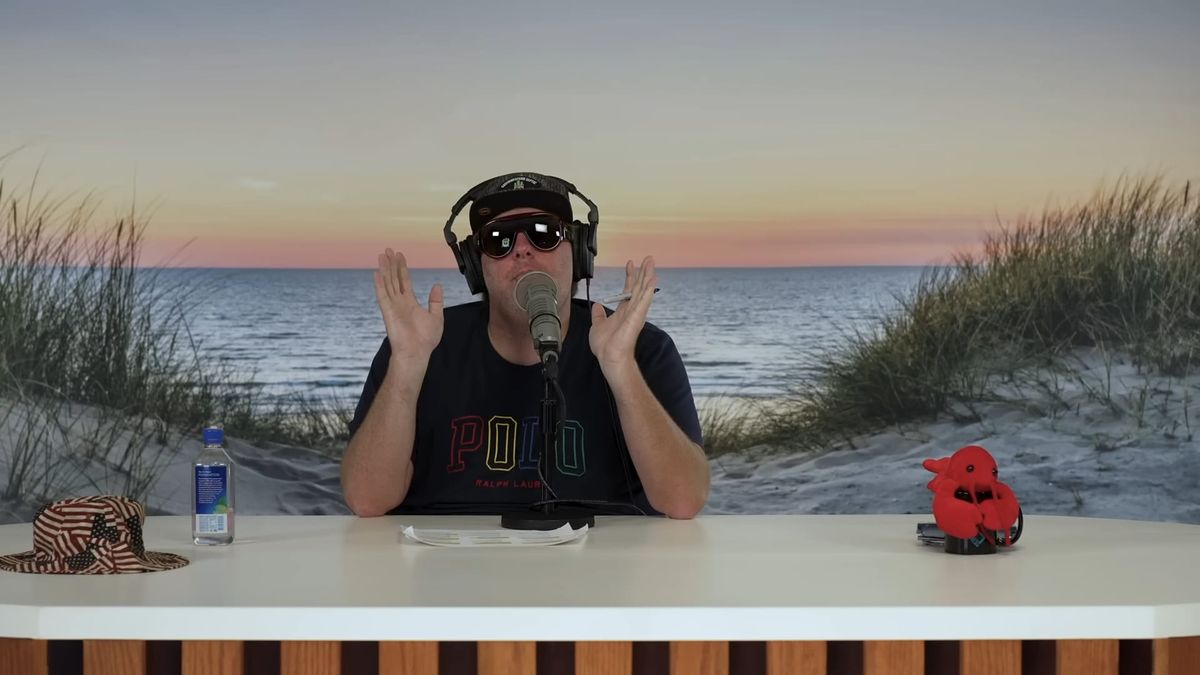
 Seth Simons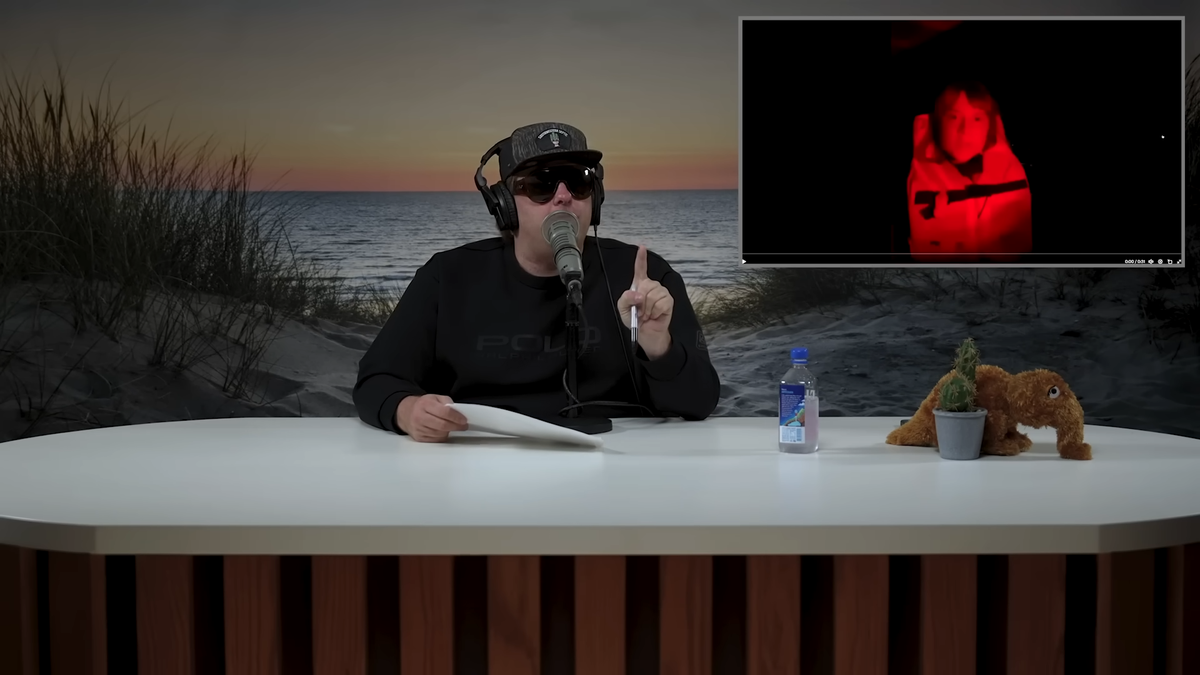
 Seth Simons
 Seth Simons
 Seth Simons