Simple Town Talks Comedy, Friendship, and the Ghost of Hollywood
Part two of my conversation with the Brooklyn sketch group.
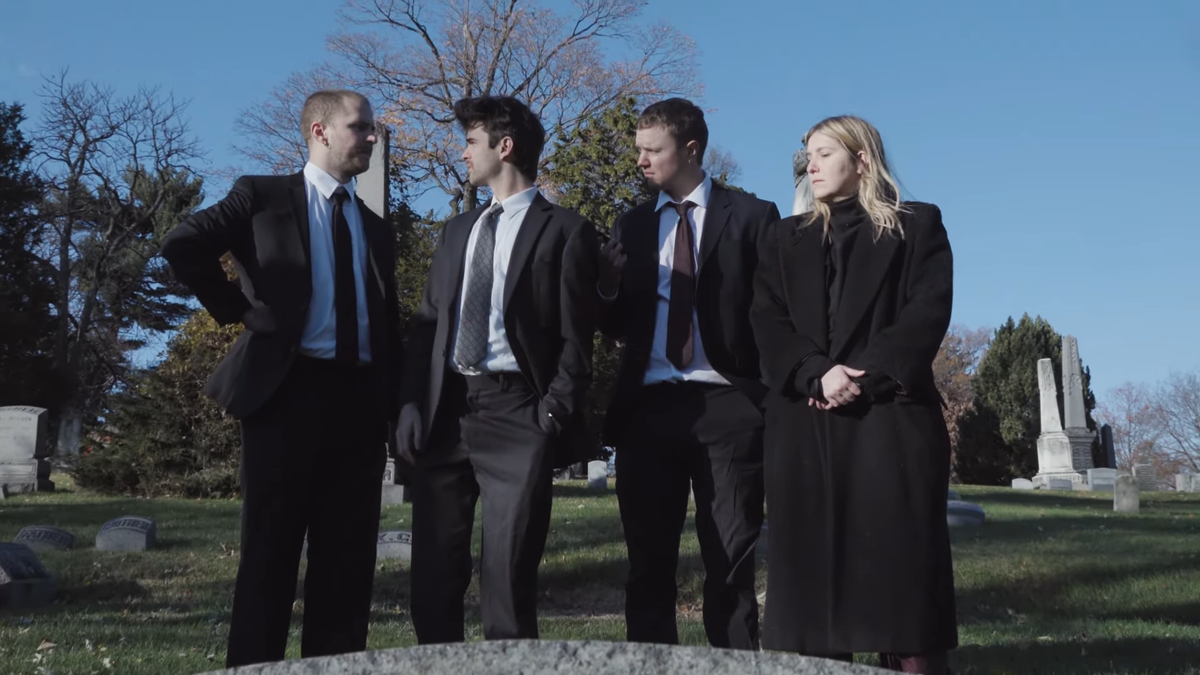
Last week I said I would make part two of my interview with Simple Town available to paid subscribers. After great deliberation, I decided I just can’t bear to withhold it from everyone else. Below you will find the rest of my chat with Felipe Di Poi, Ian Faria, Sam Lanier, Will Niedmann, and Caro Yost, who premiered their feature film Big Break at the Fantasia International Film Festival this past weekend. We discuss their creative process, how they’ve navigated a collapsing industry, their day jobs, and more. Please enjoy.
All right, let's talk about Simple Town more generally now. I don't think I know how you guys all got started making sketches together. So let's start with that.
Lanier: Felipe, take it away.
Di Poi: I'm always the one who takes this question. Will and I grew up together—we met when we were 11 years old. We made little comedy sketches all through middle school and high school, we were very creative together, we had an improv group in high school, and we self-taught all this different comedy stuff. Then when we got to college, I met Sam doing improv at Brown—we were in the same improv group, and we got in the same year. And I met Ian at RISD, in the film program. So we started spending our summers in Providence making sketches. And when school ended and we all graduated, we decided we wanted to go to New York, and we met Caroline doing open mics. So 2017 is when this version of the group came together.
How do you guys describe your sense of humor, your aesthetic?
Di Poi: Millennial cringe core. Off the record, off the record. Don't put that in.
Niedmann: I always think of it as: the comedy often comes from four people who have to do something all together. It's about four people having to decide on something, or cooperate on something, or understand what the others are saying, or even just get what someone else is thinking.
Di Poi: That's worse than millennial cringe core.
Niedmann: I'm lobbing the ball up.
Is cringe important to you? Do you feel that the humor comes from cringe?
Faria: No, it's just a thing that keeps getting said in the press for Fantasia.
Di Poi: What we strive for, I think, is that level of silliness and surreal alt-ness—of four people who are quite dumb, or who have this really twisted understanding of how to go through the world. At the same time, I think a thing that makes us specifically us is that our stuff has a lot of real emotional stakes. I think we're pretty sincere people with each other.
The way I'd put it: Shaun of the Dead is a very heightened comedy movie, but ultimately it's about real people and friendship and real problems between people. In these characters, I think we try to channel our real ideas about what's hard about living and collaborating. I think a lot of our work is about our collaboration. In all of our sketches, we're friends collaborating on something. Sometimes it's literally Simple Town, and sometimes it's not. But I think we channel all our feelings about each other, and the difficulties of our collaboration, into our work. And to me, the central tension of a lot of what we do is that our collaboration brings us together, but it also creates friction between us. So that's always the tension: we're all working toward a certain goal, and that's why we're so close, but it's also the thing that makes us want to kill each other.
Tell me about your creative process. What are the pros and cons of being five people making comedy videos on the internet?
Faria: One of the pros is that there are always gears turning in some department, even if a few of us don't have the time. It really helps keep the ball rolling. I think that's part of the reason we've been at it for so long.
Niedmann: I think another pro is that, like we touched on earlier, we've arrived at this interesting collaboration style, where we've learned not to do a lot of stuff writing in a room, but to do it in the moment—whether we're performing live or filming. And I think that's become a formal aspect of our work. There's a sense that we all—the four performers and the person directing—have this agency, and you feel the style of each individual person. I think that's a pro.
Di Poi: I think we spend a lot of time together as friends, and we know each other intensely well. And we know each other's comedic ideas really well. So even when we're improvising and negotiating, if someone does a thing, it's like, "Well, that's what they think is funny. And they know that I don't think that's funny, but now that's what we're doing." And then that becomes part of the joke, which is like, "I'm going along with your joke, which you know is not my sense of humor." So I think that friendship, and that intense knowing of each other, always comes through in what we're doing.
Lanier: I think a con is the way the Hollywood movie industry model works: if you're an unknown talent—an actor, director, writer—they pair you with a known entity. You hitch your wagon to someone who's already famous, and they make you famous through the collaboration. And because we're five people—four cast members and a director—it's hard to pair us with other entities. This is small fries, but people are always like, "I want to put you on my podcast, but how do I have all five of you?" And the same thing comes up with making movies or TV shows. So I think what makes us a strong DIY team also makes us hard to digest and incorporate into the mainstream, for better or worse.
Yost: On top of that, we're also, on some level—not quite, but almost—like a production company, since we can make everything ourselves. That puts us in a unique position, with a lot of agency and the ability to do things exactly the way we like. But it's also a little harder to incorporate us into a system with more established, more experienced entities operating more professionally. Another pro, which is also a con, a two-sided coin here, is that there's a lot of integrity in our work, because there are five people who have really strong opinions and creative vision and impulses. I often describe Simple Town as almost a group of five directors, even though that's not the role we all officially play.
That's how it can feel. And I think that does a lot for quality control, for raising everything to the highest level it can possibly be at. But it can also create challenges in the process—this grinder of all of us that everything gets turned through, which can be time-intensive and energy- and emotionally-intensive, just because everything is being worked on that way. We like having a certain amount of consensus; we like getting consensus. It's not always that we have everyone, but we do like to make big decisions collectively. And I think that can also make things less swift—it's not like, "Okay, well, I'm the executor and I'm going to move this along now." It's slow comedy, in the beginning.
Faria: I'll say one more thing, too. As the film person in the group, it's an incredibly unique experience. We all have our five-person relationship, and then they have their four-person live-performance relationship, which they bring to it when the five of us meet. And that has really changed things. I know the way we all work together has changed the way each of us works, but I definitely feel like, personally, the way I film things has changed. It's a call-and-response relationship, to an extent—they'll develop new styles over the years, and we started out making videos that were a little more high-concept. High-concept is the best way to put it. And then as you guys developed your performance style, it became more grounded and more conversational, and that changed the way I was filming a lot of the time.
Your movie is about the industry and features a lot of cynicism about the industry. I'm not gonna ask you to shit on Hollywood, but I am curious: what is it like, as comedians, writers, multi-hyphenates, and filmmakers, navigating a business that's much more fragmented—or non-existent—than it was for groups of friends making comedy on the internet in the early 2000s, or when Comedy Central and Funny or Die still existed?
Di Poi: I can speak to that. I think that was a bit of the origin myth of this group. Growing up, we really liked The State, and when we were in college, Broad City had just gotten on TV. Everyone we went to college with who did comedy ended up either at The Onion or ClickHole. There was this economic confluence of things that made it seem like, okay, yeah, you can get a show, that can happen. And it's not that that stopped, but it does feel like it maybe didn't play out that way. I guess maybe it's for someone like you to describe whether that's a general pattern.
I'm working on it. I'm trying.
Di Poi: I do feel like it was a pattern. I do feel like something changed. And it's funny that the movie is about the industry, when even people inside the industry seem a little skeptical of even using that term. So it's almost like the movie's about the ghost of this thing that maybe existed when we first got together, but maybe doesn't anymore. So I wouldn't go as far as to say that opportunities don't exist. I think it's true that when you're making stuff, you always have to find the little space where you can make your way in. And I'm sure people in the '90s or 2000s were like, "Oh, well, we found this way in, this small window in." So I think those windows still exist, but it does seem to me like we're in this weird transition period, where everybody's doing vertical Instagram shows and every offer of money for a thing is small-budget. No shade, it's great, but you're making shorts. A lot of short stuff.
Faria: Everything's changed names.
Di Poi: That too.
Faria: We were talking about Dropout, and it turns out that's CollegeHumor. That's crazy to find out.
Since this is a newsletter about work, I wonder if you can tell me about your day jobs—how they inform your creative practices, or how you juggle the two?
Yost: I can do mine, because it's pretty obvious: I'm a video editor as my day job. I got interested in video editing to support my creative practice. I wanted to make stuff, and I got excited when I found a way to do that. And I saw early on how much the speed and pacing and rhythm of a cut could change the way the comedy plays. That was really exciting to me. So often I'm working on stuff that's not so exciting, doing it for the money. But I'm grateful for that professional gig, because it's also the reason I was able to handle cutting our feature, and things like that.
Di Poi: I make my money as a freelance animator, or rather, I've made my money just making content. So it's atypical, in a way, not so different from what Simple Town is. And like any freelance work, it's subject to the randomness of where the money comes from. But I've been lucky enough that I've made it work.
Faria: I do freelance editing too, Freelance cinematography, assistant editing, pretty much any job I can get. And it definitely all informs the way I try to shoot and direct stuff, in all the obvious ways. And I especially love doing live-event videography. That's probably my favorite thing to do for work, because to me it's the most interesting parallel to shooting with Simple Town—you're reacting to something happening in real time. With Simple Town, I can ask them to do it again, but it's never going to be exactly the same. And sometimes you just want to get it the first time. I think it's really fun to shoot in a reactive way. And I feel like I really learned that from shooting events, where it's just happening one time and whatever you get, you get—trying to emulate the perspective of a person at the event. It's exciting to me.
Lanier: I animate now for money, but my last job ended at the beginning of June, so I haven't made any money recently, which is stressing me out. Before this, I did a version of consulting, for five years, while doing Simple Town. And I guess maybe the interesting thing to say is that I had this day job, and this belief inside of me, where I was like, "Oh, I could be really, really famous and successful in comedy and in Hollywood if I only really tried and was able to quit my job somehow and really give it my all."
And I did do that. I quit that job in 2022. I now have a different set of anxieties and beliefs, but that bug doesn't bug me anymore. I don't think to myself like, "God, if I had only done X, Y, Z." So I guess it's nice to say that, although in some ways none of my work questions are really resolved, that beast is slain—I'm answering a different set of questions than I was four years ago. Hope that's interesting.
Niedmann: I work for the city. I have a full-time day job, and it's a union job, because I'm scared of doing the freelance thing. And I like the steady income.
What do you each feel like is your ideal artistic form, the one where you're most yourself? Is it sketches, cartoons, films, live comedy?
Niedmann: I like a narrative thing. I found this really fun to do. I like the idea of making a TV show where I could be the same character over time. And I think that's the stuff I really admire. It feels the most complete. You can have a fuller idea, as opposed to just a sketch.
Lanier: I like movies. It's the art form I take in the most of, so it's the thing I'm thinking and dreaming about. I've tried to write pilots sometimes, and I find I don't really have that sense for it—that pacing, or what needs to happen when. In movies, that comes a little more naturally to me, and I think it's because that's what I watch. So I love movies.
Faria: Same for me. It's number one, for sure. A million times over.
Di Poi: For me, the future dream of Simple Town would be a way to continue making movies. I think that's the ultimate format. That said, Simple Town has spent so much time on stage making sketch, and even though for a long time we thought of that as auxiliary, or temporary, or a stepping stone, it's actually something we feel really comfortable doing. A big part of the Simple Town style and vocabulary, the thing we do with each other, is so much about these live shows, which we've been doing for 10 years. So I don't know if that's where we want to end up artistically, but I think it's a big part of true Simple Town.
Faria: I feel like at one point we were talking about—well, maybe I'm the only one who made this comparison—but I was thinking about Steve Coogan doing Alan Partridge, and how he got to do a TV show, a movie, a radio show, a book, an audiobook. That's the dream.
He basically just franchised one character.
Faria: If we can franchise the four characters in Simple Town…
Yost: I feel really connected in live performance—I love performing live, I love being present with an audience. And to piggyback on what Felipe said, it's something we maybe don't always think of front and center, but there's something to our style of live sketch comedy that feels really alive. That's part of what makes people excited to see it. We have these sketches that are written, but we're constantly improvising on them or riffing on them, coming up with new byways and games to play within them. There's this sense of people onstage creating something in the moment. Some people think it's cringe when I say this, but it's a little more like jazz than like musical theater. And that's something I enjoy being expressed through the group.
Niedmann: I want to dream in movies.