Simple Town's Big Break
A conversation with the Felipe Di Poi, Ian Faria, Sam Lanier, Will Niedmann, and Caro Yost of the Brooklyn sketch group.
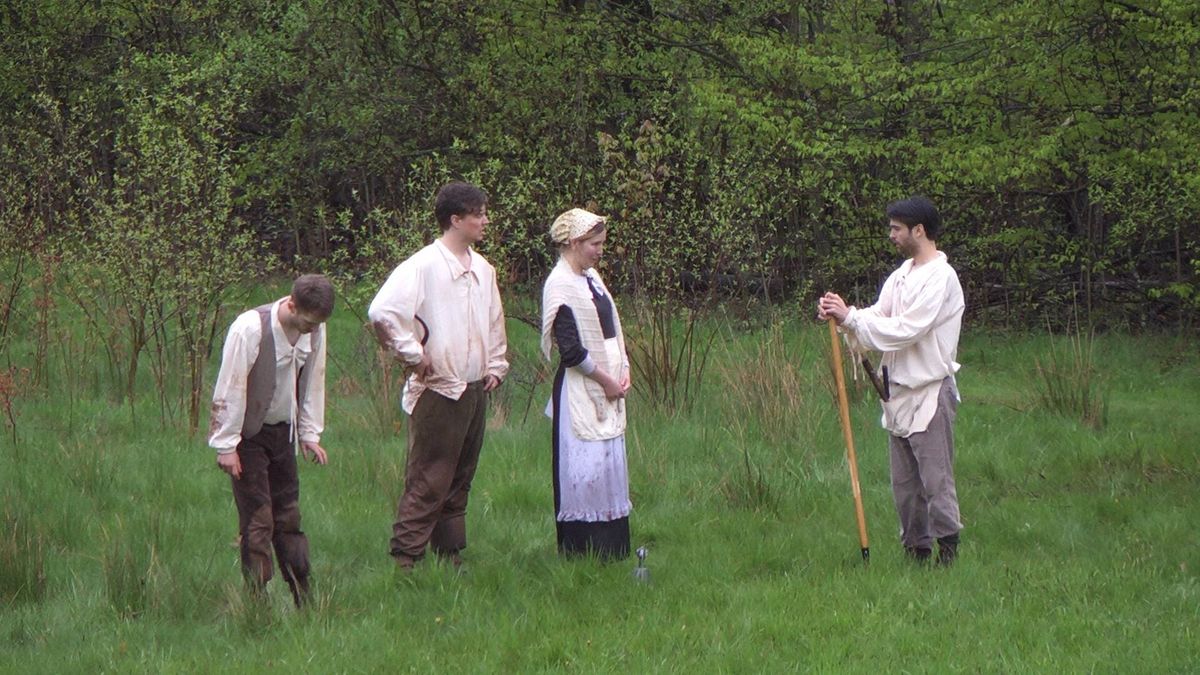
If you've been reading this newsletter for a while, you'll know that I'm a great fan of the comedy group Simple Town, which consists of Felipe di Poi, Sam Lanier, Will Niedmann, Caroline Yost, and Ian Faria behind the camera. There's something about their unpretentious, lo-fi approach that just hits my sweet spot. Most of their videos involve a handheld camera and the comedians as themselves chatting in a room, often encountering a whimsical "one weird thing," like a six-foot-tall boyfriend rendered in delightfully high POV shots, or a sting operation to find out why one of them is depressed. They're masters of the high concept and the low concept, the extremely online and self-referential, adept at visual and verbal poetry alike. In short: they make me laugh.
As a live act, Simple Town has performed in New York City, Los Angeles, New England, London, and Edinburgh; as filmmakers, they've appeared on Comedy Central, Adult Swim Smalls, and in the New York Television Festival. I recently had the pleasure of watching their debut feature, Big Break, which in true Simple Town form involves a lightly fictionalized version of the group. A comedy-thriller-horror set in a not-so-distant future, the film envisions Lanier as a famous screenwriter who left his old friends and collaborators behind when Hollywood came knocking. When they visit him at his fancy upstate house hoping to ask for roles in his next project, they discover that fame has turned him into something much darker than a celebrity.
I chatted with Simple Town earlier this week about Big Break, their comedy practice, and how the business has changed for people who make funny videos on the internet. It was a long and interesting conversation that I'm splitting into two separate newsletters: below you'll find our discussion of the movie, which premieres this weekend at the Fantasia International Film Festival, and I'll send the second half of the interview to paying subscribers next week. Sign up for $6 below so you don't miss it.
One quick disclosure before we begin: I know everyone in Simple Town personally, and I was roommates with Yost in Greenpoint many years ago. My love for their work is genuine, however, and I'm very happy to have them in the newsletter. Okay, let's get to it:
First I want to know how the project came together. When did you realize, oh, we have to make a movie now?
Faria: We'd been pitching shows for a while and we'd made a lot of shorts, so we wanted to explore a feature for a long time. We'd come up with a lot of different ideas, all based on previous shorts we'd made, and a lot of those are still in the chamber. But Sam went off and wrote this. He'd mentioned some of these loose ideas before, but my experience was that he just popped up with a complete script. We read it, and my first thought was, "Oh, this is a real movie script. It ties up at the end with a nice little bow, and I had a lot of fun reading it." That, to me, was a no-brainer. We're gonna make a movie—this is it, it's right here. And because of the quality of the script, I found it a lot easier to get made than other things we'd tried to get off the ground before.
Niedmann: My memory, too, is that we'd decided—we do these meetings at the beginning of every year—and this was around New Year's in 2023, or maybe '24. We were like, "Let's make a movie this year. No matter what, whether it's made for $5,000 or we get a real budget, this is the next thing we want to do." And then, I think, Sam had been working on this and shared it. It was really nice to move out of the, "Could we get someone to make something with us," the industry and everything, and to be able to say, "Here's our script. We're gonna make this the way we'd make a short, if that's what we have to do." So we were in a get-it-done headspace.
Sam, how did it come together on your end?
Lanier: We'd known we wanted to make a movie for a while. In the fall, we bounced around a number of different ideas. I'd talked about this serial killer idea, and what I remember is that I didn't get a ton of positive reaction from the group. But I was like, "Okay, I kind of see some parts of this movie that have a lot of heat for me or some themes that are just cool. Let's see if I can put it into a film script form." I showed them the script, and it wasn't exactly the thing that Big Break is now. The beginning was different, the ending was different. After I showed it to them, they gave me a bunch of suggestions, and we worked collectively on a beginning and an end that we felt made sense. So by the time we went into production, it was really an idea that had had all hands on it at Simple Town.
Yost: I was going to say, when Sam mentioned that the group wasn't that excited about it—I feel like that's not uncommon in our process. Getting five people on board with one creative idea can be a challenge, so often you have to keep trying. And then, eventually, in the making of it, we all come to know it and love it and get down with it. But there's always a leap of faith that the group takes, I think.
What drew you to the horror-thriller component of it? Why was that a genre you wanted to play with?
Yost: I have a thought about this, and people can tag on. First, when I joined Simple Town, these guys love horror movies, and suddenly I was watching tons of them. I think the first time we went up to Providence to shoot Quartet, we watched a horror movie. So that became a big cultural thing in the group. And then we made that short, Scary Car, in 2021. We loved how that came out, and it felt like a really rich place for us to play.
Lanier: Another thing we've talked about is that it's hard to make a comedy movie these days, and it's hard to get people to watch one. Horror seemed like sexy packaging—a way to wrap our funny material in something that would get people to watch it. So you could look at Big Break as a comedy disguised as a horror movie. Maybe some would say it's the opposite. I don't know. But I think the horror genre was a way to get people interested who didn't know our work, and to give it a plot and a sense of direction that comedy movies sometimes have a hard time achieving.
Faria: I totally agree. This is a new thing I'm trying out, but I do think that across the work we've made with the shorts, the comedy is the priority. We're trying to be funny. That's number one. But usually the stuff we're most happy with has been some combination of comedy and another thing, whether that's dread, or a weird, obtuse relationship, or something you're not sure how to respond to. I think it leads to new scenarios that are really exciting for us, and to coming up with stuff that feels a little less familiar.
What felt exciting about Scary Car, at least to me, was that there were moments where it could be a little unnerving and I'm still laughing. The idea truly is a little scary to me, but I'm still allowed to laugh, without sacrificing the stakes of how creepy the thing feels. And I feel like there were moments of Big Break where we're trying to get to that. Can you still make someone laugh while they feel really uncomfortable, feeling a mix of things at once? I don’t know that any of this resonates with anyone. Trying it out.
Niedmann: Yep. Resonated.
That's interesting. It makes me think, too, about so many internet-based comedy groups—you guys, Hotel Art Thief, Jeremy and Rajat when they were making web shorts—whose stuff doesn't necessarily read as a comedy short right away. It's in the language of the internet, you sort of have to trick someone into watching a sketch.
Faria: Right. I feel like I usually laugh the most at horror movies, more than any other genre. And I think we all do, to an extent, especially when we're watching them together.
Niedmann: It's also fun because comedy movies don't necessarily have aesthetics to them. So when we started thinking about this movie, it was fun to think about all these '90s and 2000s ensemble scary movies like Scream. The color, the music, the costumes. That felt really fun. It's a fun thing to, I don't know, give it more color and inject what we're doing with something more.
Can you tell me a bit about the shoot? Did making a long-form feature take a different part of you than making the sketches does?
Di Poi: I can talk about this a little, since I haven't answered anything yet. As actors, it was different from anything we'd done. We'd all done bit parts in features, but to be the four main characters of one was another thing entirely. There were all these acting skills we'd never exercised, and we were learning as we went: "Well, we're shooting out of order. How do I preserve this character? How do I think about this character's arc?" You're having to hold a picture in your mind of the tone of the movie in every scene, thinking, "Okay, well, what comes before this scene? What came after this scene? And how am I going to act now? Even though we hadn't just shot the scene that comes before, that's what the viewer's gonna see.” All these technical acting skills and methods that I think we were all learning as we went.
Niedmann: For me, it was an interesting transition, because normally the way Simple Town works is the five of us on a shoot, maybe one or two other people helping out. We like to improvise a lot, and to find what we're doing in the shooting of it—both in camera and in performance. With this, because there were so many other people involved, we had to really plan it out, and time was at a premium. So it meant being a little more dialed in, with a little less leeway to just get there and go, "All right, what the hell is this going to be?" Which I think is a strength of ours, a way we avoid having to decide ahead of time what we're gonna be like, so that in the moment everyone just does what they want.
So that was an interesting change. To arrive and go, "This is the scene, and more or less, these are the lines." We'd improvised a lot in rehearsal and changed the lines that way. But on set, the amount of improv was a lot less than normal for us.
Why did Will betray Caro like that pic.twitter.com/VfEiBbQcHC
— Simple Town (@Simple__Town) May 14, 2024
Di Poi: Another way to put it: there are so many of us that improv is a really effective collaboration tool, because once you've made a choice in improv, that choice has been made. Whereas in a writers' room or a rehearsal room, you can go back and forth a lot. So for us, improvising in front of the camera has always been a way to settle arguments or get through ideas quickly. A way of saying, "Okay, we're all collaborating on this in real time." On this shoot, there was a little more of it being out of your hands. You really have to align with the vision. There's still experimentation and collaboration happening, but it felt different.
Yost: Also, we were actors on set, but we'd all been involved in developing the script and in pre-production, and we're going to be involved in post-production too. So there was a unique challenge in all of us being on set and wearing a lot of different hats at the same time.
Faria: My experience was that I'm used to filming with Simple Town, where maybe we have Alex, our cinematographer, shooting. Maybe one sound person, at most. So usually, on the camera end of things, it's me and one or two other people. But now, suddenly, it was Simple Town, plus me, plus 30 more people on our busiest day. So in every way you could imagine, it was grad school for learning how to work with a bunch of people. A good chunk of them we'd worked with before, but never in that environment. And then there were people we'd never worked with before, who we were really dependent on to show us the way and bring their experience to it.
We were really lucky. Everyone we worked with was extremely open-minded about how the movie could go and how we could go about shooting it. We needed to be really flexible, and they needed to be flexible too, to meet us where we know best how to shoot something or get a sit-down scene. And I feel like no one day was completely the same—we were constantly changing. At the end of each day, we'd regroup and ask, on the dial from lighting setup to performance, how important is each in a given scene? Some scenes require a lot more work on the crew's part, and then there are scenes where you can hopefully just set up the camera and shoot and shoot and shoot, so we get as much of a variety of good material as possible.
Are you able to tell me anything about the money side of things, what it was like putting together the financing for an indie feature?
Yost: We were very lucky to be connected with Richie Doyle, who runs a company with Conor Hannon called Bronxburgh Productions. Richie was a guy we knew through the comedy scene—a standup who'd run this thing called Sunday Morning Digital that had licensed our sketches a number of years ago. We'd talked about different schemes for how to raise the money, or finding a certain number of donors who'd come in and split it. But we'd heard he was interested in funding movies and had pledged a certain amount to another filmmaker's project. So we approached him, he read the script, and he was like, "Let's make it." It was an absolute dream of how you could possibly put together the funding for an independent movie.
And on top of that, he was like, "I want you guys to have full creative control"—which, for Simple Town, is so important. We were really in a fortunate position, to find someone who could help us and was willing to give us that kind of freedom.
Lanier: Maybe a thing your readers would find interesting is there were a lot of people willing to help us find money for the project, but it came with caveats—like Ian can't direct it, or it has to star a certain kind of person.
Yost: Or the budget needs to be halved.
Faria: Or the budget needs to be twice as much.
Niedmann: Or we can't work with the other people we like to work with.
Lanier: Yes, exactly. They have to choose the cinematographer, or all the crew, or things like that. So we were lucky to find a person who really gave us creative control, and production control as well.
I want to ask about working together as Simple Town generally, but first: can you each tell me what your favorite part of making the movie was?
Faria: The most fun moment of the whole shoot—oh, I guess I don't want to spoil it, but there's a character who gets hit by a car. I feel like we're allowed to say that. We were lucky to get to do some stunts, with stunt doubles and some rigging and special effects. There was a moment where a character gets hit by a car, and we had a dummy dressed as the character. The stunt driver would drive the car at 30 miles an hour, ramming into this wooden structure, and the whole crew stood around the monitor cheering every time it hit. It made me laugh so much watching.
Di Poi: There's a fight scene in the movie that we choreographed ourselves, with help from the stunt coordinator. We've done things like that a little before, but this was very prepared and rehearsed, and it had a couple of practical effects—my head gets dunked in the water. I found that a really fun acting challenge. You're trying to get to this dance with a lot of energy. I thought that was really fun.
Faria: And they were in the bank of a real pond, it was freezing cold.
Yost: It's funny, some of the things that stick out were the ones that were most challenging at the time. At the last minute, we needed to find a new location for this scene that happens on an empty road. We found one, but we had to shoot it late at night, and it was freezing cold. And for some reason, my shoes—they'd come out of the dryer, but they weren't finished drying yet. So I'm wearing wet shoes, and all of the crew is huddled around these heaters. But where Felipe and I were doing the scene, there wasn't any heat, and you're performing through these conditions where you're like, I can barely focus on anything other than this thing that's right in front of me. And Graham pulled Will aside and was like, "Is Caro okay? She's slurring her words." And it's funny, because at the time it was so hard, but in my memory, I don't know, surrendering myself to the process that way feels like a really fun thing to do.
Di Poi: And that's the scene where I like my acting the most, at least for me. I think that scene is really good acting, partly because it was so difficult to shoot.
Niedmann: My favorite thing, I think, was that we shot for three weeks, and the way the schedule worked, the first week was normal hours, and then over the following weeks we descended into a schedule that was a 3pm start to a 4am finish or something. So our sleep schedule really adjusted—we'd be going to bed at 5am and waking up at 1pm or 2pm in the afternoon. And it was the same on the weekends. I found the weekends really interesting—we'd wake up at 2:00 in the afternoon, the vibe on the crew was very fun, and people would all hang out together in the different houses they were staying in. I remember it as a very dreamlike and fun time.
Yost: I'll tag on to that one. The other thing it makes me think of is the deep pleasure of sharing the Simple Town process with this broader group of people. This is a thing we've done for so long, over the years, and then there are all these people who are really excited about it, who were bringing us in on it. And that felt really cool. It was cool to share that with them, and also to see the way they received being a part of it.
Lanier: Part of making the movie was that once we were editing, you go from this really fun thing—shooting the movie—to editing it, which is really not fun. I went from loving the movie to seeing the first shots we'd gotten, trying to play with some of the footage myself, and being like, "I actually hate this movie." And then it took Caro a couple of months to get cuts together, and when we showed it to people this past year, they really responded to it in a positive way. And I suddenly felt like, oh, I have this secret now: I'm secretly working on a movie that might actually be good. That was a really cool experience to have.
Rock on. All right—before we wrap up, are there any collaborators on the movie you want to shout out?
Faria: Definitely our producers—Graham Mason, Sarah Wilson, Ani Schroeter, and Alex Bliss, our DP—were some of the people who put in a lot of time before we even started shooting, purely because of their experience working with us and their faith in us. And then we collected more people as we went. Murrie, our costume designer, and Carol, our production designer, were amazing. Pete McClellan our line producer. Esha, our script supervisor, rehearsed with us a lot in knowing that we had a unique process, she wanted to make sure she was as on top of that as possible. Jefferson [White] and Ivy [Wolk], that was a real boost to us, getting to work with them.
Niedmann: The whole grip and electric team—Jonas Bishop Hayes, Autumn Stevens and Francisco Acosta. There’s a ton of rain in the movie and they not only lit the movie beautifully, but they were soaked operating this rain machine.
Faria: Steve Smith and Izzi Galindo too, I would say.
Yost: We should also call out Kyle Rodriguez, the composer of the movie, a guy we've worked with for a long time. He's pretty much scored all of our short films, and he went above and beyond creating an insane score for this movie. He was really patient, and willing to put in the time to figure it out with us.
Big Break debuts at the Fantasia Festival on July 19th. Watch a clip over at Variety, and sign up here to get part two of this interview in your inbox next week: