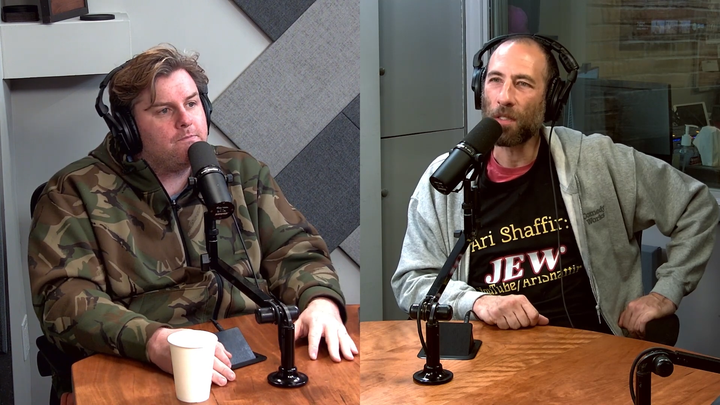
Tim Dillon: Islamic Countries "Have Not Produced the Success that Western Society Has… Our Culture Is a Superior Culture."
A peek behind the Patreon paywall.

You may occasionally find yourself wondering, “Hmm, if Tim Dillon is an out-and-out white nationalist crypto Trump supporter with Nazi friends like Alex Jones and Steve Bannon in his free, public YouTube episodes, how bad does he get behind the Patreon paywall?” The answer is: really bad! Which longtime readers already know from this post a few years ago, detailing his myriad complaints about the presence of trans comics on Vulture’s annual comics-to-watch list. It won’t surprise you to hear he hasn’t moderated his tone or language in the years since, as two recent Patreon episodes reveal.
Both episodes, one released last night and the other on January 14th, feature Dillon’s longtime friend and collaborator Ray Kump. In the more recent episode, a discussion about the Russia-Ukraine war gives way to Dillon’s complaints that it’s fashionable to hate Vladimir Putin because he’s white, unlike various African dictators, leading to his thinly veiled implication that there are reasons African countries are home to so much violence, leading to his explicit assertion that Islamic countries “have not produced the success that Western society has” and that “our culture is a superior culture.”
In the earlier episode, the pair riff about a hypothetical Taylor Sheridan series featuring a trans detective, using the usual transphobic slur over and over again. Although Patreon’s community guidelines expressly prohibit hate speech, including the use of “harmful slurs,” the company has not responded to my inquiry about the segment.
On Russia, Africa, and Islamic Countries
Let’s go to the tape.
Kump: What'd [Putin] go over to in 2014? Crimea?
Dillon: Yeah.
Kump: Like that shit—he needed a port.
Dillon: Yeah.
Kump: And as a big country, yeah, I get it. You need a port.
Dillon: And here's the other thing. So Zelensky early on was like, "Maybe I'll negotiate. We'll figure this out." Boris Johnson flew to the Ukraine and was like, "Don't negotiate."
Kump: Right.
Dillon: "We got you. We got you."
Kump: I'm not apologizing for Russia, "Oh, they should have a port if they want it." That's not my point, but we act like they're insane, like they're blood fuming—no, it's routine. If we're gonna talk shit for 20 years about how they should be gone, they should—
Dillon: Part of it is that they're white and were able to do it.
Kump: Right.
"It's a lot easier to talk about the evils of Putin or Russia than it would be to talk about the evils of some African dictator."
Dillon: Part of it is that we like an enemy that can fit into this new domestic political paradigm that we have—
Kump: Yeah.
Dillon: —where—
Kump: It's white privilege.
Dillon: Right. And it's a lot easier to talk about the evils of Putin or Russia than it would be to talk about the evils of some African dictator.
Kump: Right.
Dillon: Right?
Kump: Yeah.
Dillon: That's just the reality. That's not anything that I think anyone could even contest.
Kump: That is very funny though.
Dillon: But it's true.
Kump: Yeah. We need to have less villains of color.
Dillon: It is true.
Kump: Yeah.
"We obviously are very critical of US imperialism and all of that stuff, but it's also just tough to run a country that looks like Vermont if you believe in witches."
Dillon: I mean, you couldn't get away with—you don't hear about—do you know how many vile, murderous, genocidal maniacs there are in parts of the world you've never heard of? Janjaweed death squads and everything, you just don't hear about it as much because it's not as acceptable. Because they believe the people that would care about that will trace it back to whitey anyway. It'll be US imperialism, French. It's all whitey.
Kump: Strangely, it is—a lot of it has to do with that whole Chomsky, manufacturing consent—you have to start with making the case in the media and the news. And that part of it definitely is harder to do with this whole—
Dillon: At the end of the day, we obviously are very critical of US imperialism and all of that stuff, but it's also just tough to run a country that looks like Vermont if you believe in witches. Truly. If you believe in witches and for whatever reason you don't have an education system and you're a—I mean, "third-world country" is aspirational. These are like, God only knows the term. And women are getting prosecuted for being raped and people are getting hacked up with machetes in different—warlord groups are hacking up other, I mean, women, children, and they're leaving bodies in the street to rot and fester and then they're being eaten by animals and stuff like that—
Kump: No, it's insane.
Dillon: So I guess that's my fault, perhaps? But I wonder about, not everyone's gonna do the same thing out there, it seems like. Not everyone's gonna do the same thing.
Kump: Yeah.
Dillon: Japan was bombed, nuked. Right?
Kump: Right.
Dillon: Japan's not doing that.
Kump: Right.
Dillon: So different people value different things. Am I wrong?
Kump: No.
"If you believe in witches and for whatever reason you don't have an education system and you're a—I mean, "third-world country" is aspirational."
Dillon: Listen, if I'm wrong, I'd love to be wrong, I guess. I don't know.
Kump: You're saying that we can't police the world and that we can't—
Dillon: I'm saying more than that, but—
Kump: No, but you're saying we can't—
Dillon: Nothing I'm saying—I always want to always point this out—nothing I'm saying is racist ever.
Kump: No.
Dillon: No. You know what I mean? Because by the way, you could hear this and think it's racist by just listening to the words, but it's actually not.
Kump: I see what you mean now.
Dillon: It's actually not, because it's so easy to go, "Oh, that seems like he's being racist," but it's actually not.
Kump: No, no, no. Look, it's just, a lot of people go through cycles. Countries go through cycles of being on the back foot, of getting attacked, or being attacked.
Dillon: Okay.
Kump: And I'm saying, and they act in certain ways. And there's a certain level of, "Ha, that happens sometimes."
Dillon: Yes.
Kump: And it takes you back a little bit.
""Cultures develop in very specific and unique ways. And some are better than others."
Dillon: Well, if you believe in witches and you kill someone because you think they're a witch, which we did many, many years ago—
Kump: It's outmodded. Outmoded?
Dillon: —but we've gotten over that. And if you can't get over that, I don't think you're going to produce a functional society.
Kump: You're going to have to meet us halfway.
Dillon: That's what I'm saying.
Kump: Yeah. Why is there no halfway? I've asked that question a lot to myself. There might be anthropologic reasons. It's hot. It gets very hot.
Dillon: Yes. No, sure.
Kump: I don't know.
Dillon: It gets hot in California, actually. It's very hot in Palm Springs. It doesn't seem like that—
Kump: No, I agree. And look, you can only chalk up so much to the CIA.
Dillon: It can't be the reason that everything on earth has gone in different directions. There's just different cultures and people just want different things out of life. And cultures develop in very specific and unique ways. And some are better than others. Some cultures, and this is the other problem that people really don't want to—now, by the way, I have no interest in going into Islamic countries and making them into anything other than what they are, it's not my business or my job, but if I looked at those cultures, they have not produced the success that Western society has. So you can make that judgment. You can say that I would rather live in America for all its faults instead of Pakistan or Afghanistan—
Kump: No, sure.
Dillon: —or Iraq.
Kump: Afghanistan is quite nice.
Dillon: You know?
Kump: No, yeah. Yeah.
"Islamic countries… if I looked at those cultures, they have not produced the success that Western society has."
Dillon: You could make that judgment. You could say that our culture is a superior culture.
Kump: You could. I mean, this is not an award show. You don't have to. It's like—
Dillon: Well, you do have to, and I'll tell you why you have to, because people are bringing those people from that culture—
Kump: Oh. Well, in that context, true.
Dillon: —to our country.
Kump: Right.
Dillon: And they—
Kump: Well, sure. Yes. Right.
Dillon: So we actually do have to.
Kump: Well, that's fair. In this case, yes.
Dillon: Can you play Kanye West's "Heil Hitler" very low, please, while we talk about this? I'm kidding. I'm joking. I'm joking. We don't need a copyright strike against Patreon.
Kump: I think it's actually more racist sometimes.
Dillon: Yes. Good. By the way, good. Good. No, whichever way you're going with this, how it's more racist what someone else is doing. I like this.
Kump: To chalk up this to like—
Dillon: Yes.
Kump: —"No, it's that you're being..." No, I don't think it should be wrong to encourage people
Dillon: Yes. However you're going to land the plane.
Kump: —to do less carnage.
"People are bringing those people from that culture to our country."
Dillon: There's the runway! There's the runway! Line it up with the runway!
Kump: I think everyone has equal opportunity and ability—
Dillon: The landing gear is down.
Kump: —to enjoy all the progress that we enjoy.
Dillon: Yes, final approach.
Kump: And to act like people can't is actually a real racism.
Dillon: [Ed. note: Dillon is still using a pilot’s landing procedure jargon here and in the next few lines:] “400. 500. 300. Minimums.”
Kump: People can—
Dillon: “Minimums.”
Kump: They're perfectly capable of rising to the standard.
Dillon: "Retard, retard, retard.” Yes. Very good.
Kump: Thank you.
Dillon: Very good. It was excellent. It was excellent.
Note how Dillon brings it back to immigration at the end there, arguing that the salience of other cultures’ supposed inferiority is that they’re moving to the West without (as he’s said elsewhere) assimilating to Western culture. As I’ve said before, he and other folks in his milieu are perfectly aware that their comedy is racist, because their racism is ideological. They believe it to be a matter of fact that those people are uneducated, uncultured savages—as opposed to the white Westerners orchestrating the genocide he's been so outspoken about, but which oddly doesn't factor into his analysis here. Huh!
“Make a Show about a Tr—y”
Now let’s move on to the transphobia in the Jan 14th episode:
Dillon: Hey, Taylor Sheridan, enough. How many more shows are you gonna do? Lioness, Landman. Hey, hey, hey, we get it. He's great. Yellowstone's good. They're all great. They're all great. He's very talented. But what do you need, to give him more money?
Kump: I'm going to write a show up about a maid.
Dillon: Right. I mean, you need to give him more money?
Kump: Yeah.
Dillon: "I'm a rough Texas man." Great.
Kump: "I'm a Texas magician."
Dillon: Taylor Sheridan, you want to impress me, you make a show about a tr—y.
Kump: Yeah.
Dillon: Like a Texas tr—y.
Kump: A nasty one. Mean.
Dillon: A nasty Texas tr—y.
Kump: A mean tr—y.
Dillon: A mean Texas tr—y.
Kump: Yeah, right. You don't mess with Texas.
Dillon: Yeah, like a nasty Texas tr—y.
Kump: Yeah.
Dillon: Right?
Kump: It's called "Nasty Texas Tr—y."
Dillon: "Nasty Texas Tr—y."
Kump: NTT.
Dillon: Right.
Kump: Yeah.
Dillon: I mean, something real—just a tr—y, just hot piss on a dead body, just pissing on a dead body.
Kump: What do they do, are they a cop now? What's their job?
Dillon: What are they? They're a sheriff.
Kump: Yeah. A sheriff, right.
Dillon: There's a town run by—and they say this, they go, "There's a town and it's run by a crazy Texas tr—y."
Kump: Yeah.
Dillon: And that tr—y pisses on dead bodies.
Kump: So he's like a crooked cop? He's actually a pretty good cop, but he's nasty, he pisses on the bodies.
Dillon: He pisses on the bodies. And sometimes while they're still alive, while they're dying.
Kump: Right. It's just something he does. He doesn't know why he does it. But, he's a good detective.
Dillon: She.
Kump: She, right. He, she, yeah.
Dillon: Yeah.
Kump: They.
Dillon: They. But—move into that, Sheridan.
Kump: Yeah.
Dillon: How about you move into to that.
In a third episode released between these two, Dillon takes a phone call from his “jet guy,” private aviation entrepreneur Dirk Vander Sterre, and tells him: "You're on a Patreon podcast, meaning that no one will really hear you because it's behind the paywall.” This is a bit of hyperbole—unless his numbers have fallen significantly since he made them private a few years ago, he has tens of thousands of subscribers—but it’s still revealing of the way he treats his Patreon episodes as more intimate conversations where he has more freedom to let loose. (Related: they’re audio-only, so they don’t get clipped on social media.) And what does he do when he lets loose? Simple: he calls brown and Black cultures inferior to white ones, and he says transphobic slurs again and again and again.