Ridiculous
A roundup of writing about Louis CK.
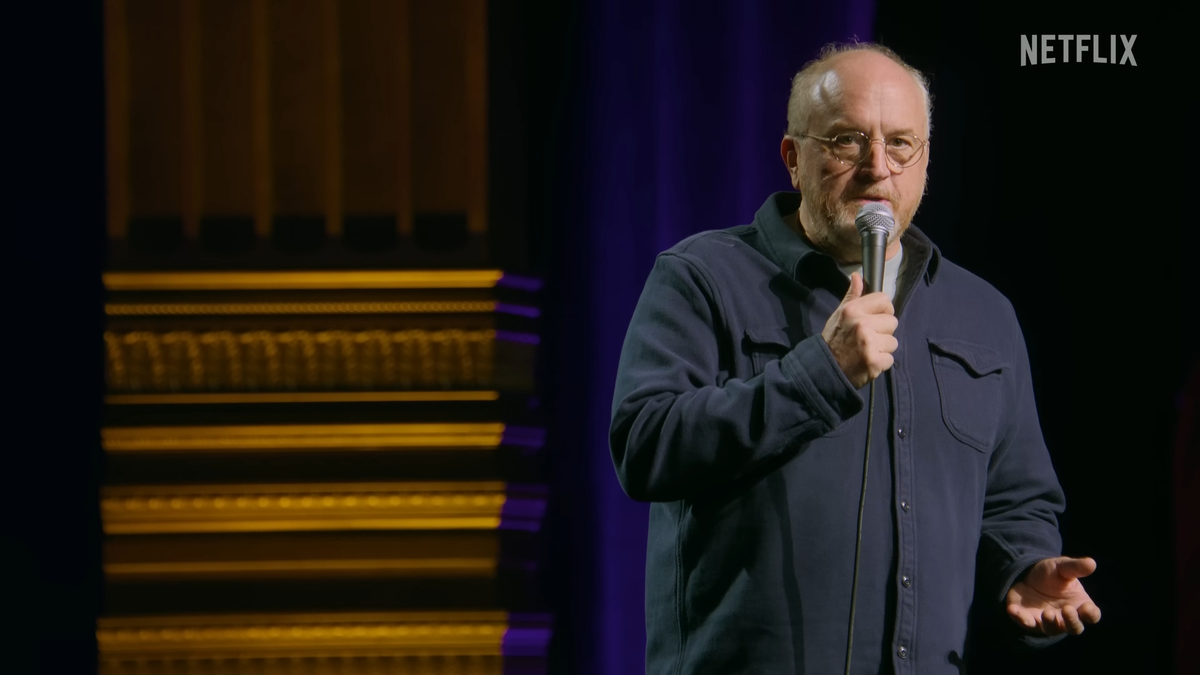
Louis CK has a new Netflix special out today, his first on the platform since he confessed to serial sexual harassment almost a decade ago. I take pride in being one of a few cultural critics, somehow, who has not succumbed to the apparently widespread temptation to treat CK as a serious, reformed artist whose work deserves consideration on its own merits. In my view, he is an unrepentant predator: that’s how I’ve written about him for the last nine years, and that’s how I will continue writing about him. In this post I’ve collected some of my past writing on CK and the people who have protected and enabled him.
“I don’t actually think those things”
ari shaffir, louis ck, joe rogan, jim norton, bread, butter, white nationalists
 Seth Simons
The question of what to do with Louis CK was always a question of what to do with standup comedy. What do you do with a business where nobody in charge will say no to an admitted, unrepentant predator? Where they don’t even think what he did was all that bad? Where nobody wants to talk openly about the many elephants in the room—racism, homophobia, transphobia, rape culture, labor exploitation—because none of their bosses will listen and none of their colleagues have their back?
It’s a hard question I don’t think many people are interested in answering. You see it reduced to culture-war squabbles about free speech and offensive humor because it’s easier to yell about whether jokes cause harm than to face the ways people do—people being the ones who tell jokes. Here’s Als: “I had never seen him live. But I am interested in performers who try to work through the difficulties in their own lives by addressing them in art.” What? The “difficulty” in CK’s life is that he sexually menaced younger women in his field and lied about it for years while his management pressured them to keep quiet. The impulse to see him address this in art strikes me as a bizarre one, especially given that he has not meaningfully addressed it in life. But Als is not the only critic with this impulse. Times critic Jason Zinoman wrote a whole column in 2018 making the case for Aziz Ansari and Louis CK to channel their difficulties into art. He, too, took CK’s return to public life as a foregone conclusion: “Whether and how these men should return has been debated endlessly,” he wrote, saying nothing more on those debates. “They are back, and while their new work will raise political and moral questions, it also poses an artistic one: Should they talk about the accusations and their experience onstage?” In both cases the answer was yes.
Why MeToo Mattered
On the comedy group that defended child rape live from The Stand last week.
 Seth Simons
What we are witnessing more specifically is the result of the comedy industry’s failure to expel Louis CK, whose abuses illustrate the precise aspects of consent, power, and workplace sexual harassment that Gomez, Oakerson, Smith, and List fail to understand. Remember that CK spent years denying the rumors about him, copped to everything in the New York Times report shortly after it published, never apologized or made restitution, and later mocked his victims in a standup special where he reiterated that they said “yes” when asked if he could masturbate in front of them. (As I like to ask people satisfied by his statements: was there anything else in the Times exposé?) Of course, it is never appropriate to ask your coworkers if you can masturbate in front of them at work. This is the crux of it all, the very definition of sexual harassment. CK so successfully manipulated the narrative that this simple fact has never registered in the popular understanding of his abuses. As a result, vast swaths of the comedy industry and the general public believe simultaneously that he did nothing wrong and that he’s earned forgiveness.
This is why MeToo mattered. People by and large do not understand how sexual harassment works; or perhaps in many cases they do, and they are themselves sexual harassers. No mechanism exists to address either problem in comedy, let alone both. Comedy workers are almost universally freelancers. They do not undertake sexual harassment training, they do not have a human resources department, and the institutions to which they might conceivably report harassment have no obligation or incentive to do anything about it. Under these conditions, it is self-evidently practical to make an example of serial harassers. There is educational value in demonstrating the many forms that harassment can actually take; there is deterrent value in showing harassers that they cannot harm people and go on living the lives they wish to live; and most importantly, there’s a clear public safety value in removing harassers from the environments where they do harm.
Louis CK Is a Sex Predator
The New York Times argues that CK’s recent work is underexamined. Sure, but so are his sex offenses.
 Seth Simons
I have no doubt that Louis CK’s new hour is technically good: he is a skilled craftsman with a funny point of view. At the same time, I don’t care if his work is good, because he's a sex predator and a liar who uses his work to distract audiences from his abuses, or even to earn forgiveness for them. This entire Times piece represents a capitulation to CK’s wish that he be treated as a subject of aesthetic inquiry—that his art be taken seriously on its own merits—rather than a real and ongoing threat to the safety of his peers. Sure, his recent body of work is underexamined; so are his sex abuses. Maybe the latter deserve a little more attention than the former.
A Brief History of Louis CK’s Non-Apologies
Also: the latest on Mark Normand’s Netflix tall tale.
 Seth Simons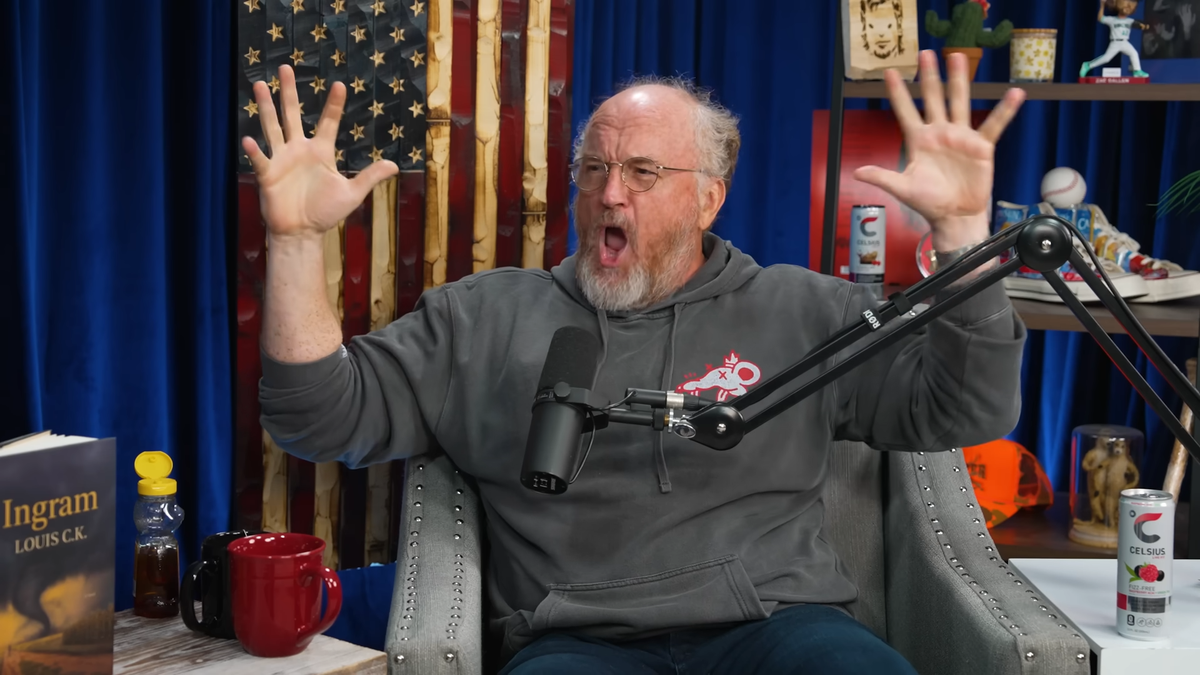
To be clear, Louis CK said all this in the context of promoting his novel Ingram. Elsewhere in the conversation he told Von that he’s already finished his second novel. He just last month completed a tour of Europe and Asia, he headlined the Riyadh Comedy Festival last year, and evidently he found the time to shoot a special for Netflix. In other words, this is an incredibly driven, productive man, a wealthy man, and undoubtedly a powerful man who is still highly regarded by pretty much all of the most famous comedians working today. His wealth is relevant insofar as it means there is much he could do to make amends for his abuses, from simple restitution to investing in systemic fixes; his power is relevant because it means there are many people who take seriously what he has to say. It is just so very strange, then, that Louis CK has yet to manage the apology he’d so dearly love to give.
Dave Becky Cannot Get a Pass
Paste Magazine is your source for the best music, movies, TV, comedy, videogames, books, comics, craft beer, politics and more. Discover your favorite albums and films.
 Seth Simons
But we shouldn’t take him at his word. His word doesn’t add up. He writes that he heard of the Goodman/Wolov story “third-hand,” and that he “misperceived” his source’s “casual way” of portraying the story. The Times reports that Lee Kernis, one of Goodman and Wolov’s managers in 2002, told Becky directly—that is, secondhand—that C.K. had acted in an offensive manner. It’s unclear how a casual portrayal might distract from the literal characterization of his conduct. Later in Becky’s statement, he says he never heard of the other incidents because he was in a bubble of power: “I have come to realize my status wielded an atmosphere where such news did not reach me, or worse yet, that it seemed such news did not matter to me.” This beggars belief. He already admitted that such news reached him. He even admitted, erroneously or not, that it reached him from someone with no direct knowledge of the incident. If that story reached him, then it’s hardly a stretch to believe others might have. This is an assumption, true, but it’s a safe assumption, just as it’s a safe assumption that C.K. has harassed or assaulted more people than have yet been reported.
The System Is People
NYC clubs are reopening, Chris D’Elia gets sued, and no one ever asks Amy Poehler about her manager.
 Seth Simons
Here's the deeper reason Poehler will never part with Dave Becky: she owes her entire career to him. As she writes in her memoir Yes Please, Becky was Matt Besser’s manager in the mid-90s when he visited Chicago to check out Besser’s improv group, the Upright Citizens Brigade. He signed the whole team and put them in front of Comedy Central, who bought their sketch series in 1998. At the time they were performing improv out of a dance studio. Thanks to the increased attention their TV show brought them (“The show fed the theater and the theater fed the show,” Poehler writes), they soon had to move into their own space. The rest, unfortunately, is history.
This is not to suggest UCB would never have risen to prominence without Becky, or that Becky would not have his current power without Poehler and UCB. It’s just a small, crystalline example of what I mean when I say the system protects itself, the system is made of individuals, and there’s not all that many of them. A few people could force some big changes. It’s to everyone’s loss that they don’t.
“You have to accept that Ireland is gonna become Pakistan or you gotta deport a whole bunch of people.”
A few tidbits about Louis CK, Marcello Hernández, and Dave Smith.
 Seth Simons
My first response to this is: who’s “we”? I don’t remember anyone deciding any of that, and I also don’t see why it would be the general public’s prerogative to “figure out a comeback process” for outed sex predators. My second response is: why would you expect an outed sex predator to offer a great work channeling the worst things they’ve ever done into the finest content they’ve ever made? Has any outed sex predator ever done that? I can't think of any obvious precedent, but by all means correct me if I'm forgetting something.
My third response is: that’s exactly what Louis CK did before he was outed as a sex predator. He spent the 2010s channeling his overwhelming guilt and shame into a beloved FX series and multiple award-winning standup specials. When the New York Times piece came out in 2017, he was one week away from the release of I Love You, Daddy, more or less a tribute to Woody Allen that arose out of a prior, failed collaboration between the two. What the exposé revealed is that Louis CK’s great skill was turning his abuses into art; what it forced us to ask is whether the art was worth the abuse.
Louis CK, Moron
Also: Theo Von and Nimesh Patel, Morons.
 Seth Simons
Note that he’s sticking by the story he used in his initial statement and comeback special: that he obtained consent to masturbate in front of some of the women he masturbated in front of. (Not all of them, however, and he never seems to mention the yet-unidentified woman he revealed in a 2015 apology to Rebecca Corry, confusing her with someone he shoved in a bathroom.) To my eye, this continued obfuscation of the nature of consent—those weren’t “edge” cases, they were straightforward abuses of power—raise questions about his sincerity in accounting for his actions. So does his strange insistence that he cannot apologize for what he did.
Louis CK’s New Special Is Amazing, Say Louis CK’s Friends
Everything’s back to normal.
 Seth Simons
The Louis CK exposé came out four years ago next week. He released his comeback special 19 months ago. He's preparing to release another one soon. He's currently on a nationwide tour that next year will become a worldwide tour. The guy's fine, he's rich, he's popular, he's working, my friend saw him walking his dog in Greenpoint, all the fuss was for nothing. What can we learn from this? Not much—just that comedy is the same industry it was before the entire world discovered one of its most beloved comedians was an abuser and a fraud.
That Louis CK may never work in television again (and I suspect he probably will) doesn't matter to the vast majority of comedians, who will never work in TV either. Most comedians work in live comedy venues, and live comedy venues are all in on sexual harassment. Any sort of meaningful transformation there would require star comics, people in positions of comfort and security, to make loud, sustained demands of comedy's ownership class, who as I've said before are highly responsive to public shaming. In the absence of change, the onus remains on comedians who don't want to get abused to steer clear of spaces that cater to abusers.
Comedy Is a Safe Space for Abuse
Some thoughts about what’s happening.
 Seth Simons
Four years ago Louis CK confessed to a series of sexual abuses one cannot refer to as assaults without incurring the indignity of comedy workers and fans eager to proclaim that CK asked his targets, one of whom said he mistakenly apologized to her for an act of physical violence he must have committed on someone else, for consent, which several of them gave. Louis CK’s only crime, his defenders will tell you, was misunderstanding the way consent, a frequent subject of his artistic output, functions when one party is more powerful than the other. CK also admitted that his manager, 3 Arts partner Dave Becky, took unspecified steps to keep these women quiet. Becky did not deny this, but insisted he merely asked discretion of women with whom he naively believed CK had a consensual affair. CK declared he would take some time to listen and reflect, returning to the stage a year later to mock trans children and another year later to remind everyone his victims said "yes." He toured before the pandemic and performed regularly during it, appearing with comedy veterans like Dave Chappelle, Michelle Wolf, Joe List, Adrienne Iappalucci, Keith Robinson, and Sean Donnelly. He’s launching another world tour next week, his first stop at Madison Square Garden. CK has never apologized to the women he assaulted; the systems he worked within have not changed; Dave Becky represents Kevin Hart, Bill Burr, Amy Poehler, Issa Rae, Natasha Lyonne, Maya Rudolph, and Hannibal Buress; neither party has ever accounted for the years spent lying about rumors that somehow kept resurfacing. The common wisdom among CK’s contemporaries from the Cellar to the Store is that he was unfairly maligned, he suffered immensely, and he possesses a genius too great to be kept from the audiences hungry for his return. The backlash lost; the backlash to the backlash won. The moral of the story? Comedy is a safe space for abuse.
Did Cancel Culture Go Too Far?
On Jerry Seinfeld, and others.
 Seth Simons
It occurred recently that I have been wrong, in this newsletter and in podcasts and casual conversations, to described quote-unquote cancel culture as over. I don’t think that’s true. Looking back over the last five years or so, it seems more like the left, whether out of exhaustion or embarrassment or both, abandoned its use of mass social censure as a means of ostracizing abusers and other bad actors from the workplace and public square. The right, meanwhile, co-opted this mechanism and industrialized it into the neo-McCarthyism that dominates our current discourse.
Chris Rufo, Libs of TikTok’s Chaya Raichik, Bari Weiss, anti-trans crusaders Dave Chappelle and JK Rowling, the billionaires pressuring New York City Mayor Eric Adams to crack down on students protestors, the NYPD officials using their public platforms to rant about communists infiltrating college campuses: all of these people are doing cancel culture. The difference is that instead of using social opprobrium as a last-ditch means of compensating for structural failures to combat abuse and inequality, the right is using it to reify those structural failures, often by explicitly targeting the victims of abuse and inequality. More frighteningly, it does this with the support of deep-pocketed institutions and the eager collaboration of lawmakers. Whereas the goal of what you might messily call left cancel culture was the expulsion of bigots and abusers from the workplace—and eventually the creation of safer and more equitable social structures—the goals of right cancel culture include defunding public education, eliminating trans people from public life, criminalizing pro-Palestinian speech, diluting the power of Black voters, and eroding the autonomy of women.
What Goes Up
On Chappelle.
 Seth Simons
I will give you an example. In conversations about Louis CK with his allies in comedy, of which he has many, and with his fans, of which he has many more, one consistently hears that Louis CK also suffered from the revelations that he forced women to watch him masturbate. When one asks what this could possibly mean, the answer always comes: Louis CK lost millions of dollars when his projects and deals were canceled. The exact numbers vary, but a popular one is $35 million, the figure Louis CK himself offered in a 2018 set at the West Side Comedy Club in Manhattan. Presumably most or all of that $35 million was future income, but for the sake of argument let's say it was all in his bank account on November 9th, 2017.
In what sense does one suffer from the loss of $35 million? I suppose it must be that once you lose $35 million, you can no longer spend $35 million. But there is nothing essential in this world that only $35 million can buy; the sort of things one would spend millions of dollars on are by definition luxuries. I do not have $35 million. You do not have $35 million. Are we suffering? Louis CK's defenders would not say we are—at least, not on that account alone. If they believe every human being is entitled to be a multimillionaire, there would be nothing unique about Louis CK's suffering and no time to dwell on it. No, it's the loss that does so much harm, even if no person needs what the loss takes away.
“I don’t know what to make of it.”
When thinkers refuse to think.
 Seth Simons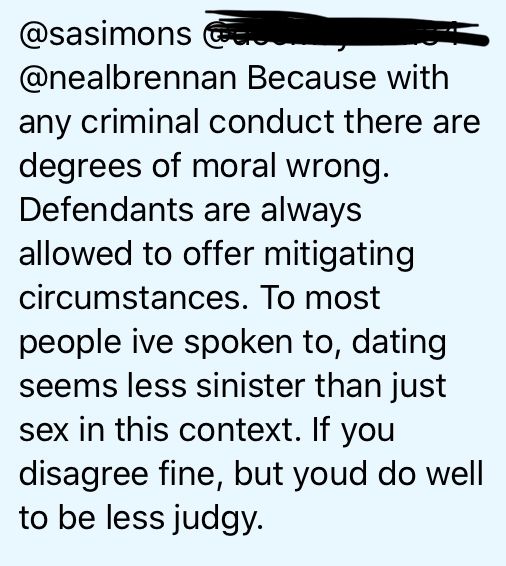
The maneuver is to ask for a consensus to form before the comic himself renders judgment. (See: Brennan and Sia harping on the Ross story’s failure to “get heat.”) Often this happens in the same breath that he decries the mob rushing to condemn his peer, who hasn’t been convicted of anything. Another common tactic is to cite the law (burdens of proof, various states’ ages of consent, differing definitions of “assault”) and speculate as to what sentence a court would levy, rather than consider what standards should exist in the comic’s own community, where the comic has power to enforce them. This is a feature especially in conversation about Louis CK: I cannot count the number of times I’ve been asked some form of, “Well, what do you think he did that was so wrong? What should the punishment be for what he maybe did all those many years ago, which no one even accused him of at the time?” It’s all an excuse not to ask the easiest questions in the world: “What do I think? What can I do?”
“It’s not fun for people to hate you.”
On Showtime’s new documentary about the Comedy Store.
 Seth Simons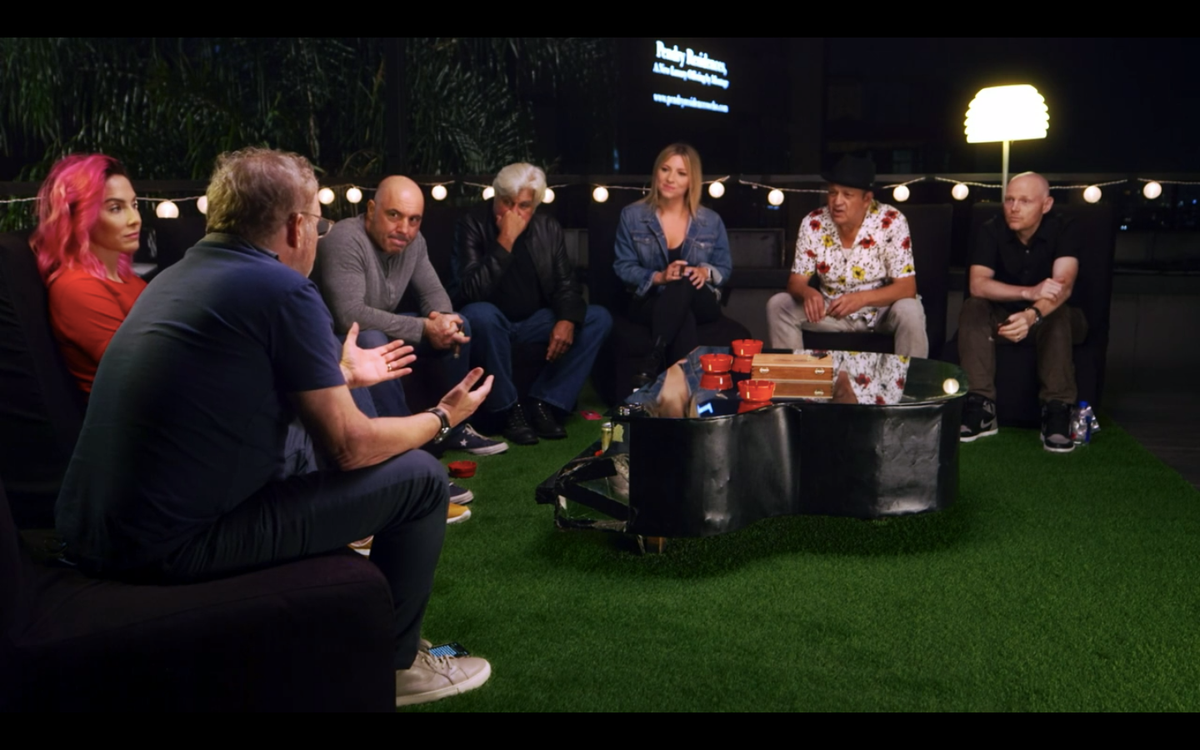
“How long do you punish somebody?” asks Binder, acknowledging later that “people” didn’t want him to interview Louis CK for the series. With Cummings’ approval, he did, conveniently omitting from the final product any mention of the reason for CK’s fall from grace. “You’ve gone through such a tough period in your life,” he tells the confessed sexual abuser during their sit-down. “I don’t mean to be Pollyanna about it, but I think it’s just going to make you such a better comic.” In response, CK recalls the owner of a chess shop telling him he’s a great martyr who must be crucified and destroyed before coming back to life. “I’d really rather fucking live my life,” he says. “But my philosophy with comedy has always been, when somebody says ‘That’s too terrible to joke about,’ that’s like saying that that disease is too terrible to cure.”
The Future
Notes toward a local theory of comedy.
 Seth Simons
Once, several years ago, when Donald Trump was president and the novel coronavirus was locked safely away in a government lab [Ed. note: JOKE!], I found myself chatting with a regular at a popular comedy venue. She was a producer as well as a performer—who isn’t, these days—and part of a tight-knit social scene that included the venue’s management, which I mention because I believe her opinions were decently reflective of the house’s. As tends to happen in these situations, we ended up arguing about Louis CK, who was still early in his return to the circuit and whose comeback, I said, merited more resistance than it was receiving, given all he confessed and all he refused to atone for. In response, this person gestured broadly around the packed venue. “Statistically, there are people here who have done much worse than Louie,” she said, more or less. “And you’re saying we should ban him?”
Present Dangers
A few thoughts about the Russell Brand story.
 Seth Simons
Neither sexual violence nor misogyny are exclusively right-wing problems, of course. The point Brand illustrates is that in our current media ecosystem, one side more reliably forgives and therefore enables abusers. This is the side that currently runs the comedy industry, as is plainly evident in the fact that nobody of any stature ever talks about it. After all the caterwauling and garment-rending about how cancel culture and MeToo would have a chilling effect on the art form, we can see now that the actual chilling effect was the one wielded by the people making this warning. Louis CK confessed to serial sexual assault six years ago. Today, nobody at his level of the industry has a word to say about his presence in their workplaces, despite the fact that he accidentally apologized to one of his victims for an act he committed on another person, someone he and everyone else have conveniently forgotten. The same is true of Chris D’Elia, who has continued touring nationally even after Rolling Stone reported this past May on allegations that he kept abusing women in the aftermath of his exposure in 2020. Each of these men is a menace, and not a single one of their peers seems to give a shit.
Window Shifts
On the success of the Austin project.
 Seth Simons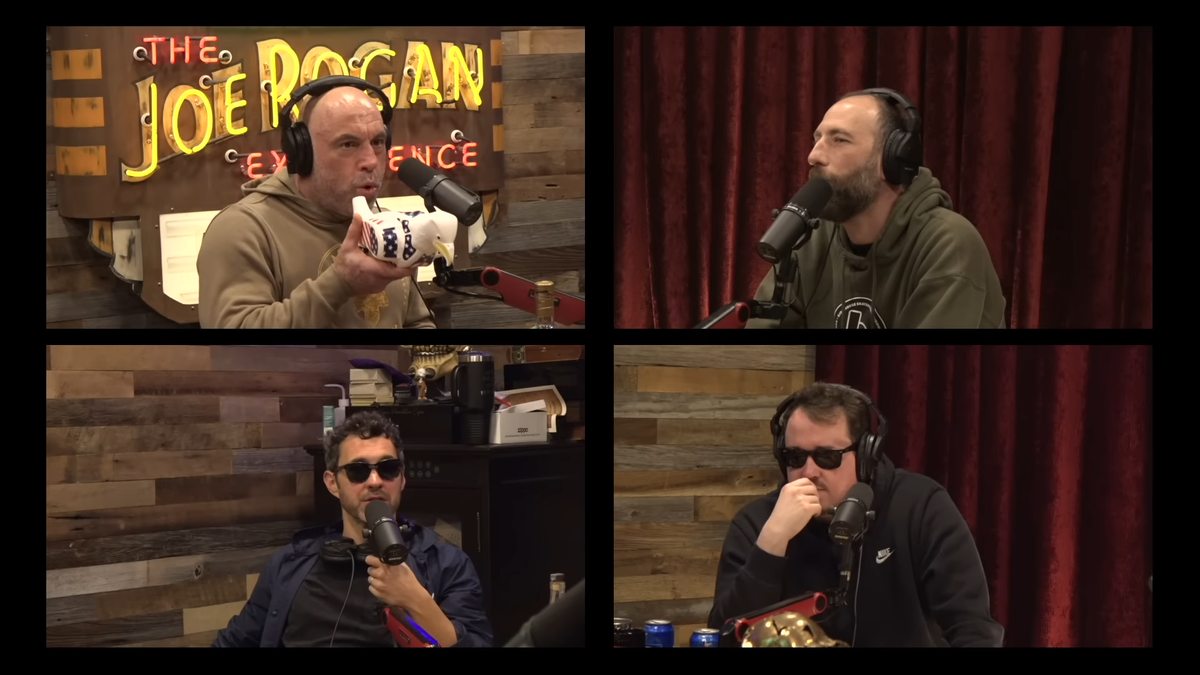
What interests me about this passage is how it speaks to the success of what I’ll call the Austin project. To recap, Rogan moved to Texas in 2020 to take advantage of its lax health restrictions and create what he explicitly described as a utopia for anti-woke comedians: “guys who are just bucking the system during Covid, during the pandemic, during the woke culture.” He was quickly followed by comics like Tim Dillon, Tom Segura, Tony Hinchcliffe, and more recently Shane Gillis. He opened his own club, Comedy Mothership, which consistently produces sold-out shows with these comics and others in their cohort. Every day we see more and more evidence of this movement’s success, both locally and in the broader comedy industry: Gillis hosting SNL; Rogan inking a $250 million new deal with Spotify; Louis CK's return, largely facilitated through appearances on the anti-woke podcast circuit (including Gillis's, Rogan's, and Segura's); Howie Mandel, the human embodiment of comedy’s capitalist class, heralding these guys as non-conformists and pure artists; and pretty much everything else I've written about in this newsletter over the last few years.
How Covid Changed Comedy
A grand unifying theory of comedy’s rightward acceleration.
 Seth Simons
In the Bloomberg feature, Austin comedian Arielle Isaac Norman described one side-effect of the migration of Rogan acolytes: the proliferation of “borderline unwatchable” open mic nights dominated by reactionary comedians. “It can be really awful to listen to men making disgusting rape-apology jokes, that kind of stuff, saying bigoted things, talking disgustingly about women,” said Norman, whose success at Rogan’s club has led to such opportunities as opening for Louis CK and Tim Dillon. “I’m not one of those people who is easily offended. But it needs to be funny.”