John Reynolds on His New Movie, Chicago Improv, and Being Silly
The Search Party star discusses his new movie, "Never Change!"
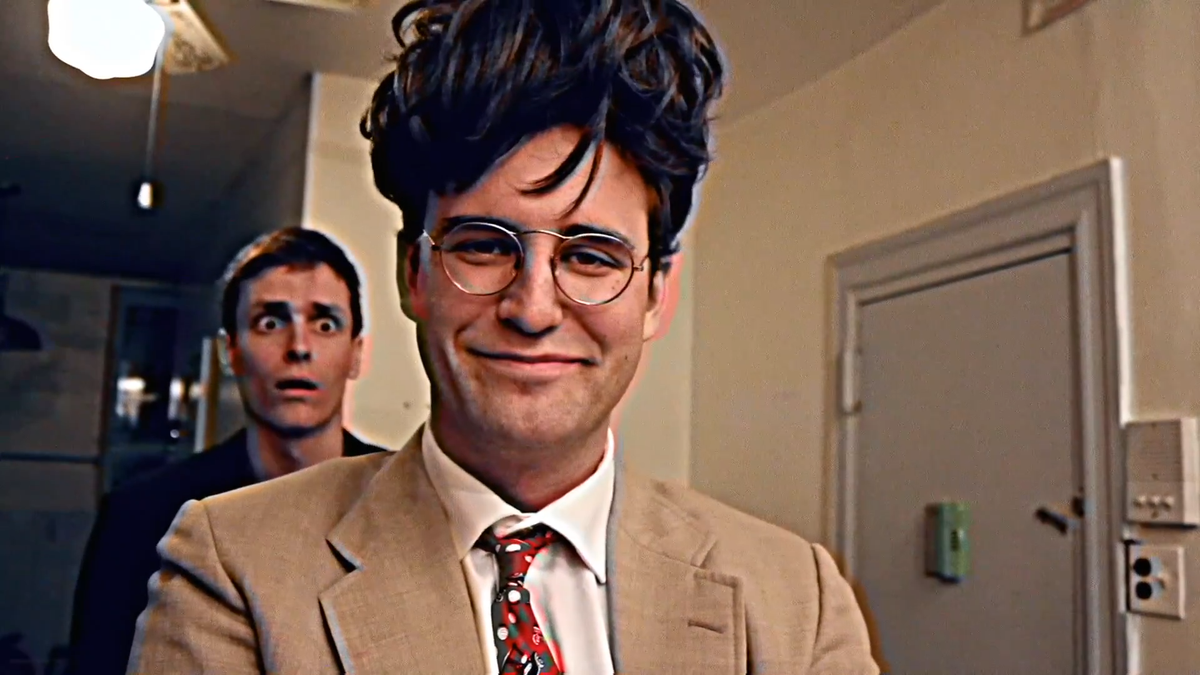
I’ve been a huge fan of the comedian, actor, and writer John Reynolds (Search Party, Stranger Things) ever since I saw his play Sadie Hawkins Day at UCB ten years ago. Written and performed with Matt Barats, another perennial Humorism favorite, the play was a riff on high school comedies, following a teacher (Reynolds) desperately in love with his student (Barats), a star basketball player with the power to turn into a giant lizard. It was silly and sweet, raucously funny and still touchingly earnest—words that also describe Reynolds’ first venture as a screenwriter, Never Change!, now streaming on Hulu.
Directed by Marty Schousboe (Joe Pera Talks With You), Never Change! is more than a riff on the high school comedy. It’s a worthy new entry in the canon, with a cast of young comedy luminaries—Reynolds, Barats, Jo Firestone, Carmen Christopher, Gary Richardson, Nick Mestad, Patti Harrison, Ana Fabrega—who bring a blend of emotional realism and cartoonish irreverence that’s perfectly suited for the genre. Starring Reynolds as the erstwhile jock Sunny Football, the film revolves around a class of high school graduates in their 30s who are forced to go back and finish their senior year due to a legal technicality. Hijinks ensue, rivalries reignite, and old flames rekindle—in particular Sunny’s with his old love interest Katie, played by Sofia Black-D’Elia (Skins, Your Honor).
The film, in other words, hit my sweet spot, and I was excited to chat with Reynolds about it last week. We discussed the project’s evolution from TV series to movie, coming up in the Chicago improv scene, how the comedy business has changed since Covid, and more. Check out Never Change! on Hulu and enjoy our conversation below.
Can you tell me a bit about how the project came together?
Marty and I have known each other for a long time. We did all our original film sketches together in Chicago, probably 15 years ago at this point, and a lot of them included Carmen and Gary. We met up to work on a different script, and then we spent hours talking about Can’t Hardly Wait—how it’s a time capsule, how funny it is, the big ensemble nature of it. We were sad because we were too old to make a movie like that, so we started thinking… well, how could we make something like that? We started spitballing and joking about it, and originally we thought it would be great as a television show, because that way we could incorporate all the tropes and characters and create this huge world. And we hadn’t really seen that done at the TV level before.
So that was the impetus. We developed it as a television show with Jon Watts, Jason Woliner, and Nick Hatton, wrote a pilot, and pitched it to Hulu. They said, “To be honest, with our mandate, we could never make this as a television show. But we could do it as a movie if you guys want to.” And we figured, well, somebody’s saying they’ll greenlight this if we do it as a movie—let’s definitely do it. So we started condensing this giant world we’d created back into an hour-and-a-half comedy, which was insane. But we did it, and it came out, and here we go.
What is it about high school as a milieu for comedy that appeals to you?
That canon is something we grew up on, and it’s truly underrated. It’s kind of like the rom-com, where it gets written off as childish or dumb, but it’s really good, really funny, and really inventive. Bill and Ted’s Excellent Adventure is a high school movie, but it’s bananas. Can’t Hardly Wait, Scream, The Faculty—these were super formative, inventive movies, and they’re a lot of fun to be in and play in.
And then there’s the ensemble nature of it. They’re all huge ensembles, which is so fun, because if you don’t relate to one character, here’s another one you relate to. They’re also sort of dying out—they’re really bizarre now, like Riverdale or Euphoria. But the old-school, sweet and funny ones are few and far between.
Do you also have a recurring dream where you have to go back to high school on some technicality? The movie was very triggering for me in that sense.
Most people have some version of it, but mine is that I haven't been to school the whole year, and I'm trying to find the library, and I get to the library and they're like, "You haven't been here the whole year." And they're like, "If you got 100 on everything now, you could get a C-minus." And I'm like, "Okay." And then I wake up stressed that I don't have a degree, but I do, and that's awesome.
That is awesome. What did you have to sacrifice on the journey from TV show to movie? What did you gain?
If you can believe it, there were more characters—a lot more. The main one is Claire, the chef in our movie; her mother worked at the school as a lunch lady, so they had a whole backstory, and we had some big set pieces with them that we were really excited to shoot. We didn’t get to do that. Sunny also had another love interest, and there was a really funny scene that got cut where I open the door and her son is standing there, and I think he’s my kid but I don’t understand it—we had sex 18 years ago and I can’t put it together. So that was a bummer. Just a lot more characters. The main sacrifice was the time to really give everyone their shine. Their 10-episode arcs got condensed into the movie format.
What we gained is something that’s tonally on its own wavelength completely. The pacing, the density, the high joke content, but also that sweetness and sincerity that’s in the movie from the jump—it’s created a completely bizarre tone, which I love, and hopefully that’s what’s memorable about it.
I really loved how it made a space for all these different types of comic sensibility. Jo Firestone is totally quiet and gentle, Carmen Christopher is so loud and boisterous, Matt Barats has this silliness that I don’t even know how to characterize, but it just hits my sweet spot.
That’s a strength of the movie, but I think it’s also confusing people. There are multiple comedic tones, and we think they all work together in harmony, but I don’t think people have really seen that before, so it throws them. Matt’s character, Nathan Min, and Nick Mestad—for lack of a better term, the nerds—are conceived as cartoons. Their inspiration was Wile E. Coyote. Anytime they even get close to Katie, we’re going to explode them or hit them in the nuts or electrocute them. That’s what we were trying to do, but then you also have this very grounded humor that Firestone plays throughout the movie. I think people are like, what the fuck is happening? But it’s all working together, and that’s the fun. These pockets of different tones are what’s special about it.
I saw one interview where you said you wrote Sunny aspirationally for yourself, giving him these easygoing traits that you feel you don’t have. Did you ever want to make yourself one of those broad, silly characters that I know you’re also very good at playing, or was it going to be the straight man from the start?
It was tough, because that was another part of writing it as a movie—we got a lot of notes that we needed that emotional arc and grounding, and it made sense that it came from me and Sophia. If it had been a show, there definitely would have been more runway for absurdity from me. But that’s also Sunny’s arc: when you meet him, my character is so stupid and unhinged, and then by the end I learn to care about somebody else. If you go back to Sunny’s first scene in group therapy, I’m talking about how I was selfish, and then at the end of the movie he does something selfless—he signs the papers, and learns. I thought it was a sweet arc for Sunny. But also, I just find it easier to write for my friends than for myself.
I also loved how the movie felt like a reunion for this set of people who were making comedy in Brooklyn 10, 15 years ago and have since gone all sorts of different ways in the industry—just about every type of comedy career is represented in the cast, except maybe the right-wing podcaster. I wonder how it’s been for you and the other comics you’re friends with, navigating the last 10 years or so of this industry evolving and contracting. There are so many fewer spaces and platforms for comedians than there used to be. What’s that been like on your end?
It’s crazy. Covid was an alternate universe, especially in the trajectory of comedy. This project was born out of wanting to have fun again and make a silly, sweet comedy, because comedy in general has really departed from that. And some people hate it—when you try to make a silly comedy, they’re like, “No, no, fuck you, you’ve alienated me completely.”
That’s crazy.
It’s crazy. I’m like, “This is supposed to be silly.” But the spaces have gotten smaller, there are fewer shows. Covid launched a bunch of people into podcasting, or into front-facing character videos. Then shows on television became dramedy-forward, these cynical pressure cookers. It’s been a bizarre time across the board. Everyone’s feeling that pinch, even when it looks like somebody’s having a lot of success. It’s still a gig economy out there—you’re just going job to job. Some people are thriving, which is awesome, and some people are at that point where they’re like, I’m not sure what I’m going to be doing.
Since you mentioned Covid, I’m always curious—what was that first year or so of the pandemic like for you? How did you get through it?
It was psycho. I was in New York, and I already have a lot of anxiety about health in general—it’s a place I put my anxiety, and I have it in droves—and on top of that, my wife’s brother was working in a lab in Chicago, testing for Covid.
Oh god.
NPR did an episode on the hospital in Fort Greene, and I remember vividly listening to it, because my apartment was less than a mile away. I was folding my clothes thinking, “They’re doing what in that hospital?” It was weird. And going back to work was really weird too. I had to go to Atlanta to shoot Stranger Things season four, and they had me do a two-week quarantine at a hotel there. So I’m quarantined in my room, and next door is a bachelorette party. I was like, there’s no way—you just can’t control it. And the South was on its own thing. Everything was so…
Free for all.
Free for all, everywhere. It was really bizarre. We shot a season of Search Party during Covid that got shut down. I had doctor friends who’d ask, “How often are you getting tested?” I’d say, “Daily. Every day they come and test me for Covid.” And they’d go, “That’s crazy.” I’m like, “You’re a doctor!” And from the comedy standpoint, it was like, what do you do? You can’t do live shows, so I guess we’ll try some internet comedy. But that’s not really my thing either, so I didn’t know what to do at that point.
Yeah, it was bizarre. And I feel like it was a huge turning point culturally, especially in comedy, that we don’t really talk about anymore.
In terms of comedy, some people did both really well—some comedians who are incredible at performing live are also really savvy online. But it also allowed the whole industry to get a little lazier. In the old days, pre-Covid, a manager or agent or exec would have to go to a show and see the live response, so you could tell who was the funniest person, or what the funniest show was. The internet changed all that, and now likes are the currency. People started doing their job from home, going, “Well, this person is really popular online, let’s give them a show,” or something like that.
And sometimes that translates beautifully. But on Instagram, I follow people who just eat and review Crumbl Cookies; I follow this guy in Michigan who reviews beer. I don’t want to see him in a television show—I want to see him review Natty Ice from his garage. That’s what I want to see him do.
Do you still do much live stuff?
During the writers’ strike I was doing a lot. Barats and I did some road gigs, and Carmen and I did some gigs too, including a week in London. I was hitting it hard then, and then I just hit a wall and thought, I don’t really know what I want to do with it. You’re familiar with me, but I do mostly sketch and character-based stuff, so if I’m going to create something, I’d want to do more with it—I don’t create an hour of comedy just to shoot a special. So I was guesting on friends’ shows, doing 10 minutes here and there, and I was like, I don’t really know what I’m doing with this right now. I just wanted to focus my energy elsewhere.
Do you still feel like a Chicago improv boy at heart, or do you think of yourself more as an actor now?
It’s tough. I definitely had imposter syndrome as an actor for a long time, but I feel like I’m over that. The Chicago comedy scene feels like high school in a lot of ways—you’re only in high school for four years, but for some reason those years are so profound and formative. It’s the same thing. I haven’t been in Chicago for 12 years, and I’ve been much more of a New York comedy boy, but because there was such a tight-knit group of us who came from Chicago at the same time, we always get lumped in. People are like, “You guys are the Chicago boys, right?” “Yeah, we were there for five years, been here for 12.”
At heart I’ll always have a fond memory of that time, and those people are still the funniest people. In Chicago, you’re given a lot of space to suck, and that’s really the main difference. By the time we came to New York, we already had five years of sucking behind us—we were already good. When you start out in New York or LA, people see you be bad initially, and then you have to prove you’re good. But nobody was coming to Chicago when we were there. If a Comedy Central executive came by, the whole town was like, “Oh my God!” Then we moved to New York and I was like, “So they’re just here every week at the show?” “Yeah, and they want to hang out.” And I’m like, “What?”
I do hear from people who come up in the smaller markets that there’s a freedom to that too, when there isn’t so much pressure to get noticed by the industry.
Yeah, 100%. I did shows in Chicago in sandwich shops, abandoned basements, people’s garages. There was a place I used to perform a lot, an attic called The Shithole. Just crazy places.
Shifting back to the movie—can you talk a bit about what makes Marty such a great director?
Something really special about Marty is that he has very specific, great alternative comedy sensibilities, and he’s a very empathetic, disarming guy. But he also doesn’t try to be cool, so his work isn’t trying to be anything it’s not. And he has an even greater love for Movies with a capital M than I do, and I have a huge love for them. A lot of comedy people want to be cool, they want to make something cool, and Marty doesn’t really have that. He just wants to make things he loves. He’s got a niche and a broad sensibility going at the same time.
Do you feel that pressure to be cool?
Naturally there’s always pressure to be cool, but in the stuff I make, no—I just want to make the stuff I like. And then I really want it to be liked, to be honest. The movie is polarizing in a way I really did not expect. I kind of thought, at worst, people would be like, “I don’t know—silly cute movie, whatever.” But it’s been very polarizing. For some people, this is their thing, they’re like, “This is the funniest movie ever,” and other people are literally like, “Fuck you, I’m so pissed.” And I’m like, “How?”
I’m dismayed to hear that!
I think it comes down to being misunderstood. With my comedy, and the comedy my friends and I have made, people always assume it’s an alternative sensibility or something, but we’re truly just trying to make something silly and fun. So more than wanting to be cool, I want that feeling of being understood. That’s obviously never going to happen, but some people do get it, and that’s really cool.
I thought the Maria Thayer character was so funny, just at the outset asking, “Can I fuck the students?” I guess I can see how people might respond negatively to that, but I loved it.
The turnaround on this movie was insane. The post-schedule was so short, we finished shooting November 1st, and the movie is out now. The thing I was trying to get ahead of, but didn’t have time for, was the framing of the movie. On the surface it’s a stupid movie, but the stupidity is crafted, and there are levels of irony to all of it. If you take it at face value, I can see a certain reaction, but if you actually look at it, you see a deeper movie. There just wasn’t time to frame it that way. It’s hard to make a movie this silly—it takes a lot of really smart people to do it.
And there are so few silly movies anymore. There’s Napa Boys, and… I don’t even know what else this year.
A lot of people are likening this movie to Wet Hot American Summer, which I understand—East Coast comedy people make an ensemble movie playing within the world of tropes. I’m like, oh, of course. But this movie is also very sincere and earnest, and I think that’s the tonal thing people are missing, or bumping on. Wet Hot is more self-aware and winking and sketch-oriented; this movie isn’t those things, even though it has a lot of goofy gags. So I get the comparison, but it’s funny to see people lumping it into the context of what they already know—and I think that’s because there are so few of these movies out there.
And the silly TV shows, as you said, are also all so serious.
In general, in the cool comedy, cynicism has replaced jokes. And sometimes it’s so funny—I’m not saying it’s bad. But I just miss some dumbass stuff.