Dave Smith Says White People Come First
They take supremacy, if you will.
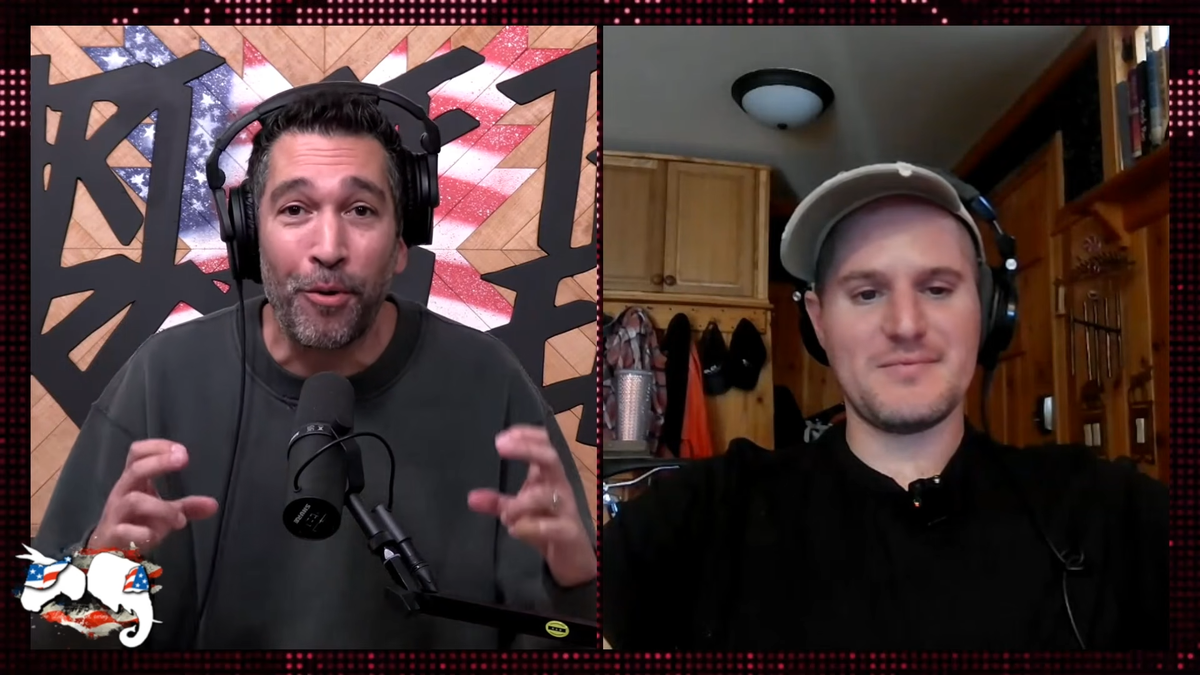
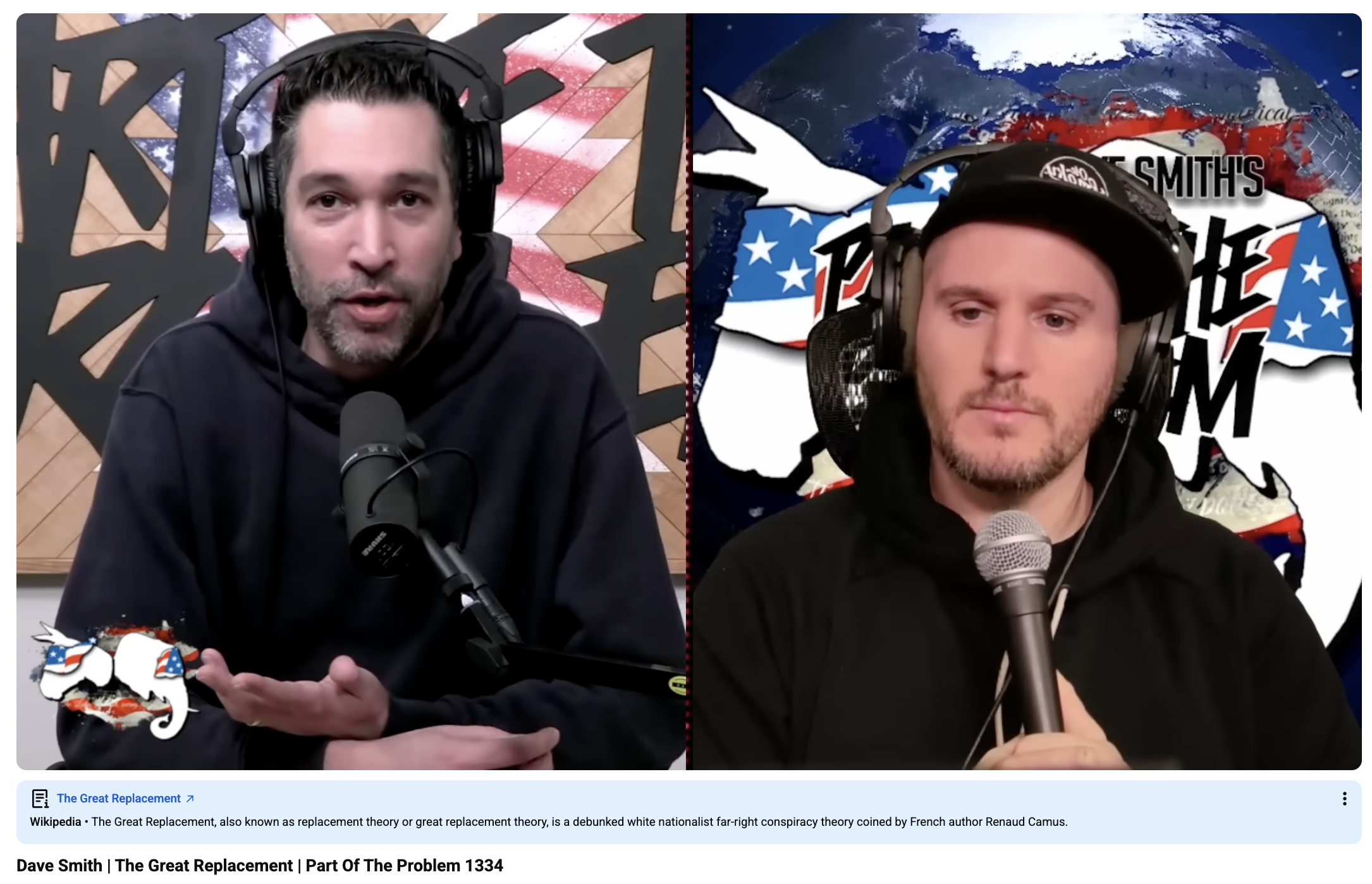
In an episode of his podcast Part of the Problem released this week, the white nationalist and comedian Dave Smith got hot and bothered over a New York Times interview in which Abdul El-Sayed, Michigan’s Democratic Senate candidate, told Ezra Klein that America has no ethnic or religious identity, only a national identity. This anodyne expression of patriotism was so upsetting for Smith that he launched into one of his odious racist rants about how white people, specifically Christian white people, were here first, and immigrants need to be grateful. Here is the section of the Times interview that sets him off:
Klein: We’re actually in this moment, of course, where there are so many fights over what it means to be American and such an effort to renegotiate the question of what it means to be an American. So I’m curious what it means to you.
El-Sayed: This is a country where there is no ethnic identity, there’s no religious identity, there is just a national identity.
And here is what Smith had to say about that to his cohost Robbie Bernstein:
Smith: Can you just pause it already. Just pause it already, dude. Listen again, do you not get my point? Look, let's just say hypothetically, this country really falls apart. Things get so bad here that I feel like I gotta grab my family and flee and I'm able to get a few things together and Japan is willing to take me. And I go into Japan and then Japan lets me in. And then I literally, they give me citizenship. They allow me and my family to live there. I thrive there. I'm doing really well. My family is doing really well. And then I turn around and I go, “All right, I'm running for office. And let me tell you first of all about Japan. And let me tell you something. The best thing about Japan, just say the absolute best thing about Japan is that they let me in. That's the best thing. Best thing is their openness to other people coming in. There's no such thing as really even being Japan[ese]. There's no identity, there's no culture, there's no anything. The best thing about them is that I could come here and be just as Japanese as anybody else.”
Dude, do you not see where the optics of the—even if you think this is correct on principle, do you not go, man, I am coming over to a dinner party and just farting in the dining room right now? Is there no sense in which you're like, this is just like, ugh. I mean, look, dude, now, he's gonna get into a point about why he's really arguing that America, he's actually arguing here that there's no other identity to American, to being American, other than the national identity. There is nothing else to it. And again, let's go to his argument here, but that to me is—I don't know, that's a wild thing to say to a nation as a very new arrival.
El-Sayed, of course, is not a “new arrival.” He was born in the Detroit suburbs to parents who immigrated from Egypt. The argument would be just as racist if he were a “new arrival,” but it’s characteristic of Smith not to let facts cloud his feelings; elsewhere in the episode he describes El-Sayed as a DSA member, which isn’t the case either.
From here Smith gets into a discussion of “heritage Americans,” which he describes as “descendant[s] of Thomas Jefferson or George Washington or something—the white ones.” (Huh.) Such people, he argues, would love America for its “founding tradition and the people and the liberties that are enshrined in the Bill of Rights,” all of which he says constitute American culture. (Along the way, he learns that Bernstein is a “fourth- or fifth-generation” American and jokes that this gives him seniority: “I didn't realize you go back further than me.”) Never one to notice that he’s making the argument he’s arguing against, he goes on to contrast this with what he perceives as the reason immigrants love America:
Smith: You can't say we have nothing. There's a culture here. Okay, for that person who was the heritage American, goes all the way back, you could see where they're more likely for that to be the story of America. Whereas Abdul El-Sayed, his story is more like, "What's so awesome about America? That they let everybody in." And I'm not saying that's not understandable, 'cause for his family, that's what's awesome about the country. That they let everybody in and they have welfare and they have affirmative action and they make sure that it's really easy for the brown guy with a weird name to race right up to the top of the line and cut through all these white people who have been here for all these years. Of course you like that about the country, and of course they like that about the country. It's like your interests are just diametrically opposed in some ways. The question becomes, who should get their way? And I say it's the people who are here. I don't know. This is not crazy. This is common sense. It's obvious once you let your mind just entertain this opinion.
Bernstein: Also, isn't the history of letting people in almost suckers that we were putting to work?
Smith: Usually.
Bernstein: Like, yeah, go ahead. Go make your way out west. Enjoy. Show up to New York. We'll shove you in a factory.
Smith: Well, however you want to—I think you might be a little bit unfairly characterizing that as manipulative or making them suckers. I mean, the fact is that right at the very beginning of, I don't know, Rob, around the time of the Louisiana Purchase or something like that, we need more people. We got this whole big frontier. We got to go explore this whole big frontier. Around the time of the industrial revolution, we have these huge factories and we need jobs. We need more people for these jobs. Yes, there was a time where for other circumstantial situational reasons, it made sense for major influxes of people. That is different than living in a gigantic welfare state following the Joe Biden years. It's just a different situation. But anyway, but just back to the idea that there is no American identity, I don't know, man. Particularly, I think that people more the liberal or left half of America, I don't think fully recognize how much the American identity means to the whole right half of America. They actually believe there is an American identity and they care very much about that.
Let’s underscore what he just said there: brown people immigrated to America and cut the line ahead of all the white people who were here first, whose interests therefore take priority. Wow, that’s racist!
Smith goes on to insist that America is not just its founding principles but also what he considers its founding identity, making the case thusly:
Smith: This almost seems to be the claim: that if you just went to Haiti and gave them the Declaration of Independence and the Constitution, they're America now. There is no difference. You know what I'm saying? Obviously, no, there would be different—that would be a different country. It wouldn't be exactly the same.
And I gotta say this, I know we’re a bunch of Jews, but to say there's no religious identity when the country has been ninety-plus-percent Christian for its entire history, that does not make any sense at all, dude. You can't say that. That is entirely, like—listen, if you want to say this hasn't been like a Christian nation through the legislative process or something like that, or that the government is secular, okay. But to say that there's absolutely no Christian identity to America, or that there's no—by the way, not white—white and Black identity to America. Like, you’re just telling me if you saw an NBA game between Larry Bird and Magic Johnson and whoever, and then I showed you a court of a bunch of Japanese people—"It's all basketball. It's all America." There's no difference here? I'm sorry, no.
I will spare you his rambling about White Men Can’t Jump and a tortured hypothetical asking, “If we imported a billion Chinese, are we still America?” (“No.”) Suffice it to say he’s wrong on the facts again: America has not been 90% Christian for its entire history, and it certainly wasn’t 90% Christian at its founding, when one-fifth of the population was enslaved. As a longtime Smith watcher, I must also make note of his preoccupation with Christianity, to which he is strangely deferential given his own identity as a Jew. A few months ago he complained that government programs destroyed the Christian institutions that, according to JD Vance, served as guardrails on laissez-faire economics. Before that, in an episode criticizing left reactions to the murder of Charlie Kirk, he praised Kirk as a “goddamn peaceful Christian,” with Bernstein agreeing that it was reprehensible to be “pro-violence against someone against someone who is using words to bring people towards Christian and conservatism.” Some time before that, he argued on Twitter that his fellow libertarians ought to believe in God:
When you don't have God, whatever your highest value is becomes your God.
If you are an atheist who doesn’t have kids, that God tends to be yourself or your conception of yourself. Your identity.
This is a particular problem for libertarians who are atheists, childless or unmarried.
Libertarianism often becomes their God, and their identity as a libertarian becomes their religion, when it was only ever supposed to be your legal theory. And because they are trying to make it something much bigger than what it was supposed to be, they end up getting the theory wrong.
This is why goofy woke libertarians will say things like “being trans doesn’t violate the nap [non-aggression principle], so why do you care” when libertarianism has nothing to say about caring. All libertarianism tells us is that I can’t beat a trans person over the head with a club or support the government doing it. It doesn’t tell me that I have to pretend a dude in a dress is a woman.
This is also why some libertarians recoil at hypotheticals, or real world situations where there aren’t perfect libertarian solutions currently available.
I guess my point is that you should be a libertarian and it’s fine if that’s a part of your identity, but there should be things you value way above it. God, family, friends, community, being a decent person, should all be more important to you than your legal theory.
He then made an explicitly Christian case for them to do so:
Think about it like this:
Often times atheists will say something like, “if God exists why are there wars and genocides?”
The Christian response is that God gave man free will. And the reason why that is such a good counter is because without free will, there is no such thing as good. If God programmed all of us to only do good and we had no choice then we wouldn’t actually be doing good. We would just be doing what we are programmed to do. If I hold a gun to your head and force you to help an old lady across the street, can you be said to have done a nice thing? No! You had no choice.
It’s not that liberty is the highest good. It’s that good is not possible without liberty. It’s a prerequisite.
I couldn't tell you what to make of it all. I just think it’s a bit notable that a non-Christian white nationalist should invoke Christianity and Christian rhetoric in so much of his political messaging. It raises the eyebrow. It makes you wonder. Has anyone done that before? Is there any historical precedent for it? Hmm.
Anyway. Soon after the above, Smith plays a clip of El-Sayed saying this:
El-Sayed: And so America, to me, is the notion that we can come together around our differences to build something that's greater than the sum of its parts, because we believe in the process by which we do that thing. It's funny, my dad, I don't think he's been to Egypt in 20 years and he still has an accent. He still looks the way he looks. And you watch him watch the Lions on Sunday and you're like, "That's a full-blooded American."
Below is Smith’s response. The “guy in Britain” bit is in reference to a story El-Sayed tells about meeting “third-generation Pakistani kids” in grad school, who insisted they weren’t British; they were Pakistani:
Smith: I mean, look, man, I don't know what to say, Rob. I just find that, I think that shit is really—I think that's wrong. I think there's something wrong about him saying that and having this attitude. It is so self-serving and awfully convenient to look around to America, to this country of America. I'm sorry, I was born here and I love it here. And to say that somebody born in Egypt with a thick Egyptian accent, there is no difference between that and America—and well, that's kind of convenient when that's your dad.
But no, Rob, I do think to most people in America, we would say that—I don't know if we would say it exactly like that guy in Britain told them, “You could never be an American because you're from there.” But no, is that as American as apple pie? No. We have a saying, that's a thing said—“as American as apple pie.” We don't say “as American as a guy with a thick Egyptian accent watching the Lions game.” That hasn't been a popular slogan here. And I don't know. I just don't think that's right. I don't think that should be the attitude. Also, Rob, everybody around Abdul El-Sayed brags about how well spoken he is. They brag about the fact that he doesn't speak with an accent. Isn't there something a little strange about all this?
"Real people made the country.… How about a little bit of gratitude rather than saying they never existed?
Bernstein: Pick a lane, people. Either accents make you less American or not.
Smith: Well, look, I mean, I just think it'd be one thing—this is just my position. I think somebody like Abdul El-Sayed, I'm not even saying he can't run for anything or he can't—I'm just saying, wouldn't it be more appropriate, when asked about this, for him to say that even if he were—at least recognize the self-interest in that, where he goes like, “Well, look, obviously one of my favorite things about America is that they were willing to take my family in and that my father who's got a thick accent can still watch the Lions game and still gets treated great in this country and doesn't face discrimination under the law, doesn't face prejudice, isn't mistreated. People like us have been totally incorporated into America, and we love that and we're really grateful to the people who made up this country for that.” Why is that crazy to say?
Real people made the country. You can pretend that it was just a notion or it was just an idea. Nope, it was people who lived and breathed with organs and thoughts and dreams and goals. They were made of matter and particles. They were real. They existed. They built the country that's here for you and your dad to come here. How about a little bit of gratitude rather than saying they never existed? “They were just a notion. And in fact, the thing we're talking about, America, that is my dad watching the Lions game.”
That is wrong and not true. And I'm sorry, but if everything fell apart for me and me and my family had to go to Japan and they would have us there, I'd have gratitude to the people who built that society. I'd appreciate them. I'd learn their language and I'd adjust to their customs. And I wouldn't say that me having broken Japanese is every bit as Japanese as you speaking it fluently. That to me just seems—it's like being incredibly rude to a house guest. You got invited over and then were very rude to them. I don't appreciate that.
(I think he means “rude as a house guest,” there.)
Here’s the thing. Everything Smith is demanding El-Sayed do is what El-Sayed is saying he did. He’s describing his family embracing America’s language and culture and he’s expressing gratitude for the system that made it possible. Again, I’m not cosigning Smith’s underlying premises about model minorities; the point is he’s so blinded by racism that he can’t even recognize a politician pandering to the very attitudes he’s expressing. All he sees is a rude, manipulative brown guy whose dad has a thick accent, and whom he erroneously assumes is an immigrant himself. It’s so transparent that his fans pointed this out to him in the comments, which he addressed a day later, in an episode apologizing to other commenters who objected to him running an ad for Kalshi:
Smith: The other thing that people were upset about, the other issue was some of the stuff with the commentary on El-Sayed and American identity and stuff like that. But that stuff, I mean, I did see one person who said well, he thought it was unfair because he has said in other places how grateful to the country he is, or something like that. All right, I guess I could accept that that’s fair enough, you know. I still kind of think I’m right. I still agree with the stuff I was saying.
I harp on Dave Smith because his profile has grown considerably since I first wrote about his nazi leanings six years ago. That ascent is largely driven by his criticism of Israel’s genocide in Gaza, which is morally correct but complicated by his full-throated support for ethnic cleansing here in the United States. (And also by the venue in which he has delivered much of that criticism: “debates” with other ghoulish right-wing pundits and YouTubers that he and his fanbase treat like spectator sports.) Still, that criticism has earned him credibility in purportedly left-wing milieus, like The Young Turks and Zeteo, whose founder Mehdi Hasan interacted amiably with Smith on Twitter as recently as last week. From the way other pundits talk to him, you’d think he was a serious person, even an intelligent one. Alas, he’s a normal idiot white supremacist, steadily marching his way into the mainstream. God help us if he gets there.
 Seth Simons
 Seth Simons
 Seth Simons