Financial Advice from Lorne Michaels
Also: Shane Gillis complains about young people's fascination with communism, and Dave Smith keeps ranting about anti-white racism.
Good afternoon and welcome to the Humorism newsletter. In this edition you will find:
-As the title promises, some stellar financial advice from Lorne Michaels;
-Shane Gillis and Matt McCusker’s warnings about the dangers of communism;
-and Dave Smith’s continued whining about anti-white racism, this time featuring his argument slavery was the fault of a very small number of white people, and even some Black people too.
Let’s get on with it:
"Spend all your money on an apartment, because you want to be comfortable."
I thought these were some interesting SNL reflections from Kevin Nealon in a recent episode of Mark Normand and Sam Morril’s podcast We Might Be Drunk:
Nealon: But yeah, when you came on the show, you're new, everybody's scared. They're not sure what to do and how to write a sketch. And I wrote a sketch in the beginning that had an ending. And we finished reading that and Lorne goes, "Ahh, so that's the ending of the sketch. Okay." Or something like that. That's when I learned you don't add an ending. You just let it fade out, I guess.
Normand: I like an ending.
Nealon: So there's that writing thing and then there's just being on—
Morril: The guy who's trying to get away, he's like, "You gotta stop getting away." And then the voice comes on, he's like, "And then he did stop."
Nealon: Yeah.
Morril: It's the ending.
Nealon: I remember right before I was going on to do my first sketch, it was a Subliminal sketch and it's live and it's SNL. I'm standing there on the stage and they're coming back from 10 seconds from the commercial. And Lorne Michaels, creator of the show, he puts his hand on my shoulder and he goes, "Are you sure this is what you want in life?" You know what I mean? Do you want this fame and all that. And then boom, gotta go on.
Normand: Is he trying to psych you out?
Nealon: No, no, he's trying to loosen you up. That's a silly question.
That’s our Lorne: the eccentric comedy wizard who doesn’t think sketches should have endings and loves to play mind games with his employees. I was also interested in this bit about how Lorne advised Nealon to spend his salary:
Nealon: You know, your whole life is being in that building. Sure. you're just totally focused on it. And we didn't get paid that much. You don't get paid much to be on that show. I can't even remember. Is it $4,000 per show or $8,000? And Lorne goes, "Spend all your money on an apartment, because you want to be comfortable." And I remember getting an apartment finally down in the West Village. This was tricked out, this was a Federal-style building, it was a walk-up, there's only four floors, the top two was ours. High ceiling. It was like the Friends apartment. High ceiling, fireplaces in the dining room, four fireplaces, the old wood floors and big tall windows looking down at the cobblestone street. Four thousand bucks a month, which seemed like a lot back then.
Morril: I mean, that is a lot. In the 90s, that’s a lot of money.
Normand: That's a ton. Yeah.
Nealon: I wouldn't know.
Normand: What were you making a week back then, you think?
Nealon: I think it was $8,000. It might've been $4,000. I don't know. Per show. And it was opening up all this other stuff for you too, with standup and movies. You know what the crazy thing is, we all get paid that minimum amount, but the writers, we found out, were getting paid more. And Lorne would say, "You guys will be making tons of money when you do this show. They'll always be writers." And he's talking about—Conan O'Brien was one of the writers. Greg Daniels from The Office and—
Morril: Those guys are gonna struggle for sure.
Nealon: Yeah, they're gonna struggle.
Let us overlook Nealon’s inability to remember if he was making $4,000/week or $8,000/week. (Relatable!) This passage reminded me of an interview with Chloe Fineman a few years ago, who described similar advice from Lorne:
MarketWatch: What’s the best piece of financial advice you’ve ever gotten?
Fineman: I can give you my favorite one, which came from Lorne. He said you always want to live in a place you can’t quite afford, which is a very New York thing to say.
MarketWatch: That’s fascinating, especially in an era of sky-high rents in the city. What do you think the logic is there?
Fineman: I do think it’s motivated me to work 10 times harder than I probably would. And I’m very happy working.
That isn’t good financial advice at all. It’s very bad financial advice. It does strike me as very Lorne advice, however, in that it’s part and parcel of what I have argued is his structural role in Hollywood: ushering ambitious young artists into the upper class, turning them into the kind of artists who serve the interests of the upper class. It also has the neat effect of placing his employees in a state of financial precarity even as they have the best jobs in show business, making them dependent on SNL and the lucrative opportunities it opens up—which tend to require placing their financial interests over whatever ambitions they might have to make interesting, risky work. In other words: he’s a highly skilled manager.
"How are you even comfortable calling yourself a communist if that many people died?"
For your enjoyment and edification, here are Shane Gillis and Matt McCusker discussing communism’s death toll:
Gillis: I watched a little documentary on Mao Zedong.
McCusker: What's he up to?
Gillis: He's dead, but he killed a lot of people on the way out.
McCusker: A lot.
Gillis: It's important to study communism.
McCusker: Yeah.
Gillis: Because the youngsters these days, they think it's far out and fly.
McCusker: Yeah, it's really weird.
Gillis: It's not. Usually results in about 50 million people dying.
McCusker: Doesn't work.
Gillis: Typically.
McCusker: Yeah. No, it's pretty—again, I've been making the YouTube debate sphere watching that and that's a big one. How are you even comfortable calling yourself a communist if that many people died? And it's like, "Well, it's because it sounds nice." It's like, "No, we share." It's like, "Oh."
Gillis: It starts with the seizure of private property.
McCusker: Exactly. That's the thing.
Gillis: That's fucking crazy.
"It's important to study communism. Because the youngsters these days, they think it's far out and fly. It's not. Usually results in about 50 million people dying."
McCusker: Yeah. It is funny where it's built on—it's not really sharing.
Gillis: It's built on the government taking everyone's property. What the fuck? The government's terrible.
McCusker: Yeah.
Gillis: I don't trust them with anything.
McCusker: It'd be horrible.
Gillis: Why do people want to give them more power? What the hell? Lemaire, you love the gov'mint. You love the gov'mint.
McCusker: It's framed as the world—
Gillis: "We need to pay more taxes. I want to pay more taxes. We need more money."
LeMaire Lee: I don't need to pay more taxes.
Gillis: Yeah, you don't. I fucking do.
McCusker: I mean, it would be funny with Nazism to be like, "Well, they didn't really do that right. They kind of messed it up. We should run it again." That's the big communism thing. They go like, "Well, yeah, they didn't do it right."
Gillis: It is actually that.
"It's built on the government taking everyone's property. What the fuck? The government's terrible."
McCusker: What is it—communism is what, two for two? I mean, they have a couple other ones.
Gillis: No, there's a lot.
McCusker: Yeah.
Gillis: There's a ton of communist countries.
McCusker: They have two big bad ones.
Gillis: The Soviet Union and China are the two.
McCusker: Big bad boys.
Gillis: Yeah.
McCusker: Yeah. Not good.
Gillis: Yeah.
McCusker: I mean, it was like—how many did Mao get? 20 mil?
Gillis: Way more. Yeah. In a three-year period, they think it might be—I mean, the estimates are—no one knows. Anytime something happens in China, they're like—and then 450,000 billion people died in the fucking Yellow Revolution. [Ed. note: the Yellow Revolution was in the Philippines; Gillis may be thinking of the Cultural Revolution.]
McCusker: Yeah, yeah.
Gillis: But no, I think it was the Great Leap Forward and it was estimated at 45 mil of fucking starvation.
McCusker: Geez. Goddamn.
Gillis: Yeah.
"How are you even comfortable calling yourself a communist if that many people died? And it's like, 'Well, it's because it sounds nice.' It's like, 'No, we share.' It's like, 'Oh.'"
McCusker: And that's how it works. You come into power as the communist leader, then you go, "All right, here's the plan." And if people are like, "I don't know about that," you just murder them.
Gillis: Yes.
McCusker: Because you're like, "Yeah, okay, that's kind of annoying."
Gillis: You say this guy, he's anti-revolutionary.
McCusker: Yeah.
Gillis: He's against the party. You got to arrest him. And the way it started was they got all the kids, they got the college students and then they were encouraging them to be violent towards older people in the old system.
McCusker: What?
Gillis: So they'd beat up their professors and shit, which—tough to not fall victim to that. They go, "Wait a second, there's a new president saying I should go punch my teacher in the stomach?"
McCusker: "Punch this dork in the fucking head."
Gillis: Fuck it, dude.
McCusker: "And then I get all this stuff?"
"You come into power as the communist leader, then you go, 'All right, here's the plan.' And if people are like, 'I don't know about that,' you just murder them."
Gillis: Those kids were definitely getting straight A's though, right before the revolution. Teacher being like, "Everybody did great again."
McCusker: Yeah. Well, it's one of those things that it is funny. It sounds so nice in theory. "Yeah, we'll all share. It'll be nice." And it's like, but in the meantime, we're gonna fucking, we're gonna just whoop people's ass. I don't feel like anyone ever does that well under it.
Gillis: The people at the top do. Every single time they do really good.
McCusker: God. That's gotta be sweet.
Gillis: The pigs move into the man's house and start standing and wearing clothes. All the other animals go, "What the fuck."
McCusker: Being the party boss. Well, I've also heard a thing that communism doesn't even work unless it's global. So they're like, that was the real dream.
Gillis: That's Marx's, yeah.
McCusker: They're like, "Well, it's gotta be global." Which is a very funny philosophy. "Yeah, if everybody does, it'll work." It's like, yeah, it's kind of tricky.
Gillis: Yeah, it's crud. I think it's crud.
McCusker: It's kind of bullshit.
Smart guys.
"Muslims had slaves. Asians had slaves. Everyone had slaves."
In a conversation with the podcaster and wrestler George Murdoch, aka Tyrus, Dave Smith discussed the scourge of anti-white racism, arguing that only a very small minority of white people were enslavers in the US and that even some free Black people were enslavers too:
Smith: I'm not trying to paint an inaccurate picture. It's not as if white men over the last decade have gone through what Black people in Jim Crow went through or something like that. But there is no question that it was just like bigotry against white men, was not only accepted but institutionalized.
Tyrus: And profitable.
Smith: And thrown in these kids' faces from the time they were very, very young. And people wonder why, say, the young white right-wingers are so much more hardcore today than they were 15 years ago or something like that. And it's like, okay, well a big part of it is that these kids all went to college and went to high school with this as the status quo, that racialism was totally accepted and it was just anti-white racism where there would be, literally it was encoded into the law in all this DEI affirmative action nonsense, that you ought to discriminate against straight white men in every position of power, whether it's just corporate jobs, or positions of political power, or whatever, getting into universities. They would openly talk about it, they would lecture people about their whiteness. They were made to feel like you're inherently wrong for things that are done in the past. And by the way, none of that even makes sense. I mean, the Black people who are—
Tyrus: You don't even know if you were—I always say this all the time, when people are like, "Well, he's an oppressor." I'm like, "Wait, wait, he's white now. He might not have been white back then." You know what I'm saying? When you look at family trees and stuff, you could make an argument, you don't know what anyone's family tree is or where they go. And here's the other thing, slavery was not a one group deal.
Smith: Yes.
Tyrus: Native Americans had slaves. My Jamaican ancestors had slaves. Unfortunately, there was a point—
Smith: Muslims had slaves. Asians had slaves. Everyone had slaves.
Tyrus: Muslims still have them. Ask the people in India what they think about Africa.
"Literally it was encoded into the law in all this DEI affirmative action nonsense, that you ought to discriminate against straight white men in every position of power."
Smith: Well, also, I mean, look, even at the height of slavery in America, most white people didn't own slaves. Most white people were poor—
Tyrus: Indentured servants. They had a different name.
Smith: Doing backbreaking agricultural labor and they didn't own anything, let alone another person. It was always wealthy people. And then—not in large numbers—but there were also free Black men who owned Black slaves. It's a little bit more complicated than people want to make it out to be, but that's okay. People naturally tend to simplify things, but then it becomes like, oh, by the way, there were also a lot of white people in the country who fought for the North in the Civil War.
Tyrus: And helped with the underground railroad, it wasn't—
Smith: Yes. And then more than that, in much greater numbers, there are just people, like white people in America today, who have been in the country for three generations, whose parents came over in the 1920s or something like that.
Tyrus: Ask somebody from Ireland how they were treated when they got here.
Smith: Yes. The huge waves of immigration we had were in the 1870s and then in the early 1900s. This was all after slavery had been abolished. And particularly in the Northeast in the tri-state area, if you talk to any white person—my wife is Italian American. Her mother's mother came over here and my family, my mother's father came over here. Our lineage doesn't even go back to them.
Tyrus: Yeah, it's the same thing. Half my family came from Jamaica. The other half came from Scotland.
Smith: And the idea that, again, that some white kid in Appalachia is privileged, but Barack Obama's daughters are oppressed.
Tyrus: Exactly.
"Even at the height of slavery in America, most white people didn't own slaves… There were also free Black men who owned slaves."
Smith: That doesn't really add up now, does it? Life's a little bit more complicated than that. And of course there's a—now, that's also not to say that probably generally speaking, it's always a little bit more difficult to be a minority than to be in the majority. If me or you were to move to Tokyo tomorrow with our whole family, it would be a little bit of a thing that every room we go in, we're different than the majority of the people who are in this room. And there might be some stereotypes that go along with that. You might be getting glances. There are instances of racism and all of that. But if you're talking about America in say 2015 or 2020 or 2026, there are so many bigger factors than race to determine whether you're privileged or oppressed. How about just having a dad? The people who have dads have a privilege that the people who do not have dads don't have. Literally, I grew up without a father.
Tyrus: Yeah, me too.
Smith: And I'm a very present father in my kid's life. So me and you both were very aware of what a privilege that is. Now I would argue it's not exactly just a privilege. It's a duty that we have and it's a birthright for them to have their father around, but a lot of kids don't have that. And so would I rather my son be a Black boy in America who had a present father or a white kid from a broken home? I would go with Black kid with a present father.
If you’re a longtime Smithwatcher, as I am, you may find it curious that he would cite his own family’s immigrant roots given his staunch opposition to immigration. Well, let me remind you that he believes those early 20th Century waves of immigration weren’t so bad, because back then immigrants actually contributed to society. Not at all like those immigrants today, who are flooding in “against the will of the domestic population” and drowning out the poor, doomed whites.
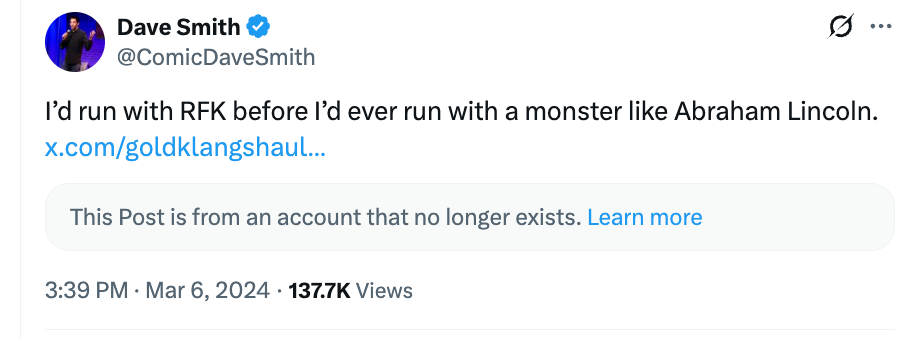
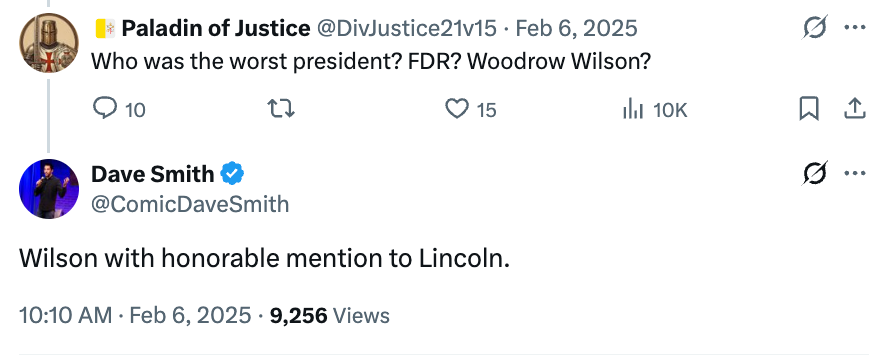
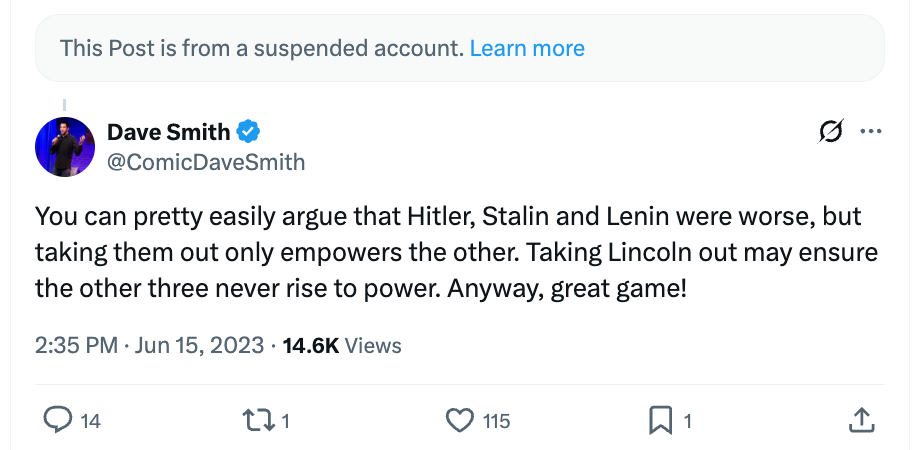
You may also find it interesting that he cites the Union Army as an argument against the existence of anti-Black racism, given his longstanding belief that Abraham Lincoln was a monster and tyrant who shredded the Constitution by conscripting an army to fight the Confederacy. As he said in 2023:
The South was certainly clinging to slavery and probably would not have given it up if it wasn't for the war. But at the same time they did have a constitutional right to secede and there was really no justification to attack the South for the crime of seceding from the Union. And the North also had slavery at the time, mind you. Lincoln conscripted an army to fight against the south, kind of enslaved all of those people.
In reality only about 2% of the Union’s 2.2 million soldiers were draftees, but that’s sort of the point here—Smith is much less concerned with facts than he is with defending the honor of white people against the dreadful lie of what he calls “racialism.” A great and funny guy.
Thanks as always for reading and don’t forget to check out the Humorism Evening Podcast.