More Cynical Bullshit from Dave Chappelle
On the Riyadh Comedy Festival: "Where is this clean money you're talking about?"
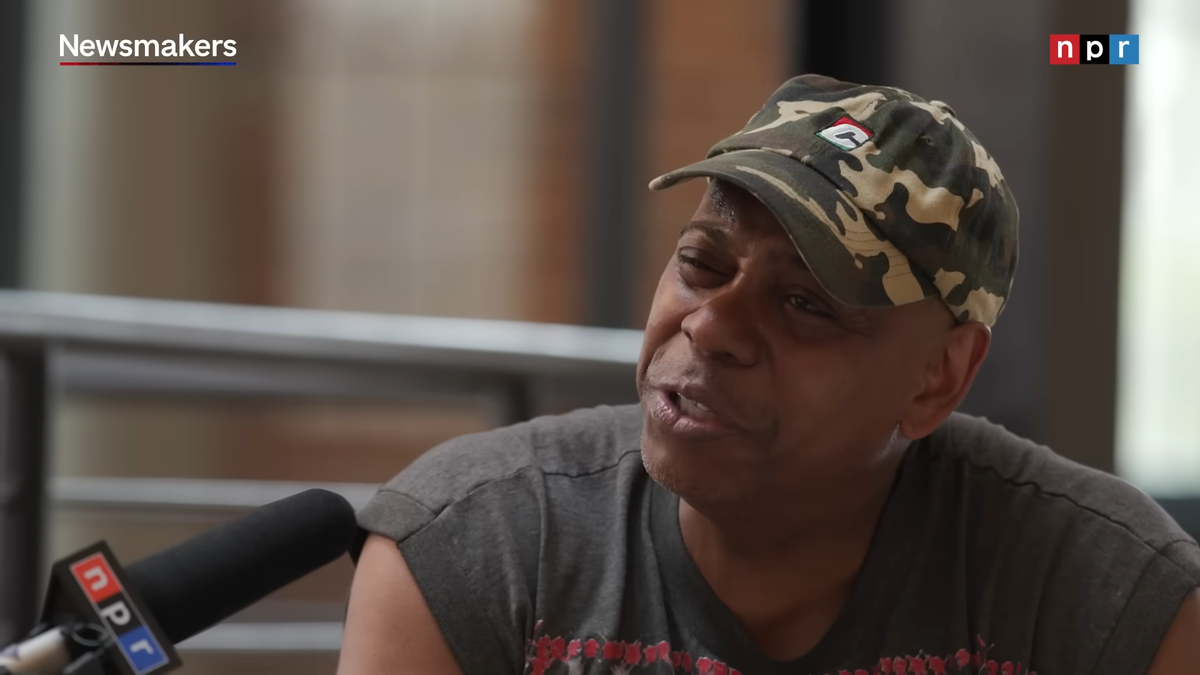
NPR just released a wide-ranging new interview with Dave Chappelle in which he defends his decision to perform at the Riyadh Comedy Festival, complains that Republicans “weaponized” transphobia, and says he’s sick of talking about his anti-trans jokes, which he believes people only ever complained about in the first place because the media misrepresented him. Here are some highlights, or maybe rather lowlights:
On the Riyadh Comedy Festival
Here’s where Chappelle says his presence at the Riyadh Comedy Festival legitimized it:
Chappelle: But I got all that flack for doing that festival in Saudi Arabia. But in Saudi, I don't think that festival would've been legitimate if I wasn't there.
NPR: Say more about that. Say more about that.
Chappelle: I'm not the biggest comedian, but my voice is sought after. In Saudi Arabia, for the last 20 years, they've been doing—really maybe 15 years—they've been trying to do comedy shows in Saudi Arabia. Underground shows. The jokes were like contraband. These shows would happen in people's homes. They would happen in embassies. Comedians like Maz Jobrani and guys like this, They've been going over there for years and doing these shows.
NPR: But privately. Privately?
Chappelle: Quietly. Yeah, close to being private. I don't know what their laws are.
NPR: But for the elites, basically. People who—
Chappelle: Not for necessarily the elites. But yeah, for people who could have a house like that. I don't know what those shows were like because I didn't do those shows. The first time I can remember doing a big show in the Middle East, my opening act was a guy named Mo Amer, who's Palestinian-American from Houston, but originally from Kuwait, but he's Palestinian. And Mo was probably on that circuit doing the secret shows in Saudi. And man, the thing that was remarkable was the crowd reaction. Right before I went onstage—this is actually funny. Right before I went on stage, they gave me a list of all the things I wasn't supposed to address. It was like right before I went onstage. So I took the list on stage and that was the show. I just did the list. "Don't talk about the royal families." "That's y'all," and I just made fun of them. Man, they were screaming, screaming.
Then after the show, I'm backstage at a meet-and-greet. And there was all these young comedians from all over the Middle East. They were looking at me like I wouldn't even know that they'd know who I am. They couldn't believe I was there. They kept saying, "You just say that? You just say that stuff?" Yeah. I mean, yeah, it's not a big deal in my mind. But I never forgot that.
And that was in Dubai. Man, in Riyadh, that crowd watching that comedy, the first time the government let them even see something like this, it was like a baby tasting sugar. If I had choked a tiger out, they couldn't have been more impressed. They were screaming.
NPR: You think you're creating space for them—that it wouldn't exist?
Chappelle: At the very least, and this is not nothing, that must have felt incredibly cathartic if you can't say everything you want to say, but you see somebody model that behavior. Oh man, you're gonna want it. So if you think of all the violence and all the things we export to the Middle East, I think our culture is the best export we got. I didn't feel wrong being up there.
Some useful context for Chappelle’s defense of his cathartic Riyadh set can be found in his latest Netflix special, in which he describes the actual jokes he told at the festival:
Chappelle: These motherfuckers act like because I did a comedy festival in Saudi Arabia, I somehow betrayed my principles… They said, “Well, Saudi Arabia killed a journalist.” And rest in peace, Jamal Khashoggi. I’m sorry that he got murdered in such a heinous fashion. But—and no “buts,” like, you know, period. And also—I mean, look, bro, Israel’s killed 240 journalists in the last three months. So, I didn’t know y’all was still counting.
These n—-as clowned me because I was on stage in Saudi Arabia. I didn’t tell them to put this in the paper. I just said it on stage. I said, “It’s easier to talk in Saudi Arabia for me than it is in America.” And n—-as felt some kind of way. Oh, I stand ten toes on that. Don’t forget what I just went through. Two years ago, I almost got canceled right here in the United States for transgender jokes. But I gotta tell you something. Transgender jokes went over very well in Saudi Arabia. Them n—-as couldn’t get enough of that shit. I was in the pocket, n—-as. I was like, “Where have you been?”
NPR asks Chappelle how he justified performing in Riyadh in light of the Khashoggi murder. His response? That in the past he turned the Saudis down because of it, but now that everyone else is working with them, it’s racist to expect him not to:
NPR: US intelligence did make it clear that they believe that the Saudis killed Jamal Khashoggi at the embassy in Turkey. And you knew that when you went, right?
Chappelle: Oh, absolutely.
NPR: You had no qualms?
Chappelle: I won't say that. They asked me to go years before that and I said no for that very reason. Since that time, the United States government does business with the Saudis. Netflix does business with Saudis. Everyone—Saudis financed tons of movies, all these things. I know. I see them financing boxing matches and all these things. And none of these things were an issue until I went there. And why is that? As soon as a Black man can make money off the plantation, they're trying to tell you that the money is dirty. Well, okay. I'll go home and spend the money with actual slave owners on it. Where is this clean money you're talking about?
NPR: But you said you hesitated for years to go, the years you didn't go. So what made the difference for you?
Chappelle: Time. Time and circumstance. Time and the wheels of commerce kept turning. If you want to be that pure about money, then stop driving your car, stop eating, don't use your cell phone. Everything is tethered to something that's just terrible. And I can make a million excuses or reasons to deprive that crowd of that show. But man, when I was standing in front of them, I feel like I did the right thing. Our governments are gonna ruin everything for us. We'll never get to know each other if we just do everything that they want to do or function on the terms that they want us to function. And we don't even really know what's going on. Not for sure.
NPR: Well, artists have always made these decisions. I mean, there were these decisions in South Africa under apartheid. There were decisions about whether artists should go there or not go. And then the question is, are you validating the system or are you resisting it with your presence?
Chappelle: I mean, look. In the middle of apartheid, if I went and played Sun City, I'd say I'm a bad person, but if I went and played Soweto, why would I not do that?
Some more context: Sun City is the resort where various artists performed in defiance of the UN cultural boycott on South Africa in the 1980s; Soweto became a locus of the anti-apartheid movement after student uprisings in the 1970s.
The Riyadh Comedy Festival, meanwhile, was held in Riyadh’s Boulevard City, an entertainment zone run by the kingdom’s General Entertainment Authority, whose president, Turki Al-Sheikh, is accused of imprisoning people who criticize him on Twitter.
Here is Chappelle posing for a picture with Al-Sheikh.
And here’s the part of the NPR interview where Chappelle likens his performance in Riyadh to performing for a city’s Black community after a police shooting:
Chappelle: Okay, I'll give you another example. It's not a good example. I'm doing a show, there's a police officer killed a Black person and the Black community asked me to cancel the show. "We don't want artists to come. We want a boycott." Well—
NPR: Was that in Ohio? Was that in Cincinnati?
Chappelle: Yeah, it was exactly where it was. Yeah. And I respect their wishes. Or we could have gotten together and talked about it. I do that often. When Minneapolis was going through it—I was in Paris when they killed Alex Pretti. And man, I booked the show in Minneapolis right after they killed that guy. "Man, they're gonna need talk about this." And that was nerve-wracking. Another situation—Tops Market in Buffalo.
NPR: Man killed 10 black people.
Chappelle: Ten black people unprovoked in the grocery store. That happened right after I got tackled in LA at the Hollywood Bowl. But man, I went to Buffalo. It's not that I think that jokes help, but you can console certain communities with your presence or just acknowledging that you see them and that you hurt with them.
NPR: You feel like you're lancing the boil in a way for people or just what? Giving them a place to feel their feelings, or?
Chappelle: Okay, well, one, it's mutual. The Tops Market thing would be so upsetting that I want to be there. I have a friend from Buffalo, that's their local grocery store. His mother shops there. Thank God she was all right, but it hits close to home.
The implication here is that his set at the Riyadh Comedy Festival, where he joked about trans people and said he had more freedom of speech in Saudi Arabia than in America, was somehow consoling to the audiences in Riyadh. Pretty gross stuff, right? Well, that’s just the half of it.
On Republicans Weaponizing His Anti-Trans Jokes
Elsewhere in the interview, Chappelle whines about the GOP taking his anti-trans jokes the wrong way:
Chappelle: I did resent that the Republican Party ran on transgender jokes. You know, I felt like they were doing a weaponized version of what I was doing. That’s not what I was doing. I’ll give you an example, before I learned the phrase, ‘I respectfully decline,’ I was on Capitol Hill, and everybody ran up to take pictures with me from every congressional office. And I just take pictures with whoever asked. I didn’t ask how they vote or what their voting record is. At first, it was CBC people. Then here comes Lauren Boebert and she said, ‘Can I get a picture?’ And I had already taken 40 pictures. I didn’t want to say no in front of everybody, but I didn’t know the phrase ‘I respectfully decline.’ So I just took the picture. And then she posted the picture before I could even get from there to the show and says something to the effect of, ‘Just two people that know that it’s just two genders.’ Just instantly, like, weaponized or politicized. So I got to the arena, and I lit her ass up for doing that. And she should never do that to a person like me.
The notion that Chappelle’s jokes were not already weaponized before the GOP came along is difficult to reconcile with his jokes themselves, for instance this one in 2021’s The Closer:
Chappelle: Listen to everything I’ve ever said about that community. I’ll go through ’em. I said, “How much do I have to participate in your self image?” I said, “You shouldn’t discuss this in front of Black people.” I said, “I know n—as in Brooklyn that wear high heels just to feel safe.” I asked you “Why is it easier for Bruce Jenner to change his gender than it is for Cassius Clay to change his name?”
If you listen to what I’m saying, I’m not even talking about them, I’m talking about us and “they don’t listen.” It’s very annoying. And they have canceled people, more powerful than me. They canceled J.K. Rowling, my God. J.K. Rowling wrote all the Harry Potter books by herself. She sold so many books, the Bible worries about her.
And they canceled it because, she said in an interview and this is not exactly what she said, but effectually she said that gender was a fact. And then the trans community got mad as shit, they started calling her a TERF. I didn’t even know, what the fuck that was. But I know that trans people make up words to win arguments. So I looked it up. TERF is an acronym. It stands for Trans-exclusionary radical feminist. This is a real thing, this is a group of women that hate transgender. They don’t hate transgender women but they look at trans women the way we Blacks might look at Black face. It offends them like, “Oh, this bitch is doing an impression of me.” Now I shouldn’t speak on this because I’m not a woman, nor am I a trans. But as we’ve established… I am a feminist. That’s right.
I’m team TERF. I agree. I agree, man. Gender is a fact. You have to look at it from a woman’s perspective. Look at it like this, Caitlyn Jenner whom I have met, wonderful person. Caitlyn Jenner… was voted, woman of the year. Her first year as a woman. Ain’t that something? Beat every bitch in Detroit. She’s better than all of you. Never even had a period, ain’t that something? I’d be mad as shit if I was a woman. I’d be mad if I was me. If I was in the BET awards, sitting there and they’re like “And the winner for n—-r of the year… Eminem.” My man. Gender is a fact, this is a fact. Every human being in this room, every human being on Earth had to pass through the legs of a woman to be on Earth. That is a fact. Now… I am not saying that to say, that trans women aren’t women. I’m just sayin, that those pussies that they got… You know what I mean?
I’m not saying it is not pussy, but that’s like Beyond Pussy or Impossible Pussy. You know what I mean? It tastes like pussy but that’s not quite what it is, is it? It’s not blood, that is beet juice.
Now, here’s what happens when NPR asks Chappelle to reconcile his anti-trans jokes with his vision of comedy as a means of bringing people closer after a tragedy:
NPR: But what about people who feel you’re punching down? Like you’re not—you are not a trans person. And there are people who feel like, it’s different when you are part of the group that has been attacked, hurt, demeaned, et cetera, and then if you are outside that group and you’re having commentary about it, it causes feelings. And what do you say to people who feel that in some occasions, you’re punching down?
Chappelle: Well, okay. This is a conversation that—that, you know—
NPR: You’re bored by, sick of.
Chappelle: Yeah. Well, not sick of it, I don’t want to be dismissive to that sentiment. But I don’t know. That’s a tough one because so much of that to me was a media phenomenon. What was happening in actual life versus how the media was reporting on my show. And I feel like the way they reported on that show was rage-baiting to some degree. And there’s so many different branches to talk about it. But I would say that not everything is for everybody. I don’t tell country artists what to sing about if I’m not gonna go see a country show. You k now. If they bought tickets, ever, maybe, I’d listen, I don’t know, they’re just never there. I don’t even know who’s telling them to say thee things. Who—
NPR: Do you feel like your jokes are misrepresented?
Chappelle: I do.
NPR: You feel like they’re misrepresented for a purpose, which is to—
Chappelle: They almost reported on it as if I was doing something other than a comedy show. You know. I could go on and on about this.
NPR: Interesting. So in a way, you’re saying, “I’m a comedian, everybody knows that I’m a comedian, so if you don’t like my humor, don’t buy a ticket.”
Chappelle: Reading a joke is a lot different than sitting in a room and hearing it. And part of the sitting in the room part, part of the reason comedy works is because everyone that bought a ticket, clearly they want it to work. They want to have a good time, they want to have fun. But if you’re a person that is very angry or passionate about something and you’re afraid that you’re gonna be misrepresented or misconstrued, and you feel like you have to police comedy to get your point across, you should assess your point.
For any of this to make sense, one would have to believe that Dave Chappelle does not know his comedy specials are available on the global streaming platform he releases them on, for the express purpose of making them available to people who cannot attend his live shows. And for any of his complaints about the GOP weaponizing his jokes to make sense, one would have to believe he sees comedy as a means of telling brave, important truths about the world that simply don’t matter enough for people to internalize or act on them.
One would have to believe, in other words, that Chappelle is some sort of huge idiot moron—or maybe just that he’s just too cynical to tell right from wrong anymore.