Jessy Morner-Ritt on "Female Documentarian," the Pandemic, and Keeping the Audience Safe
"I want to create a show that's provoking and boundary-pushing while treating other people well."
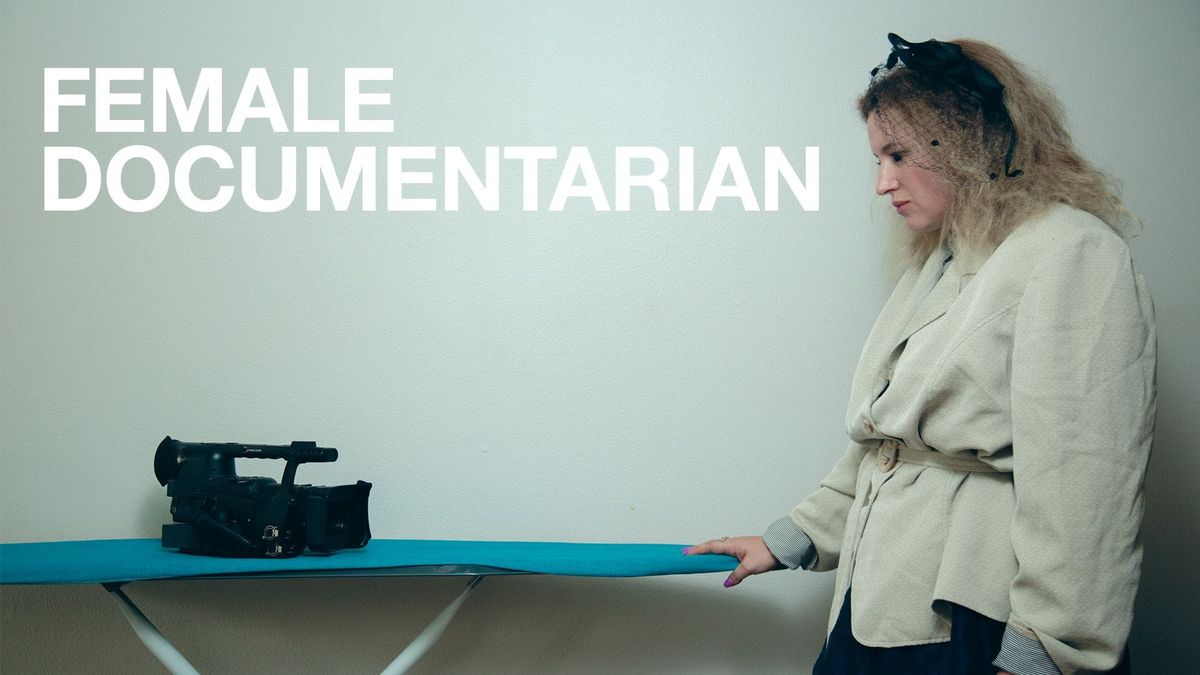
Today I’d like to share a conversation with Jessy Morner-Ritt, an LA-based comedian and a friend of mine. She spoke with me from Montreal, where she was attending the Fantasia International Film Festival premieres of Sour Minnows (dir. Harrison Atkins) and Bagworm (dir. Oliver Bernsen); she has roles in both. Tonight, at the Brooklyn indie space Life World, she’s performing her live show Female Documentarian, in which she makes a documentary about an audience member in real time—if you’re in the city, you can get tickets here. Below we discuss what exactly the show is, how it was shaped in part by the traumas of the pandemic, and how she protects the people she turns into her subjects.
Tell me about Female Documentarian.
Female Doc is a show that grew out of a friend asking me two years ago to host her night of short films. It was in this really massive room, without a very formalized stage but obviously a really nice projector. So I did a bit where, essentially— and this was two years ago, so that's important to note—I had AI write up a script of what it would be like to go to a screening downtown. Then I live-directed it, and I used my iPhone to film the audience members doing the script. I was interjecting a lot and putting myself on camera as the quote-unquote director.
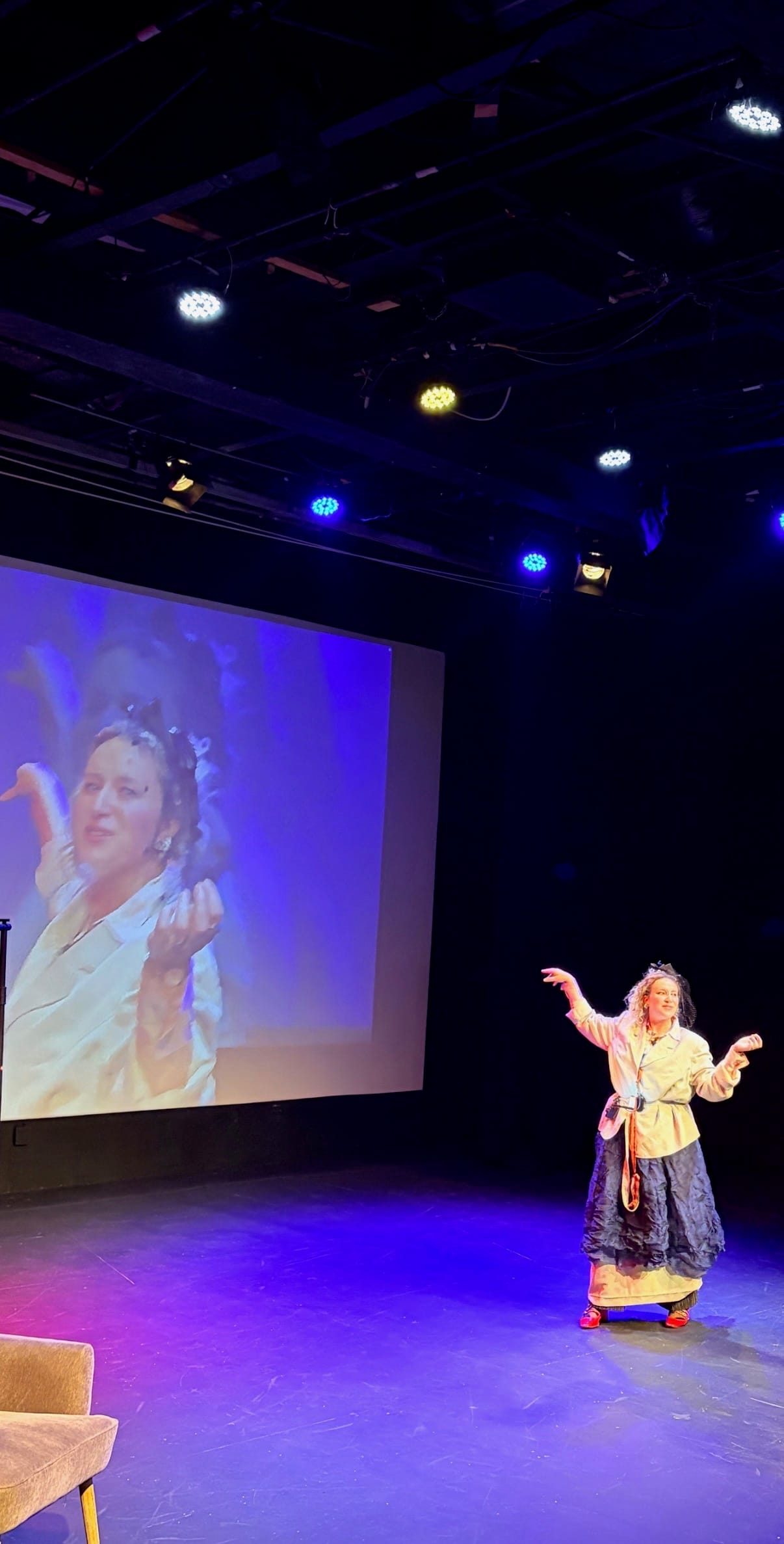
I just kept playing with that format until we reached the current iteration of Female Doc, which is a live show that takes place primarily at Eastwood Performing Arts Center in LA. It has a massive screen, it's so beautiful, and there's a stage area right in front of the screen. We have a camera hooked up that's recording in live time, and I find someone in the audience who I don't know to try and make a documentary about. Once we've gathered footage, that footage is being live-edited by my friend Noah Kentis, who's just an unbelievable filmmaker and editor and actor in LA. So he's up in the tech booth live editing the footage we're getting. Then, ideally, after we've gotten enough information about this person, we pass over all the footage and end the gathering portion. I tell people that after they see the finished documentary, they won't have any questions, because my work answers all the questions for them.
And so then we have the Q&A moderated by David Brown. David has been watching the show and the way I've been interacting with people as this female documentarian character, and he's been keeping track of my failings and occasional cruelty. He and I usually have a moderated discussion about that, and we take audience questions. Then we screen the documentary Noah has edited with the footage we got there that night.
It sounds like one of those perfect shows that can only happen live and nowhere else. How do you even workshop something like that?
That feeling of “it can only happen here” is something I really missed about live shows. I just think there's something about all of you being in the room, that feeling where it's hard to describe what happened, where things can go off the wall. I still really want that as part of the experience when someone sees a show. In terms of workshopping it, I did it for a while as a smaller bit on other shows, but really I can only workshop it with the audience. Right now, pretty much every show, we have insane tech failures, because I'm essentially a Luddite and this is the most tech intensive show ever. So we always have tech mistakes. We're always changing up certain things about the format, and it does kind of feel like it will always be a work-in-progress. We're confronted with something new every single show.
Tell me about a time it's gone off the rails.
What's kind of interesting to me is that a lot of guys who come to the show think we're doing a Tim Heidecker bit. What's that show called?
On Cinema at the Cinema.
On Cinema at the Cinema, where the tech is failing and we're playing with that. But basically our live stream gets interrupted constantly. Sometimes images freeze on the screen. Sometimes the projection goes out completely. There's often a lag between what I'm saying or doing and what's being projected. At the first show we did at Eastwood, I was also working with one of my new producers, Madeline Zimmer, who is so funny and is always taking deep breaths before the show to calm herself, so loudly that we can hear her from the tech booth. We're always like, “Enough with the breathing.” But at one of the shows, we kept getting interruptions and she kept having to go up and down the stairs, and she fell down the stairs twice in one show. Everyone thought that was scripted. And I was like, I don't think Madeline wants to be falling as many times in front of these people as she is.
It sounds like the kind of show that needs a big tech budget and a lot of people coming and paying a lot of money for tickets. I’m gonna shift gears a bit now. What's good in LA lately? Tell me about LA, LA comedy.
In terms of LA stuff I'm liking, I have to live up to the expectations of LA culture here and say my acting class, the Community, capital C, that has grown out of Al Warren's SHAPE Actor's Workshop. It's really evolved, and there are all these indie filmmakers making stuff. Because because no one has any money to do anything, things have leaned toward that loosely scripted but highly stylized world, with really genuine acting behind it, and I'm just really liking it.
I know you primarily as a comedian and a writer and a filmmaker—well, that's three things, so I guess it's not really primarily at all—but anyway, my question is when you got into acting-acting.
Probably two years ago, around when I started doing Female Doc more consistently. A friend of mine was helping Al with the class and said he thought it was something I'd be into. I did not expect to be someone who loves acting. I'd never taken acting classes before, and now I'm like, "I love acting class." And they're every week, for hours.
You moved to LA during the pandemic, right?
Yeah.
What was the pandemic like for you? I ask people this because to me it was a big pivotal time, but I find no one really likes to talk about it anymore. And I’m curious how it affected the way people make art and exist generally.
Why do you think no one likes to talk about it anymore?
I'm not sure. In grad school I would bring in poems about Covid and my professor would say, "Yeah, we all went through Covid, we're all sick of Covid." And I'm like, "I'm not really. I want to talk about it." I think it was a period of great change, but maybe because it was a period when things could have gone one way, a good way, and instead they went the other way, the bad way, it's particularly difficult to think about.
I definitely feel like Covid for me was kind of huge. The civilized life, the way we operate society, is an illusion, and that illusion became shattered. For me it very quickly trickled down into my family life. My family life kind of broke open. A lot of things I thought were true were not. Things became very blurry between what is real and what I thought was real, and the narrative of my family life and the relationship I had with my family was no longer true. I'd been living on the East Coast for so long before Covid, and my family is from LA, so my experience of my family came out of what I was telling myself about them and us. With everything breaking down, from what I've heard, a lot of people had very similar experiences, where people couldn't really hide from immediate truths. People got divorced, some people got together. But most people had these real cracks in the systems, not just the systems around them, but in their day-to-day stuff.
When people ask me if I'm really angry, I'm like, “Yes, about a lot of things.”
All of the sudden the only way we could talk with people was with these very performative versions of ourselves, on the internet or through text messages or FaceTimes. That's a little bit of where my obsession, where Female Doc actually started for me—the screens are such a big part of it. We're so used to seeing ourselves through screens or on screens and far away from each other, and Female Doc is this place where it's right there, all these images of yourselves. Do you recognize yourself up there? Is it natural? You do see people's faces kind of slip, or there's something real. Covid made me feel really far away from what is true. I felt like everyone was a double of themselves, and I was too. So in an effort to get back to substantial conversations, to break through the illusion, you have to find a different, almost completely counter idea to getting back in, which for me was Female Doc. Or is Female Doc.
I’m pleased the question ended up looping things back to the show. I spent a lot of grad school thinking about why I like the art that I like, and what it is I want out of an experience of art. Where I arrived a lot of the time is that I want an experience of someone's mind as it actually is, the real shape of their mind, which often is kind of deranged and difficult to move through. It sounds like something you're trying to get at too—the real mind, the real person.
I read Umberto Eco's essays, Travels in Hyperreality. He talks about this thing where the American imagination demands the real thing all the time, but it's a lowercase-R “real.” To get at it, we're always making up all these fake narratives. Therapy can be helpful for that in a damaging way. That desire for the real is us freaking out about a vacuum of memories, which is basically what I was doing all of Covid, trying to figure out where my memories were and what they meant to me. On the other hand, the fake being that we all create is the offspring of us being unhappy and not connected in our present moment, because we don't know how to talk in it, because we just want to be these perfected double versions of ourselves.
With Female Doc, a lot of people ask about the tech problems. I usually have a meltdown with the tech stuff at some point in the show, and they ask if that's real. Is my anger real, or for show? And I'm like, “No, I'm an angry, volatile person with nowhere to put it.” That's sometimes fake in the moment, but it's also me having created this space where anything goes. So I'm saying inappropriate things or behaving inappropriately. I'm throwing things at a wall that maybe I don't stand by on further reflection. That's also why I love David being part of the show, because he's so smart and funny.
I hate when people pull audience volunteers and the volunteer feels like it's now their duty to make it a good show. It's my job. It's my show.
A lot of people compare the show to Nathan Fielder, which I do take as a compliment. But I want to create a show that's provoking and boundary-pushing while treating other people well. I think that is possible. The way we've come up with it, the infrastructure with the people I work with on the show, is that I basically have permission to say whatever, act poorly, freak out, but they all have full control in the show and are encouraged to step in if something is really going off the rails. One time we did have a 15-year-old in the audience without any parents, and she was amazing. I really wanted to make the doc about her. My producer and director, Mel Barnes, was like, "You can't use the child." And I was like, "Okay, totally, yeah." But I really wanted to use the kid. You set things up in place so that I can freak out and act poorly and we still take care of people. I go back and forth on this, but maybe that is the path of how I'm trying to access a kind of presentness, and it's both real and fake. So when people ask me if I'm really angry, I'm like, “Yes, about a lot of things.” The tech specifically, not always. I really wish it would work.
That's really interesting. You're creating a space for spontaneous human things to happen, but it still needs that infrastructure there to be done safely. A lot of comedians' version of giving themselves the space to say anything and go crazy is… saying slurs… but you're actually trying to get at something deeper about the self.
The things that come from spontaneity, in order for them to be even remotely good and productive, I just don't think conversations can happen in any environment where someone really feels bad. I try to make it a demonstrative thing where I can take the heat. No one should ever feel like they're messing up when they're the subject. I hate when people pull audience volunteers and the volunteer feels like it's now their duty to make it a good show. It's my job. It's my show. I don't think it's fun or good, or that anything interesting can happen, if someone doesn't feel cared for in some way, whether that's from me or the producers or the audience or whoever. I can't have something where people walk away feeling bad for that person, because then we're just having a conversation about that person instead of the dialogue about the things I want to be talking about. So we need that infrastructure to take care of them.
Could you say a little more about what, practically speaking, making them safe looks like?
We basically have Mel, who I made the show with, essentially. She's been with it the entire time. Then we have Madeline, who is the main producer, and she's just so brilliant, watching the show. We've assigned everyone in the show a role. Madeline and Mel are the "good guys," who watch while everything is happening to make sure that the person on stage seems as if they're good and comfortable.
I also think that for the first five minutes of the show, I mean, I'm out there the whole time, but I'm greeting people a little bit as they come in. I have largely made this show picking men, because I think guys are a little bit easier to bully socially. I think they can withstand the heat, or maybe they deserve it a little bit. That said, I have a wireless mic that turns on and off. And I will never bring someone up on stage who is like, "I don't want to go. I really, really don't want to go." I'm doing a vetting process, which I've been working on these past two years, in order to even pick my initial subject. I do turn my mic on and off to check in with the subject while we're making the doc. Sometimes I'll talk to them behind the curtain or something, just to check that they really are okay.
Female Doc is this place where it's right there, all these images of yourselves. Do you recognize yourself up there? Is it natural?
We have meetings after every show and share any feedback we got from people, good or bad. Obviously, I feel like I don't have as much access to the negative feedback, because sometimes it still can be a little bit of a vacuum. But one of my really close friends said she felt uncomfortable when this woman went up on stage and I was doing an elaborate visual gag with her. So I brought that to the group, and we said it's a case-by-case basis. After every show we do regroup and try to share feedback and talk about ways Mel and Madeline can interject from the tech booth if they feel that something is uncomfortable or someone is feeling uncomfortable. I don't know if that fully answers the question of legitimate infrastructure. It's kind of meetings and dialogue, and trying to be really open. I tell everyone that if they have friends who come to the show and those friends have legitimate negative things to say, I really, really want to hear it.
It's a lot more conscientious than I think most comedians are about their work. Let me just ask you this, because you were talking about the Umberto Eco essays. Is there anything else you've read or are reading that affects the way you think about your work?
With Female Doc, for every different one, we try to have a couple of different topics that we as a group are interested in, or things I've been reading about. So Female Doc is kind of a living reflection of the culture all of us are ingesting all the time. I was really influenced by Travels in Hyperreality. I really liked Naomi Klein's Doppelganger, the doubling and everything, that was very influential to me. I'm reading The Varieties of Religious Experience by William James, his collection of essays on human nature and religious theology, and I find that really helpful when doing something like this. I just read Granta's issue on therapy and its different forms. I did read Camille Paglia's Sexual Personae, her early work, because I wanted to know what all the 21-year-old girls were freaking out about, but I wouldn't say that's relevant to the show. Hegel, Freud, William James—the boys.
The boys do fine work.
I like the boys.
Check out Female Documentarian at Life World tonight.