About that Shane Gillis Monologue
He's a comedian who pushes boundaries.
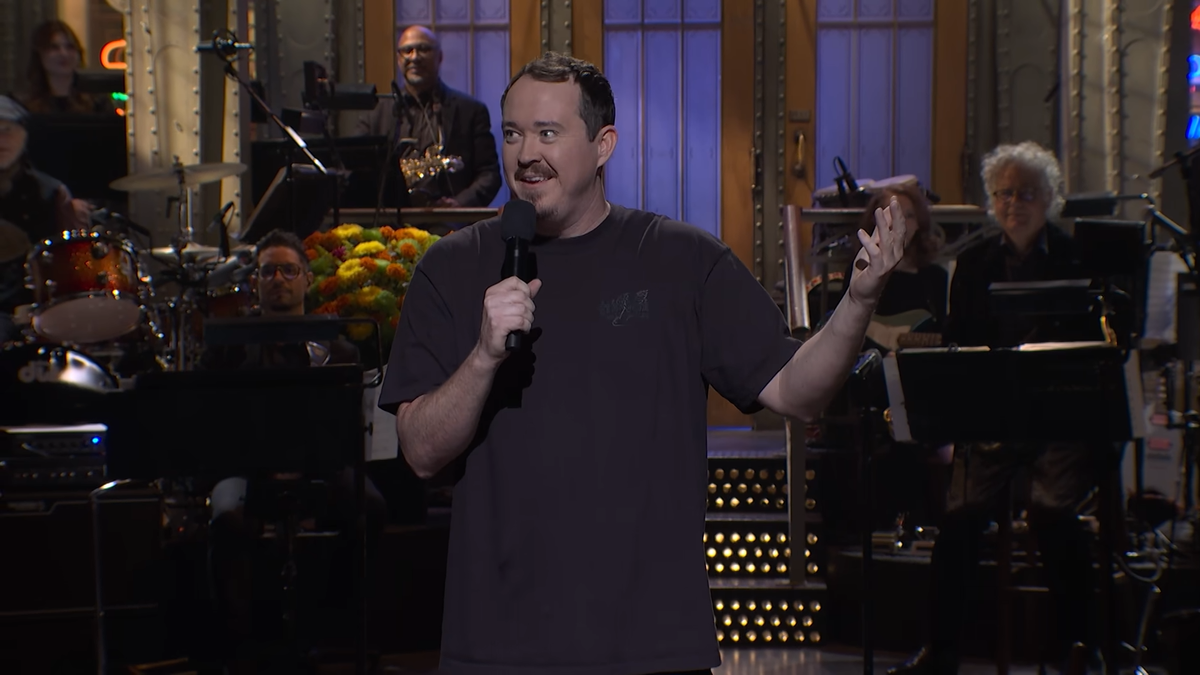
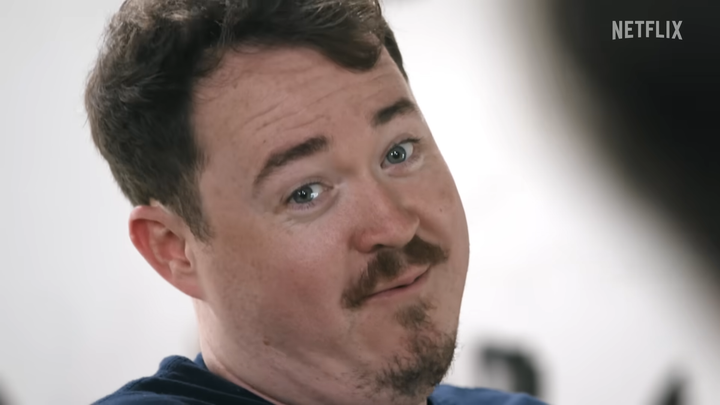
In his Saturday Night Live monologue this weekend, Shane Gillis said women at the gym dress like whores. This may be the first time he has expressed such bald hatred of women on live TV, but it is not the first time he has expressed bald hatred of women. For at least four years, he has been a friend and collaborator of Louis CK, who has abused women. For at least three years he has been a friend and collaborator of Dave Chappelle, who spent multiple Netflix specials demonizing women. For at least 10 years he has been an admirer of Donald Trump, who demonizes and abuses women. In June, at Netflix’s Roast of Kevin Hart, he called Lizzo “a fat fucking bitch,” and said of Teyana Taylor: “Thank god she’s good-looking, because boy is that bitch not funny at all.” In a 2023 episode of the podcast Guys We Fucked, asked if he considered joining the 2017 Women’s March, he said: “Fucking not even once. I was mad, I was mad about it. It’s lame, dude.”
*
Gillis’s hatred plays to his own considerable audience, but not to an audience that cares about its social backdrop—in this case, the Cornell rape scandal, which elevated the problem of sexual violence back into the national spotlight. Comedians like Gillis openly resented the conversations around sexual violence in the 2010s, and they viewed Trump’s victories as their own victories over those meddling feminists. Perhaps they did not consider that a problem left unsolved would inevitably boil over again, forcing them to defend their bigotries against an audience that doesn’t share them.
*
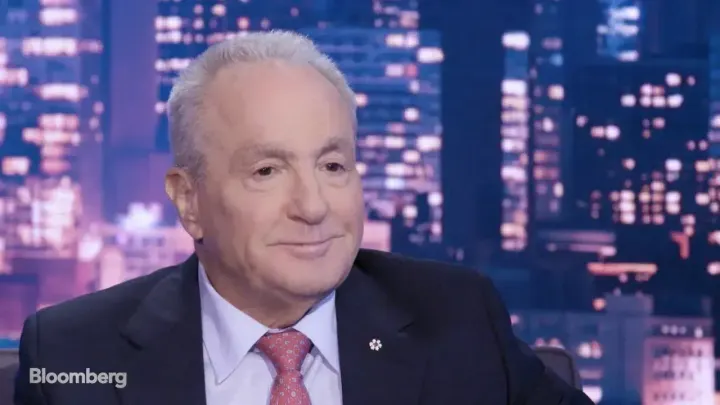
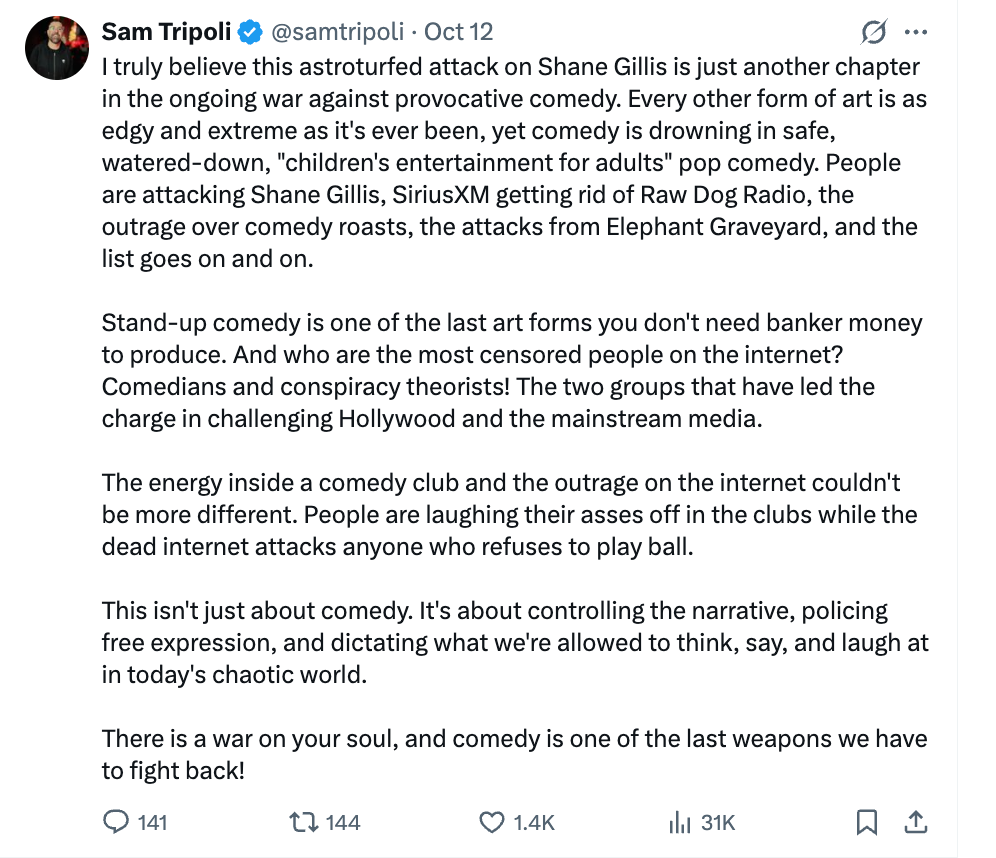
Lorne Michaels has often stated his belief that SNL’s audience is the ultimate arbiter of what’s funny. As his stubborn support of Gillis shows, he does not extend this philosophy beyond SNL’s studio audience, the one primed to laugh at everything it does. His attitude mirrors the belief common among standup comedians—and articulated here by the conspiracist comic Sam Tripoli—that the comedy club audience is the only one whose opinion matters, not the audience who consumes jokes on the internet and on TV. One problem with this logic is that jokes tend to be about other people, including people outside a comic’s audience. Another is that every comedian wants an audience beyond the walls of the comedy club, which means they cannot dismiss the broader public so easily. The broader public is often much more discerning than any one comic’s audience, which may be why they’re not in it.
*
Comedians like Gillis often defend their bigoted material on the grounds that they’re being ironic. Implicit in this defense is that their material adopts a point of view they don’t share. If they want anyone to believe this, they should stop podcasting.
*
Comedians like Gillis also defend their bigoted material on the grounds that they are pushing boundaries. Oddly, they only seem to push boundaries that society doesn’t actually enforce. They target minorities in a country actively persecuting minorities; they target women in a world that subjects women to sexual violence and punishes them for speaking about it. One of comedy’s oldest traditions is taking part in that punishment.
Me: Shane Gillis's comedy is harmful and not funny
— joanna schroeder (@iproposethis) October 12, 2026
Them: It's not for you
Me: Yes, but it's about me
Being the target of harmful jokes makes it for you AND about you. I'm a woman and I have a daughter. Shane Gillis being offensive toward women is very much my business.
*
You can usually tell from a comedian’s material whom they envision as their target audience, the people they relate to most. When Louis CK said in a 2020 set, “Wouldn’t it be amazing if your mom was, like, ‘I was with a Black guy once, it was hot’?” he was evidently not speaking to Black people. When Shane Gillis complains that women dress like whores, he is evidently not speaking to women. Jokes like these give us a glimpse of how the comedian views their own identity—whether they see themselves chiefly as a white person, for instance, or a man, or a straight man. This is not problematic in and of itself. The question for those of us in the audience is whether their material reinforces their positionality, or whether it complicates and even resists it. Do they revel in their status? Do they invite you to laugh at people with less? Do they assume you’re like them, which means you agree with them, which means you share their premises? This is important: a punchline reveals what a comedian believes, but a premise reveals what they think you believe.
*
You might apply this same analysis to SNL, which purports to offer something for everyone and yet consistently regresses to juvenile schoolboy comedy, produced by a cast and creative team that recreate all the old hierarchies. When Lorne Michaels complained that NBC made him fire Shane Gillis because “200 Asian companies were going to boycott the show,” he implicitly dismissed the possibility that those 200 companies might have a point. Their opinion didn’t matter; they were a nuisance. SNL is for people who don’t care about anti-Asian racism. Who might those people be?
*
Many have asked why SNL would bring back Shane Gillis three times after firing him, and twice after he bombed in his first hosting gig. The answer is that Lorne Michaels likes him. He thinks Gillis is “the real thing.” He regrets firing him. He thinks cancel culture was tantamount to the Reign of Terror, which killed tens of thousands of people. This is a man who told his writers to go easy on Donald Trump and who has long surrounded himself with young blonde assistants, one of whom he married. In the oral history Live from New York, when Janeane Garofalo unpacks the toxic conditions that led to her leaving the show, she describes her season as “the year of fag-bashing and using the words ‘bitch’ and ‘whore’ in a sketch.” In response, Lorne Michaels said: “Some people, their whole lives, are just injustice collectors. They’re going to find new injustices every day. That’s what they do, and that’s what they are.”
*
Four years ago I observed that after The Daily Beast published a damning interview with Jane Doe, the plaintiff in Jane Doe v. Horatio Sanz, SNL promptly drowned out the story by announcing its upcoming hosts and musical guests. Last night, after celebrities like Dan Levy and Ego Nwodim made headlines criticizing Gillis, Puck revealed that SNL has tapped the content creator Druski to host an upcoming show. I have no doubt SNL will weather this scandal—its audience has a high tolerance for controversy, and the commentariat never seems to consider that any particular incident might betray a deeper rot. The thing to watch is Gillis’s standing among his more liberal peers, who have long managed to convince themselves that his history of bigotry is all just a big misunderstanding. This monologue is much harder to dismiss as a comedic misfire: he tosses off the “whores” remark so casually as to leave no doubt it’s how he really thinks. Then again, I suppose his friends wouldn’t have become comedians if they couldn't stomach a little misogyny.
Further reading:
MS Now: Shane Gillis’ SNL monologue was misogynistic — and painfully unfunny
Slate: Shane Gillis’ SNL Joke About Women Wasn’t Just Offensive
Marie Claire: Shane Gillis’ Gym Short Monologue On ‘SNL’ Isn’t Just Humourless, It’s Harmful
The Daily Beast: MAGA-Friendly ‘SNL’ Host Walks Off Show Early in Unaired Footage
Press Play with Madeleine Brand: I went on KCRW this afternoon to discuss this story. The episode hasn’t posted yet, but you should be able to find it here when it does.